
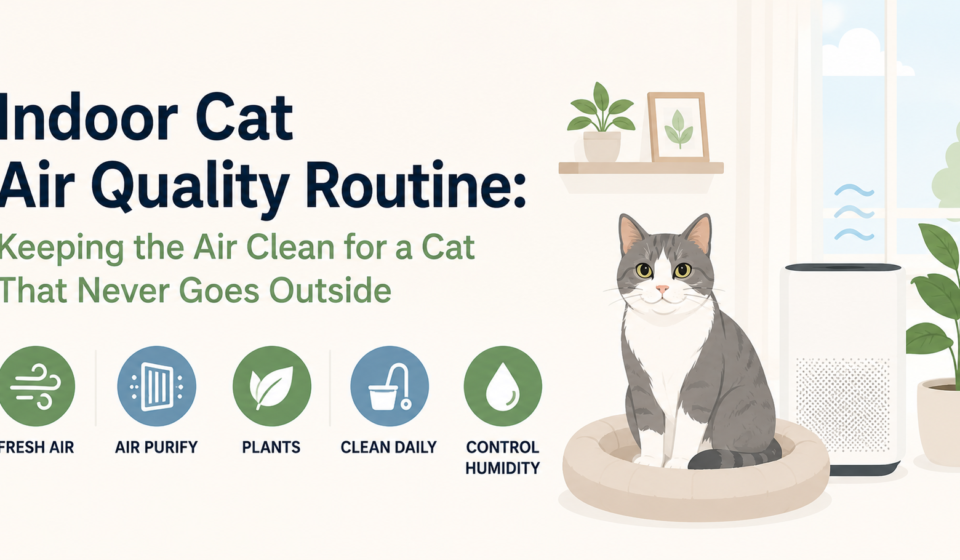
My cat started wheezing a little every time I lit a candle, and it took me embarrassingly long to connect the two. I’d light one in the evening, she’d curl up near the couch, and within twenty minutes she’d have this faint rattly breath I only noticed because I happened to be sitting close enough one night to hear it clearly. Vet visit confirmed it, mild airway irritation, nothing dramatic, but her lungs are basically working with whatever air I fill the apartment with, all day, every day, since she never sets foot outside. That’s the whole premise behind an indoor cat air quality routine. She doesn’t get fresh air the way an outdoor cat does. Whatever’s floating around the apartment is what she breathes, full stop, and most cat owners never actually think about it until something like my wheezing incident forces the issue.
Here’s a real rundown of what actually affects indoor air quality for a cat, what’s worth changing, and what’s honestly just marketing dressed up as pet care.
Why This Matters More for Cats Than People Realize
Cats spend the overwhelming majority of their lives close to the ground, at floor level where dust, dander, and heavier particles tend to settle more than they do at human breathing height. A room that smells and feels perfectly fine to a person standing up can still have a meaningfully worse air quality zone down where a cat actually spends its day, napping, walking, sitting near vents or baseboards.
Cats also groom constantly, which means anything settling on their fur gets ingested directly during normal self-cleaning, not just inhaled. Dust, residue from certain cleaning products, even some air fresheners- none of it stays purely in the air. A good chunk ends up licked off fur and swallowed, which adds a second exposure pathway that doesn’t really apply the same way to people in the same room.
Litter Box Placement and Ventilation
The litter box is probably the single biggest air quality factor most owners never really think through carefully. Ammonia from urine builds up fast in an enclosed space, and a box tucked into a small closet or bathroom with poor airflow can create a genuinely unpleasant, irritating environment, both for the cat using it and for anyone nearby.
Placing the box somewhere with actual airflow, near a window that gets opened occasionally, or in a room with a working exhaust fan, makes a real difference. Open boxes, cleaned more frequently, tend to be the better choice for the cat’s actual air exposure even though they’re less tidy-looking to a person walking by.
Daily scooping matters more for air quality than most people treat it. Waiting two or three days between scoops lets ammonia concentration build up considerably, and a cat using that box multiple times a day is breathing that buildup directly, repeatedly, far more than anyone in the rest of the house ever notices from a distance.
Dust, Dander, and What Actually Filters It
Cat dander is a genuine airborne irritant, for cats themselves as well as people, and it circulates constantly in any home with a cat, settling on surfaces and getting kicked back up into the air with normal movement, vacuuming, even just walking across a room.
A proper HEPA air purifier, sized correctly for the room it’s actually placed in, makes a real measurable difference in airborne dander and dust levels over time. Cheap purifiers without true HEPA filtration mostly move air around without meaningfully cleaning it, which is worth knowing before spending money assuming any purifier does the same job as any other.
Regular vacuuming with a machine that has decent filtration, rather than one that just recirculates fine dust right back into the room, helps considerably too. Carpet holds dander and dust far more than hard flooring does, so homes with a lot of carpet specifically benefit more from a consistent vacuuming schedule than homes with mostly hardwood or tile.
Scented Products, Which Cause More Problems Than People Assume
Candles, plug-in air fresheners, scented cleaning products, and essential oil diffusers- all of these are far more common sources of respiratory irritation in cats than most owners ever suspect, mostly because they smell pleasant to a person and it’s easy to assume pleasant equals harmless.
Cats have a much more sensitive respiratory and olfactory system than people do, and certain essential oils in particular are genuinely toxic to cats, not just mildly irritating, tea tree oil and a handful of others causing real documented harm even through ambient diffusion in the air, not direct ingestion. Anyone using a diffuser in a home with a cat should specifically research which oils are safe, because a fair number of common ones simply aren’t, regardless of how natural or gentle the marketing makes them sound.
Scented candles, like the ones behind my own cat’s wheezing, release particulate matter into the air as they burn, and cats spending hours in a room with regular candle use are getting a real, repeated exposure that adds up over weeks and months even if any single evening seems harmless enough on its own.
Cleaning Products and What’s Actually Safe
Many common household cleaners release fumes that linger in the air well after the actual cleaning is done, and a cat walking across a recently mopped floor, then grooming its paws afterward, gets a direct dose that a person in the same room, standing upright and not licking the floor, never experiences in quite the same way.
Pet safe cleaning products, or at minimum products that ventilate and dry fully before a cat’s allowed back into the room, reduce this exposure considerably. Bleach based products specifically deserve real caution, strong fumes, and residue that a cat can pick up on paws and later ingest during grooming, which makes proper ventilation and full drying time before letting a cat back in genuinely important, not just a nice extra precaution.
Ventilation, the Simplest Fix Most People Skip
Opening windows regularly, even just for ten or fifteen minutes a day when weather allows, cycles out stale indoor air and brings in genuinely fresh air that no purifier fully replicates on its own no matter how good the filtration is.
For homes without easy window access, or in climates where opening windows isn’t practical most of the year, a mechanical ventilation system or even just running exhaust fans regularly in kitchens and bathrooms helps cycle air more than most people realize it does, especially in smaller apartments where stale air can build up fast without anyone noticing the gradual change.
Humidity, Which Affects Air Quality More Than People Expect
Both very dry and very humid air create real problems. Dry air can irritate respiratory passages in cats, particularly during winter with heating systems running constantly, while overly humid air encourages mold and dust mite growth, both of which are genuine respiratory irritants for cats specifically, often more sensitive than people to these particular triggers.
A humidity level somewhere in the moderate range, roughly 30 to 50 percent, tends to be the sweet spot for both comfort and actual air quality. A simple hygrometer, cheap and widely available, takes the guesswork out of this rather than relying on how the air just feels to a person, which honestly isn’t a reliable gauge either way.
Building an Actual Weekly Routine
None of this works well as a one time fix done once and forgotten.
Daily litter scooping, a quick daily wipe down of the litter area itself, weekly vacuuming with proper filtration, and a regular schedule for changing air purifier filters, since a clogged filter stops doing much of anything useful no matter how good the unit was when new, cover most of what actually matters. Checking humidity levels occasionally, and simply opening windows whenever weather cooperates, rounds out a routine that’s honestly not much extra effort once it’s an established habit rather than something requiring conscious thought every single day.
Signs Your Cat’s Air Quality Might Already Be a Problem
Wheezing, like what alerted me to my own candle situation, sneezing more than occasionally, watery eyes, or a cat that seems to avoid a particular room entirely for no obvious reason, these are all worth paying attention to rather than dismissing immediately. Cats are naturally good at hiding discomfort, a survival instinct left over from being both predator and prey in the wild, so by the time a symptom’s genuinely obvious to an owner, it’s often been building for a while already under the surface.
A vet visit is always worth it if symptoms persist beyond a few days, since respiratory issues in cats can stem from a lot of causes beyond air quality alone, and ruling out other possibilities matters before assuming the apartment’s air is definitely the culprit behind whatever’s going on.
Final Thoughts
An indoor cat air quality routine doesn’t need to be some elaborate, expensive overhaul of an entire home. It’s mostly a handful of consistent, boring habits, litter box care, mindful use of scented products, regular ventilation, decent filtration, that add up to genuinely cleaner air for an animal that has zero choice about what she’s breathing all day long. My own cat stopped wheezing within a couple weeks of cutting out candles entirely and switching to a proper open litter box setup with daily scooping. Small changes, but they mattered a lot more than I expected going in.



[…] a die-hard Ole Miss fan about the program’s history, and you’ll probably get two very different reactions depending on which decade they’re […]
[…] was effortless” and “we spent twenty minutes solving problems we could’ve avoided” almost always comes down to what you packed, or more specifically, what you […]
[…] friend of mine had a horse spike a fever on a Tuesday. By Thursday, the whole barn was on lockdown, nobody in, nobody out, and everyone […]
[…] first milk, colostrum, isn’t just food. It’s basically the foal’s starter kit for its immune system, loaded with antibodies, because almost none of that immunity crosses over […]