
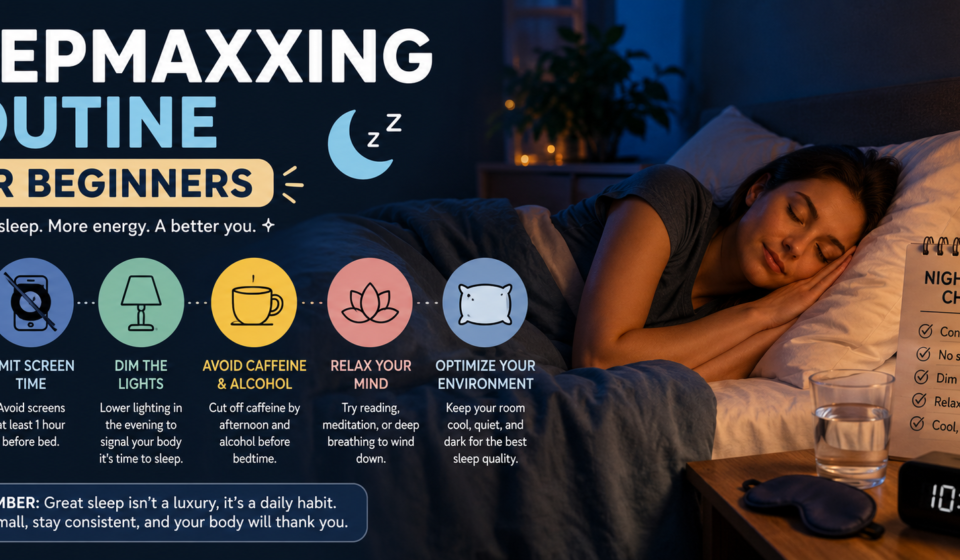

Sleepmaxxing Routine for Beginners: A Realistic Starting Guide
“Sleepmaxxing” has taken off as a term for deliberately optimizing sleep quality, and if you’ve spent any time scrolling through wellness content lately, you’ve probably seen it associated with cooling mattress pads, blue-light-blocking glasses, weighted blankets, magnesium supplements, and elaborate ten-step evening routines. Some of that content is genuinely useful. A lot of it is also expensive, overwhelming, and honestly unnecessary for someone who’s just trying to sleep a little better and wake up without wanting to go straight back to bed.
The truth is that the fundamentals of good sleep are backed by far more research than most of the gadgets marketed around them, and they cost nothing. If you’re starting from scratch, here’s a realistic, beginner-friendly approach that builds in the right order instead of throwing everything at the wall at once.
Why Most Beginners Get the Order Wrong
The biggest mistake people make when they decide to “fix their sleep” is trying to overhaul everything simultaneously — new supplements, a strict no-screens rule, a rigid bedtime, temperature control, and a full evening routine, all starting the same night. It rarely lasts more than a week, because it’s simply too much behavioral change to sustain at once, especially while you’re still tired and running on the sleep debt that got you here in the first place.
A better approach is to build in a specific order, starting with the single highest-leverage change and only adding the next layer once the first one feels automatic.
Step One: Anchor a Consistent Wake Time, Not Bedtime
Almost all beginner sleep advice focuses on when you go to bed. In practice, your wake time is actually the stronger anchor for your circadian rhythm — the internal clock that governs when your body naturally wants to feel alert versus sleepy. Waking up at a wildly different time on weekends compared to weekdays, even by two or three hours, meaningfully disrupts that rhythm, an effect sometimes referred to as “social jet lag.”
The starting move is simple, even if it’s not easy: pick one wake time and stick to it every single day, weekends included, for at least two weeks before changing anything else about your routine. Your body will naturally start to adjust its own sleep pressure to match, often making it easier to fall asleep at a consistent hour without forcing it.
Step Two: Get Sunlight Within 30 Minutes of Waking
This is arguably the most evidence-backed, lowest-effort change on this entire list, and it’s the one beginners skip most often because it doesn’t feel like it’s “about sleep.” Morning light exposure — ideally direct sunlight, even on a cloudy day — is one of the strongest signals your body uses to regulate its internal clock. It suppresses lingering melatonin, boosts alertness for the day ahead, and, critically, helps set the timing for when melatonin will naturally rise again roughly 14 to 16 hours later, supporting easier sleep onset that same night.
Ten to fifteen minutes outside, without sunglasses, shortly after waking is enough for most people. You don’t need special light therapy devices to start — natural daylight works fine, and it’s the habit that matters more than the tool.
Step Three: Cut Caffeine Earlier Than Feels Necessary
Caffeine has a longer half-life than most people account for — roughly five to six hours on average, though it varies by individual. A cup of coffee at 2pm can still have a meaningful amount of caffeine active in your system at 8pm, even if you don’t consciously feel wired. It doesn’t necessarily stop you from falling asleep, but it often reduces the depth and quality of sleep once you do, which is why some people feel like they “slept” but still wake up tired.
A reasonable beginner target is cutting caffeine by early-to-mid afternoon, adjusting based on your own sensitivity. You don’t need to eliminate it — just shift the timing.
Step Four: Build a Short, Sustainable Wind-Down
This is where most beginners overcomplicate things, building an elaborate hour-or-two-long evening ritual that feels great for a few days and then quietly falls apart under the weight of its own complexity. A shorter, more realistic wind-down — even just 20 minutes — is far more sustainable long-term, and consistency matters more than duration.
A simple, effective wind-down usually includes: dimming the lights in your space, stepping away from screens (or at minimum, stepping away from anything work-related or emotionally stimulating), and doing something calm and low-stakes — reading, light stretching, or just sitting quietly. The specific activity matters less than the fact that it’s the same activity most nights, which helps signal to your body that sleep is approaching.
Step Five: Prioritize a Cool Bedroom Before Anything Else
Temperature has a bigger measurable impact on sleep quality than most of the products marketed in the sleepmaxxing space, and it’s the cheapest fix available. Your body’s core temperature naturally drops as part of falling asleep, and a room that’s too warm works against that process, often leading to more restless, lighter sleep even if you don’t consciously wake up.
Before investing in a cooling mattress topper or a smart thermostat, simply experiment with keeping your bedroom cooler than you might normally — most sleep research points to a range that feels slightly cool rather than cozy-warm being ideal for most people. A fan, lighter bedding, or simply cracking a window can accomplish most of this without any additional cost.
Step Six: Track Loosely, Not Obsessively
Detailed sleep-tracking data can be genuinely useful for identifying patterns over time, but for a true beginner, it can backfire — creating a kind of performance anxiety around sleep that ironically makes it harder to fall asleep, sometimes called “orthosomnia.” A simpler approach for the first several weeks is a quick, subjective note each morning: how rested do you feel, on a basic scale, and were there any obvious disruptions the night before.
This kind of loose tracking is enough to notice whether the changes you’re making are actually helping, without turning your sleep into a metric you’re anxiously optimizing every single night.
Putting It Together As a Beginner
Rather than adopting all six steps simultaneously, add them roughly one per week:
- Week 1: Fix your wake time. Everything else builds from this.
- Week 2: Add morning sunlight.
- Week 3: Adjust caffeine timing.
- Week 4: Build your short wind-down routine.
- Week 5: Address bedroom temperature.
- Ongoing: Keep loose, low-pressure tracking throughout.
By the time you’ve layered all six in, most beginners find they’ve built something that actually sticks, rather than a routine that collapsed under its own complexity in the first week. Sleepmaxxing doesn’t require cooling mattresses, elaborate supplement stacks, or blue-light glasses to start working — the biggest, most reliable gains for someone starting from zero almost always come from consistency, morning light, and a calm, repeatable wind-down, in that order.




[…] stress tolerance over time is a more interesting, if less flashy, benefit. Regularly and voluntarily exposing yourself to an acute physical stressor in a controlled way appears to build a degree of […]