
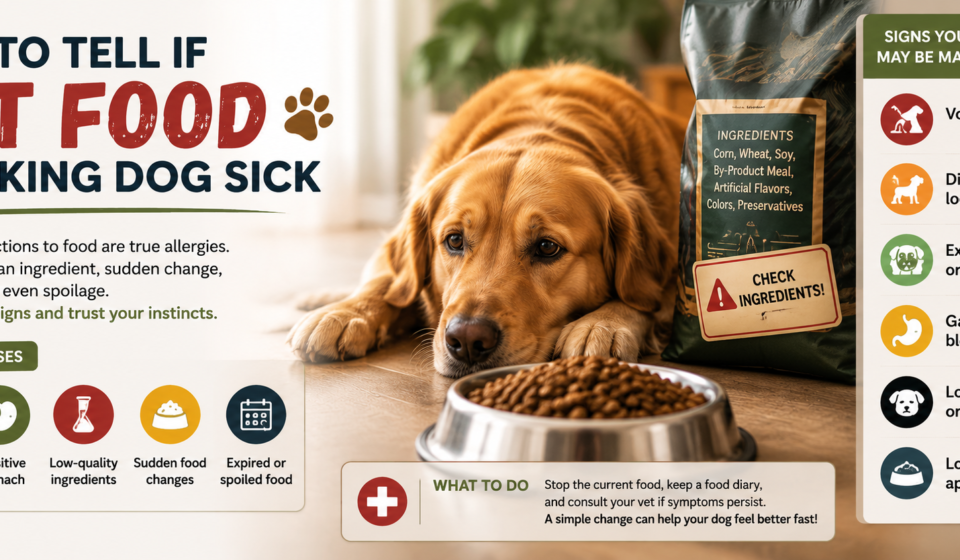
How to Tell If Pet Food Is Making Your Dog Sick
When a new dog food causes an obvious, immediate reaction — vomiting shortly after eating, sudden diarrhea, visible hives — it’s fairly easy to connect the dots. The timing lines up, the symptom is dramatic, and most owners switch food right away. But the far more common scenario is much subtler: a dog that seems generally “off” in ways that don’t obviously point back to their bowl, sometimes for months, while the owner tries everything else first — different treats, a new vet, allergy medication, grooming changes — before ever suspecting the daily food itself.
If you’ve ever felt like something is a little wrong with your dog but couldn’t quite pin down what, it’s worth taking a closer look at food as a possible root cause, even if nothing about mealtime looks obviously problematic on the surface.
Why Food Reactions Are So Easy to Miss
Part of the reason food-related issues go undiagnosed for so long is that they rarely present the way people expect an “allergy” to look. True food allergies, involving a full immune response, are actually less common than food sensitivities or intolerances, which build up gradually and produce symptoms that are easy to attribute to something else entirely — the weather, a new detergent, seasonal allergies, stress, or simply “getting older.”
Because the symptoms are often chronic and low-grade rather than sudden and severe, owners tend to treat each individual symptom separately instead of stepping back and noticing that they might all be connected to the same underlying cause.
Chronic Low-Grade Itching Without Fleas
This is one of the most common — and most frequently misdiagnosed — signs of a food sensitivity. Persistent scratching, especially around the paws, ears, face, or belly, that isn’t explained by fleas or an obvious environmental trigger is a strong signal worth investigating. Recurring ear infections that keep coming back despite treatment, or paw licking that’s severe enough to leave the fur stained or damp, often get treated symptomatically for months — antihistamines, medicated shampoos, ear drops — without anyone stepping back to ask whether the food itself is the underlying driver.
The frustrating part is that these treatments often provide temporary relief, which reinforces the idea that the issue has been solved, right up until the symptoms return a few weeks later.
Stool That’s “Normal” But Not Quite Right
Obvious diarrhea gets noticed immediately. But stool that’s consistently a little too soft, slightly inconsistent from day to day, or unusually strong-smelling — without ever crossing the line into what most owners would call “diarrhea” — is very frequently dismissed as normal variation. In reality, this kind of subtle, chronic stool inconsistency is often one of the earliest digestive responses to an ingredient a dog struggles to process well.
If you’ve gotten used to your dog’s stool looking “fine, but not quite firm,” it’s worth reconsidering whether that’s actually the baseline it should be, rather than an early warning sign that’s been normalized over time.
Excessive or Unusually Frequent Gas
Occasional gas is completely normal in dogs, just as it is in people. But frequent, strong-smelling gas — especially if it’s a noticeable change from how a dog used to be — is often a sign that the current food isn’t being digested efficiently. This usually points to either an ingredient the dog’s system struggles with, or a food that’s simply lower quality and harder to break down than it should be, leading to more fermentation happening in the gut than normal.
A Noticeable Energy Dip After Meals
Some dogs show a clear pattern of low energy, sluggishness, or a “food coma” effect in the hour or so after eating. While some post-meal mellowing is completely normal, a dramatic or consistent energy crash — where a normally playful dog becomes withdrawn or wants to just lie down every time after a meal — can indicate that their body is working unusually hard to process something in their food, redirecting energy toward digestion in a way that shouldn’t be this taxing on a regular basis.
Coat Changes That Don’t Improve With Grooming
A dull, dry, flaky, or thinning coat is often chalked up to needing a better shampoo, more frequent brushing, or a seasonal shed. And sometimes that’s exactly what it is. But when coat quality doesn’t meaningfully improve despite consistent grooming and care, it’s worth considering that the issue may be nutritional rather than external — the coat is often one of the first visible places where a poor-quality or poorly tolerated diet shows up, since it’s one of the lowest biological priorities for the body to maintain when resources are being diverted elsewhere.
Weight That Won’t Stabilize
Unexplained weight gain, or difficulty maintaining a healthy weight despite feeding consistent amounts, can point to a food that isn’t being properly absorbed or metabolized. This is a subtler sign than most people expect from a food issue, since it’s easy to assume weight problems are purely about portion size or exercise. But if a dog’s weight keeps drifting despite a stable feeding routine, the food’s actual nutritional profile — not just the quantity — is worth examining closely.
How to Actually Investigate, Without Guessing
If you suspect food is playing a role, the biggest mistake most owners make is switching brands repeatedly and quickly in response to each new symptom. This makes it almost impossible to isolate what’s actually causing the problem, since you’re changing variables faster than symptoms have time to resolve or reappear.
A more structured approach:
- Choose a single, limited-ingredient food — ideally one with a novel protein source your dog hasn’t eaten regularly before — and commit to it exclusively for at least 8 to 12 weeks, since food-related skin and digestive symptoms can take a while to fully resolve even after the trigger is removed.
- Avoid introducing new treats, table scraps, or supplements during this window, since even small amounts of an inconsistent ingredient can muddy the results.
- Keep a simple log of symptoms — itching, stool quality, energy, coat — on a weekly basis, so you have an actual record to compare rather than relying on memory.
- If symptoms improve significantly during the trial, you can reintroduce previous foods or ingredients one at a time to identify the specific trigger, rather than assuming the entire old diet was the problem.
When to Involve a Vet
If symptoms are severe, worsening, or not improving despite a genuine elimination trial, it’s time to bring in a veterinarian, who can run more targeted testing to distinguish between a true allergy, an intolerance, and an unrelated underlying condition that simply looks similar on the surface. Chronic symptoms that seem food-related but don’t resolve with diet changes alone are also worth a vet visit, since they may point to something else entirely that just happens to overlap in presentation.
Dogs can’t tell you when something isn’t sitting right with them — they can only show you, often in ways that are easy to explain away individually. Paying attention to the pattern, rather than each symptom in isolation, is usually what makes the difference between months of guessing and actually finding the answer.


[…] hydration status they had when younger. At the same time, many senior dogs develop conditions — arthritis, reduced mobility, dental pain, or cognitive changes — that make it physically harder or less […]