
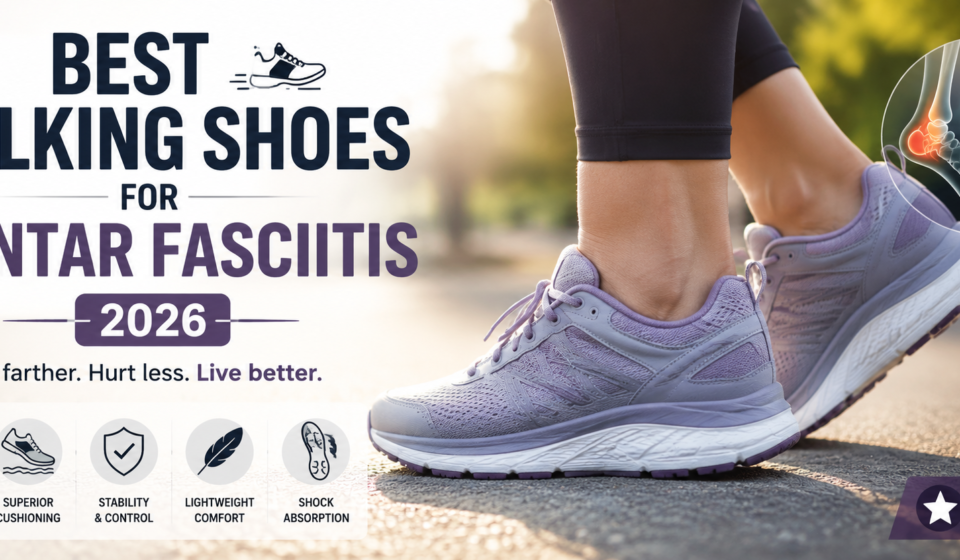
Best Walking Shoes for Plantar Fasciitis in 2026: What Actually Matters
Plantar fasciitis has a way of turning something as basic as walking into a genuinely painful daily decision. That sharp, stabbing sensation in the heel with the first few steps out of bed, or after standing up from a chair, is one of the most recognizable symptoms of the condition, and if you’re dealing with it, you’ve probably already discovered that not all walking shoes are created equal when it comes to managing it.
Rather than chasing brand names or whatever’s trending this year, it’s far more useful to understand the specific structural features that actually make a difference for plantar fasciitis — because those features matter far more than any particular label on the box.
What’s Actually Happening With Plantar Fasciitis
Before getting into shoe features, it helps to understand what you’re actually managing. The plantar fascia is a thick band of tissue running along the bottom of your foot, connecting your heel to your toes. When it becomes inflamed or irritated — often from repetitive strain, inadequate support, or sudden increases in activity — it causes the characteristic heel pain that tends to be worst first thing in the morning and after periods of rest, since the tissue tightens during inactivity and gets stretched abruptly with the first steps.
This matters for shoe selection because the goal isn’t just “cushioning” in a generic sense — it’s specifically about reducing strain on that tissue with every step, which comes down to a fairly specific combination of structural features.
Arch Support Is Non-Negotiable, But Not All Support Is Equal
Adequate arch support is probably the single most important feature for plantar fasciitis, since it directly reduces the amount of stretch and strain placed on the plantar fascia with each step. But “arch support” isn’t a single, uniform thing — it needs to match your specific arch type, which is why a shoe that works wonderfully for one person with plantar fasciitis can feel unhelpful or even uncomfortable for another.
People with flatter feet generally need more structured, motion-control-oriented support, while people with higher arches typically need more cushioned, flexible support that doesn’t create pressure points under an already elevated arch. If you’re not sure which category you fall into, a foot-mapping assessment at a specialty running or walking shoe store, or through a podiatrist, is worth doing before investing in shoes based on arch support alone.
Heel Cushioning Needs to Absorb Impact, Not Just Feel Soft
A shoe can feel soft in a store and still provide inadequate impact absorption where it actually matters — specifically at the heel strike, where the majority of ground reaction force travels directly into the already-irritated plantar fascia. Look specifically at heel cushioning technology and heel-to-toe drop, which measures the height difference between the heel and forefoot of the shoe.
A moderate heel-to-toe drop, generally in the range most podiatrists recommend for plantar fasciitis, helps reduce the amount of stretch placed on the plantar fascia during the gait cycle compared to completely flat shoes, which force the tissue to stretch further with each step.
A Firm, Supportive Midsole Matters More Than Softness
There’s a common misconception that a maximally soft, plush shoe is automatically better for foot pain. In reality, a shoe that’s too soft and unstructured can actually allow excessive foot movement within the shoe, which increases strain on the plantar fascia rather than reducing it. What you actually want is a midsole that’s supportive and appropriately firm, providing structure and stability while still absorbing shock — a combination that’s more about engineering than simple softness.
This is why some of the shoes most frequently recommended by podiatrists for plantar fasciitis don’t feel like the softest option in a shoe store lineup — they’re built for structured support rather than plush comfort alone, and the difference matters significantly for symptom management over the course of a full day of walking.
Toe Box Space Prevents Secondary Issues
A narrow, cramped toe box doesn’t directly cause plantar fasciitis, but it can contribute to altered gait mechanics as your foot tries to compensate for restricted space, which in turn can increase strain elsewhere in the foot, including the plantar fascia. A wider, more accommodating toe box allows your toes to spread naturally with each step, supporting a more natural and less compensatory walking pattern.
This becomes especially relevant if you’re already dealing with plantar fasciitis, since your foot is likely already adjusting its natural mechanics to avoid pain, and a restrictive toe box adds another layer of compensation on top of that.
Rocker-Bottom Soles: Helpful for Some, Not for Everyone
Some walking shoes designed specifically with plantar fasciitis in mind include a rocker-bottom sole design, which is curved to reduce the amount of bending required at the ball of the foot during each step, theoretically reducing strain on the plantar fascia during push-off. Some users find genuine relief with this design. Others find the altered gait mechanics uncomfortable or destabilizing, particularly if they’re not used to walking in a rocker-sole shoe.
This is a feature worth trying rather than assuming will work universally — it’s a more individualized preference than the other features on this list, which tend to help most people with plantar fasciitis fairly consistently.
Replacing Shoes on Time Matters as Much as Choosing Them Well
Even the best-designed walking shoe for plantar fasciitis loses its supportive properties over time as the cushioning and support materials compress and break down with use. Continuing to walk in shoes well past their effective lifespan — generally somewhere in the range of 300 to 500 miles of walking for most walking shoes, depending on your weight, gait, and walking surface — significantly reduces the benefit you’re getting from even a well-chosen shoe, and can quietly contribute to symptom flare-ups that get mistakenly blamed on the shoe model itself rather than its worn-out condition.
Tracking approximate mileage, or simply replacing walking shoes on a defined schedule rather than waiting until they visibly wear out, is a simple habit that meaningfully supports ongoing plantar fasciitis management.
Orthotic Inserts: When Shoes Alone Aren’t Enough
For some people, even a well-chosen shoe with good built-in support isn’t quite enough, and a custom or semi-custom orthotic insert provides an additional, more individually tailored layer of arch support and cushioning. This is particularly common for people with more severe or persistent symptoms, or unusually pronounced arch types that off-the-shelf shoe support doesn’t fully accommodate.
If you’re finding that well-reviewed, feature-appropriate shoes still aren’t providing enough relief, discussing orthotic options with a podiatrist is a reasonable next step, rather than continuing to cycle through different shoe models hoping to find the right fit through trial and error alone.
Bringing It Together: What to Actually Prioritize
Rather than searching for a single “best” shoe, prioritize these features in combination: arch support matched to your specific arch type, a moderate heel-to-toe drop with genuine heel cushioning, a firm and structured (not overly soft) midsole, adequate toe box space, and a defined replacement schedule rather than waiting for visible wear. Rocker-bottom soles are worth trying but shouldn’t be treated as a requirement, since individual response varies significantly.
If symptoms persist despite a well-chosen shoe and consistent replacement schedule, that’s a sign to loop in a podiatrist rather than continuing to shop for the next shoe model — plantar fasciitis is highly manageable, but persistent, unresolved symptoms sometimes need additional treatment beyond footwear alone.



[…] you submerge your body in cold water, several things happen fairly quickly. Blood vessels near the skin constrict, redirecting blood flow […]
[…] it depends on what you’re after. If you want raw nature, national parks like Yellowstone, Zion, and Yosemite are hard to beat. If you want culture and energy, cities like New York, New […]
[…] from the outside. Concrete and asphalt add extra impact with every step compared to softer ground. Your legs end up absorbing more shock than they’re meant to, and that shows up later as […]