

Somebody asked me once, half-jokingly, whether robots basically do the surgery now and the doctor just watches. I get why people think that. The word “robotic” does a lot of heavy lifting in people’s imagination. But no, that’s not how it works, not even close. Good question. Turns out there’s a real answer, and it’s more layered than a quick Google search tells you.
The Robot Part Isn’t the Hard Part
Here’s something that surprised me. The mechanical side of controlling the robot — the console, the hand movements, the pedals — isn’t actually the difficult part for most surgeons going through robotic surgery training. If someone already has years of open or laparoscopic surgery under their belt, picking up the controls is relatively fast.
What’s genuinely hard is the loss of touch. A surgeon operating traditionally feels tissue resistance directly through their hands. You’re watching a screen, judging things visually that you used to judge by feel. That’s a real cognitive shift, not a technical one, and it’s a big part of why this training takes as long as it does. It’s less “learn the machine” and more “relearn how to trust your own judgment without the sense you’ve relied on your whole career.”
Simulation Comes First, and It’s Not Optional
Nobody gets handed robotic instruments on day one with a real patient in front of them. It always starts with simulation, and this stage matters more than people assume from the outside.
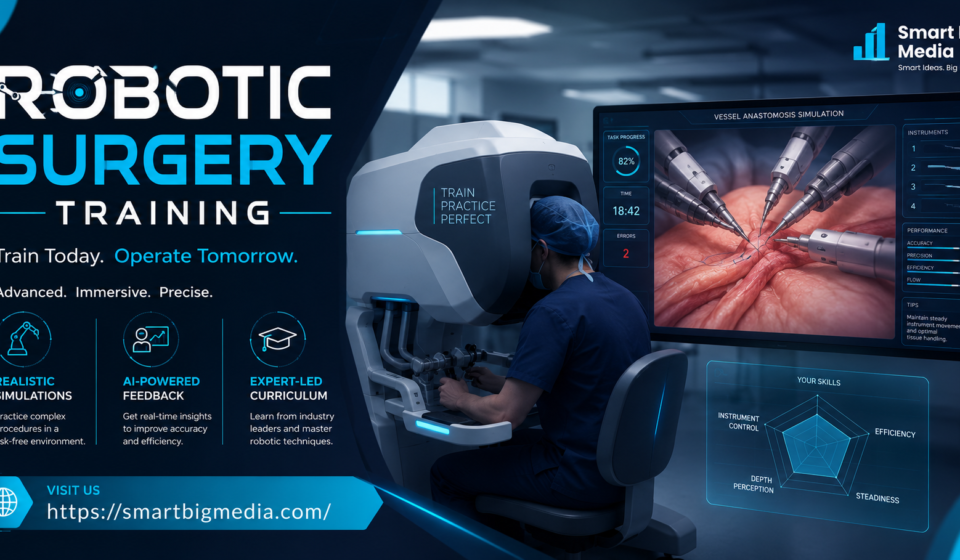
Simulators let trainees practice things like suturing, knot-tying, and basic tissue manipulation in a completely virtual space. These systems track accuracy, how efficient the movements are, and how many errors happen along the way.
How long this takes really depends on the person. Some residency programs build simulator hours right into the schedule; others expect trainees to put in the time on their own outside of regular duties. Either way, it’s the foundation everything else gets built on.
Then Comes Dry Lab, Then Wet Lab
After simulation, training usually shifts to dry lab work — practicing on synthetic materials like foam pads or plastic models, but now using an actual robotic system instead of a screen. This is the first time a trainee deals with things like docking the robot properly and coordinating what their hands are doing at the console with what’s happening at the operating table itself.
Wet lab is the next step up, and it’s a bigger jump than people expect. This usually involves animal tissue or cadaver models — something that behaves unpredictably the way real human tissue does, not something that resets with a button click like a simulator. Trainees often work through entire simulated procedures here, start to finish, before they’re anywhere near a live patient.
This stage is where judgment actually starts getting tested under conditions that don’t behave the way a controlled environment does. It’s the closest thing to the real deal before the real deal actually happens.
Proctored Cases Are Where It Gets Real
The stage that really determines whether someone’s ready for independent robotic surgery is proctored casework — live procedures on actual patients, with an already-certified robotic surgeon supervising every step.
This isn’t a single observation and done. Most credentialing paths require a set number of successfully proctored cases before a trainee is cleared to work independently, and that number shifts depending on the hospital, the specialty, and the specific procedure. What the proctor is really watching for isn’t whether the trainee can technically operate the robot — by this point they usually can. It’s how they handle the unexpected. Unplanned bleeding. Anatomy that doesn’t quite match the pre-op imaging. Whether they communicate clearly with the surgical team if something needs to change mid-case.
Honestly, this is the real core of robotic surgery training. Everything before this — the simulator, the dry lab, the wet lab — exists to get someone ready for this exact moment without putting a real patient at unnecessary risk while they’re still learning.
It’s Not One Path — Specialty Changes Everything
Something people don’t realize: there’s no single, universal robotic surgery certification that covers everything. A urologist training for robotic prostate procedures goes through a different case load and skill progression than a gynecologic surgeon training for robotic hysterectomies, or a general surgeon training for robotic hernia repairs. Each specialty sets its own procedure-specific standards, usually through professional societies within that field rather than one overarching body.
So if you’re trying to figure out what a surgeon’s robotic training actually means, it helps to know that being credentialed for one type of robotic procedure doesn’t automatically mean broad competency across every kind. Hospitals credential procedure by procedure, not with one blanket “robotic surgery” stamp.
Hospitals Add Their Own Layer on Top
Even after someone finishes formal training, individual hospitals run their own credentialing review before granting robotic privileges. That usually means looking at training records, proctored case logs, and sometimes requiring a few more supervised cases specific to that hospital’s equipment and internal protocols.
Why the extra step? Because training program quality varies, and hospitals want their own verification before letting a surgeon operate independently under their roof. It also means a surgeon switching hospitals might have to go through part of this again, even with solid prior robotic experience, if the new hospital’s standards are different.
So How Long Does This Actually Take?
There’s genuinely no fixed timeline here, and anyone who tells you a specific number of weeks is oversimplifying. For a surgeon who already has strong open or laparoscopic experience, getting through simulation, lab work, and proctored cases to reach independent competency usually takes somewhere between several months and a year — depending heavily on case volume, specialty, and how much practice time they’re actually getting.
For surgical residents, it’s spread across years as part of a much broader curriculum. It’s not a fast-tracked side skill. It’s woven into the entire arc of their surgical education alongside everything else they’re learning.
Training Doesn’t Stop After Certification
This part gets left out of a lot of explanations. Robotic surgery training doesn’t just end once someone’s credentialed. The equipment itself keeps evolving — new instruments, platform updates, refined techniques. Surgeons who regularly perform robotic procedures typically go through periodic skills checks, updated simulation modules whenever new equipment rolls out, and sometimes formal recredentialing depending on their hospital or specialty board’s rules.
It matters because a surgeon trained five years ago on an older robotic system isn’t automatically fluent on a newer one without some additional training specific to that update. The learning doesn’t really stop, it just shifts from foundational to maintenance mode.
If You’re the One About to Be Operated On
For patients, all of this really boils down to one reasonable question worth asking directly: how many of this specific type of robotic procedure has the surgeon performed independently, and are they still in a supervised proctoring period or fully cleared? Any surgeon who’s confident in their training will answer that plainly, without dancing around it.
A growing number of hospitals are also being upfront about surgeon experience specifically for robotic procedures, separate from their general surgical background, because the two skill sets are related but not identical. A surgeon with twenty years of open surgery experience isn’t automatically equally skilled robotically on day one. That’s exactly why this whole training pathway exists — the gap is real, and it has to be closed deliberately rather than assumed away.
The Part Nobody Really Talks About
Most conversations about robotic surgery training stick to the measurable stuff — simulator scores, case counts, credentialing checklists. What gets skipped is the mental adjustment that comes with this. Surgeons who’ve been through it often describe the console feeling less intuitive than they expected, even after doing well in simulation, simply because live surgery throws in variables that no training environment fully prepares you for.
That’s part of why the proctored case requirement exists in real volume, not as a token handful of supervised procedures. It’s not bureaucratic caution for the sake of it. It reflects a genuine, well-documented learning curve, and training programs have adjusted their requirements over time based on real outcomes data, not guesswork.
Bringing This Together
Robotic surgery training is a longer, more deliberate process than the phrase probably suggests to most people outside medicine. It starts in simulation, moves through lab practice on both synthetic and biological tissue, progresses into closely supervised live cases, and only then leads to independent practice — and even after that, ongoing training keeps going in the background.
Whether you’re a future surgeon weighing this path, someone setting hospital credentialing standards, or just a patient trying to understand what “robotic surgery” actually says about a surgeon’s preparation, the honest takeaway is the same. This isn’t a quick add-on skill or a weekend certificate. It’s a genuinely serious, multi-stage commitment, and it takes real time to do it properly.




[…] sneakier because it feels like it’s helping at first. You get drowsy, fall asleep fast, then wake up at […]