
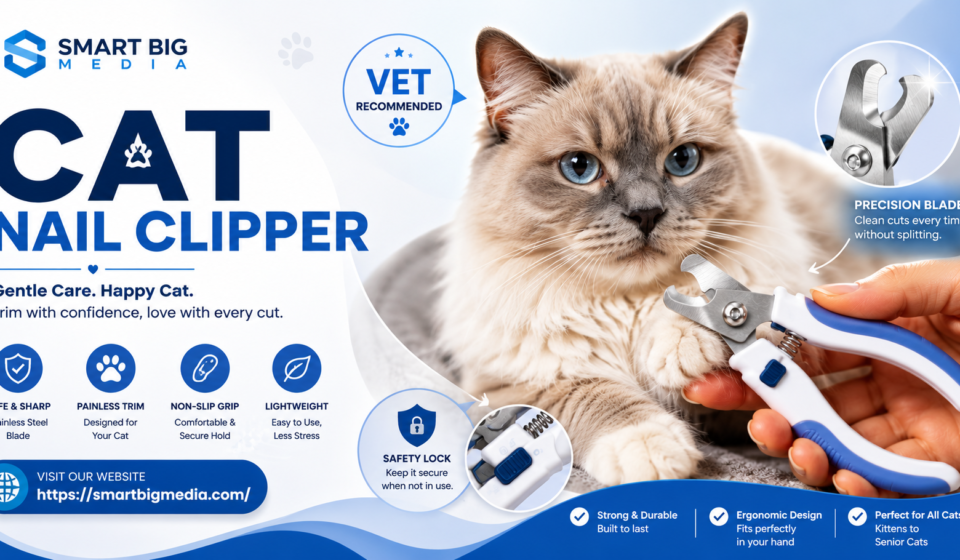
Okay, so here’s a scenario a lot of cat owners know too well. Your cat is calm, half-asleep on your lap, everything’s fine. You grab the clipper. Two seconds later, it’s a blur of claws and pure betrayal, and you’re sitting there wondering what just happened. Nine times out of ten, honestly, it’s not even the cat being dramatic. It’s the clipper doing a bad job.
A decent cat nail clipper isn’t some optional extra you can skip on.
Why the Clipper Itself Actually Matters
You’d think any small clipper would work fine — it’s just a nail. Except cat claws aren’t shaped like human nails at all. They’re curved, thin, layered in a weird way. A clipper that isn’t built for that shape ends up crushing the nail slightly before it actually cuts through, and that’s uncomfortable even when there’s no blood involved. That’s probably the real reason so many cats dread nail trims in the first place. It’s usually not the trimming itself that’s the problem. It’s a bad tool doing a bad job, session after session.
A clipper actually made for cats has a curved blade shaped to match the claw, instead of the flat blade you’d find on something built for humans. One design difference, and it changes the whole experience — for the cat and for you.
The Different Styles You’ll Come Across
There’s more than one type of clipper out there, and which one you pick genuinely changes how the whole thing goes.
Scissor-style clippers look like tiny curved scissors, basically. They’re popular because they’re simple, and you can actually see the nail clearly before you make the cut. A lot of people, trimming a cat’s nails for the first time, find these easiest to handle, especially with a nervous cat, where being careful matters more than being quick.
Guillotine-style clippers work differently. You slide the claw through a small hole, squeeze, and a blade slices across in one motion. People who’ve been doing this for years tend to like these because once you’re used to them, they’re fast. The catch is they take some practice, and they’re not exactly beginner-friendly if it’s your very first time with a squirmy cat.
Plier-style clippers are somewhere in between — sturdier, and often used by people with multiple cats or breeds that have thicker claws. They’re bulkier, though, which isn’t great if your cat already hates having its paws touched in the first place.
None of these is “the best” one across the board. It comes down to your cat, your own hands, and honestly how much patience you’ve got that particular day.
Blade Sharpness Doesn’t Get Talked About Enough
Here’s something that gets skipped constantly. A dull blade is arguably worse than not having a clipper at all. A sharp one cuts clean in a single motion. A dull one pinches and crushes the nail before it finally gets through, which hurts a bit and sometimes leaves small splits that weren’t there to begin with.
Cheap clippers dull fast. If you’ve had the same one for over a year and trimming’s started feeling harder, or the nail seems to crack instead of cut smoothly — that’s the blade telling you it’s done. That’s not a “you” problem. That’s just the tool wearing out.
Better clippers, usually stainless steel, hold an edge a lot longer.
The Handle Matters More Than People Realize
This one honestly surprises a lot of people. An awkward handle doesn’t just feel weird — it makes precision genuinely harder, and precision matters a lot when you’re working that close to the quick, which is the sensitive part of the nail you’re trying to avoid.
Safety Features Actually Worth Looking For
A few features keep showing up on clippers that are genuinely designed for cats, not just repurposed human tools with a cat printed on the packaging.
A quick-guard or safety stop is probably the single most useful thing to look for. It’s a small guard that limits how far the blade closes, which helps avoid cutting too deep and hitting the quick. Really helpful if you’re still learning exactly where that is on your specific cat, since it’s not the same from cat to cat, or sometimes even claw to claw on the same paw.
None of these is a dealbreaker by itself. But a clipper with two or three of them tends to be noticeably easier to actually use week to week.
Size Isn’t Just a Kitten-vs-Adult Thing
People assume clipper size only matters for kittens versus fully grown cats, but there’s a bit more to it. Cats with thicker claws — often larger breeds, or older cats whose nails have naturally thickened with age — need a clipper strong enough to get through the nail cleanly in one go. A clipper that’s too light or too small for a thick claw struggles, and struggling usually means multiple attempts on the same nail, which no cat is thrilled about sitting through.
Kittens are the opposite issue. Thin, delicate claws, and an oversized or stiff clipper makes precision difficult. A smaller, lighter clipper with a gentler squeeze tends to work better there, mostly because it gives you more control over how much pressure you’re actually applying.
Mistakes People Keep Making
A handful of patterns show up over and over, and most of them are easy to avoid once you know what to watch for.
Grabbing the cheapest option available is probably the biggest one. Not that budget clippers are always terrible — plenty are fine — but the really cheap ones dull almost right away, and the handles often don’t hold up after a few months of regular use. If you’re doing this every couple weeks for years, that adds up.
Ignoring blade shape is another common one. A flat-edge clipper built for dogs, or some generic all-purpose pet clipper, doesn’t match a cat’s narrower, curved claw nearly as well as one made specifically for cats.
Not replacing a clipper once it’s dulled is a mistake a lot of people don’t even realize they’re making. There’s no dramatic warning sign. It just gets a little worse each session, cut by cut, until trimming becomes something the cat actively dreads and you can’t quite figure out why.
What to Actually Check Before Buying One
Instead of just grabbing whatever pops up first in a search, it’s worth going through a short list.
Check what the blade’s actually made from — stainless steel holds an edge a lot longer than the cheaper alloys some budget clippers use. Make sure the blade shape is curved for cats specifically, not flat, dog-style, or generic all-purpose. Think about how the grip actually feels in your hand, since comfort directly affects how precise you can be. Look for a safety guard, especially if you’re still figuring out exactly where the quick sits on your cat. And factor in your specific cat’s size — a kitten with thin nails and a big adult with thick claws genuinely need different tools, even if owning two feels like overkill at first.
None of this takes long to sort through, but skipping it is usually how people end up with a clipper sitting in a drawer after two frustrating tries.
Where This Leaves You
A cat nail clipper seems like a small, forgettable purchase, but it quietly decides whether nail trims become a routine five-minute task or a recurring fight every couple of weeks. The gap between a genuinely well-made clipper and a cheap generic one isn’t always obvious from a product photo, but it shhttps://smartbigmedia.com/how-to-tell-if-pet-food-is-making-dog-sick/ows up the second you actually use one.
Pay attention to blade shape, blade material, grip comfort, and safety features before anything else. Spending a little more upfront is almost always worth it if it means fewer stressful trims, and a cat that doesn’t bolt the moment it hears the clipper come out of the drawer.