
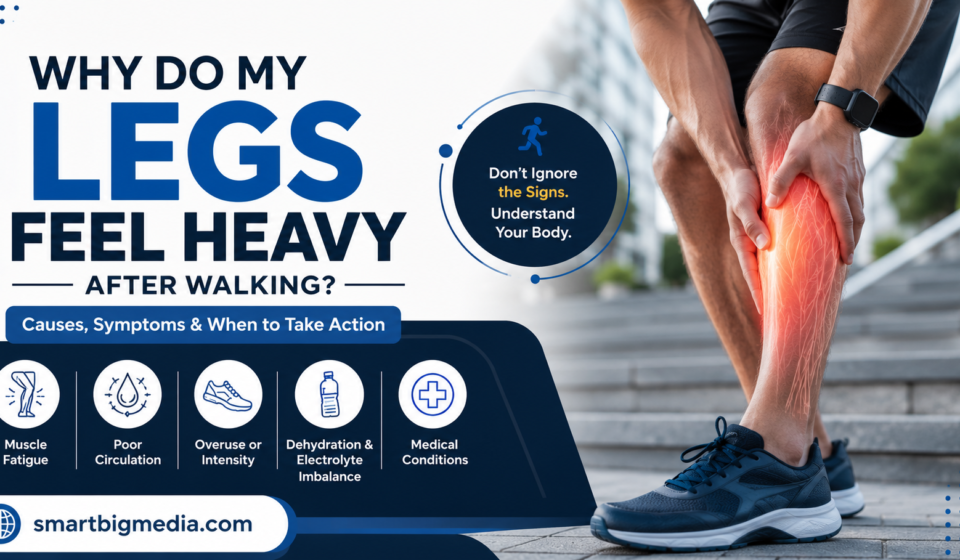
You go for a walk. Nothing crazy — maybe just to the shop and back, or the same loop around the block you’ve done a hundred times. And somehow, by the time you’re done, your legs feel like someone tied bricks to your ankles when you weren’t looking. Every step costs a bit more than it should. Even the stairs afterward feel personal.
If that’s you, here’s the short version: it’s almost never random. There’s usually a real reason. Sometimes it’s boring — muscles, water, shoes. Sometimes it’s worth a doctor’s visit. Let’s go through it properly.
Quick thing before we dive in: heaviness isn’t the same complaint every time. For one person it means “my legs feel tired and slow.” For another it means “my legs feel swollen and tight.” Those can point to different causes, so as you read through the list below, try to pin down which version actually matches what you’re feeling. It’ll make the right answer easier to spot.
Muscle Fatigue
This one explains most cases. Walking puts your calves, thighs, and hips through constant, repetitive work — contract, release, contract, release, hundreds of times a minute if you count it out. When those muscles aren’t used to that load, they produce waste faster than your body clears it, and that buildup is what gives you the “concrete legs” feeling.
It shows up more after a longer walk than usual, a faster pace, or a hill you weren’t expecting. There’s nothing wrong with you here. Your muscles just haven’t adapted yet. Keep walking regularly and most people notice it fading within a couple of weeks, sometimes sooner.
Worth knowing: heaviness and soreness aren’t the same thing. Soreness usually hits the next day. Heaviness shows up while you’re still walking, or right after. That immediate version is basically your muscles saying “this is more than I’m used to” — not a warning sign, just information.
It’s also worth thinking about what you did before the walk, not just during it. Standing all day at work, a poor night’s sleep, or a leg workout the day before can all leave your muscles starting from a deficit, so a walk that would normally feel easy suddenly feels like it’s dragging.
Poor Circulation
Your legs are about as far from your heart as it gets, so blood has to fight gravity the whole way back. Your calf muscles actually help with that job — they squeeze the veins as you walk, pushing blood upward. Some people call it your “second heart,” which is a little dramatic but not wrong.
Problem is, if you’ve been sitting all day, wearing something tight around your waist, or your circulation just isn’t great to begin with, blood pools in your lower legs instead of moving properly. That pooling is exactly what creates the heavy, achy feeling.
A few signs it’s circulation: ankles that puff up by evening, legs that go a bit cold, heaviness that gets worse the longer you’re upright rather than just during the walk. If that sounds familiar, compression socks genuinely help. Not a gimmick — actual graduated pressure that supports blood flow back up.
Sitting cross-legged for long stretches, wearing shoes with no support, or standing still for long periods without moving your legs at all can all make circulation-related heaviness worse. Even something as small as flexing your ankles up and down while sitting at a desk gives your calf muscles a little pump action, which can genuinely take the edge off by the time you’re ready to walk later in the day.
Dehydration and Electrolytes
Muscles need water plus sodium, potassium, magnesium, and calcium just to contract and relax the way they’re built to. Even mild dehydration throws that off, and legs end up feeling sluggish and heavy as a result.
You don’t need a marathon for this. A hot afternoon, two coffees with no water to balance them, skipping breakfast before heading out — any of it can do it. And here’s the annoying part: you can drink plenty of plain water and still be short on electrolytes, especially if you’ve been sweating.
Quick gut check — when did you last actually drink a full glass of water before this walk? If the honest answer is “hours ago” or “I don’t remember,” start there before looking anywhere else.
Sports drinks aren’t necessary for a normal walk, but if you’re out in the heat for a while or sweating more than usual, a pinch of salt in your water or a snack with some potassium in it, a banana works fine, can genuinely make a difference in how your legs feel by the end.
Varicose Veins and Venous Insufficiency
Some people have valves inside their leg veins that don’t close all the way. Blood flows backward instead of moving up, pools instead of circulating, and that’s called venous insufficiency. It’s more common than most people realize, and it doesn’t always look dramatic on the outside.
It tends to build steadily through the day and ease up overnight, once your legs have been elevated for hours during sleep. Visible veins, ankle swelling, or family members who’ve dealt with varicose veins are all clues this is playing a role.
Standing jobs, pregnancy, and carrying extra weight all raise the odds, since each adds pressure on the veins over time. It builds slowly, which is probably why so many people just chalk it up to “getting older” instead of recognizing it as something with an actual name and actual treatment options.
Simple habits help even before you see a doctor about it: avoid standing completely still for long stretches, move your calves periodically if you’re on your feet a lot, and elevate your legs above heart level for a bit whenever you get the chance during the day.
Nerve-Related Causes
Not everything comes down to muscles or blood. Sometimes it’s nerves sending confusing signals. Sciatica — a pinched nerve somewhere in your lower back — can cause a heavy, dragging feeling down one specific leg. Peripheral neuropathy, often linked to diabetes, can feel similar, usually with tingling or numbness thrown in.
If it’s only one leg, or there’s tingling involved, mention it to a doctor rather than brushing it off. People often describe nerve-related heaviness as feeling “off” or “not quite mine” rather than just tired — a distinction worth using if you do end up explaining it to someone.
Doing Too Much, Too Soon
Maybe you recently ramped up your walking. New routine, new goal, decided this was finally the month. Good on you — but your legs might still be catching up behind the scenes. Muscles need real recovery time between sessions, and walking long distances several days straight without a break doesn’t give that heaviness a chance to clear before you’re back at it.
This is your body asking, politely, for a rest day. Ignore it long enough and simple fatigue can turn into something more annoying, like shin splints.
The fix isn’t complicated, even if it’s not what people want to hear: back off for a day or two, actually let your legs recover, then ease back in. Pushing through it day after day usually stretches the problem out longer, not shorter.
Worn-Out Shoes and Hard Ground
Sounds too simple to matter, but it does. Old shoes lose cushioning even when they still look fine from the outside. Concrete and asphalt add extra impact with every step compared to softer ground. Your legs end up absorbing more shock than they’re meant to, and that shows up later as fatigue.
If your shoes have a lot of miles on them, or you genuinely can’t remember buying them, that’s an easy fix. Rough rule of thumb: replace walking shoes every three hundred to five hundred miles, or every six months to a year for most regular walkers, tread wear or not.
Underlying Health Conditions
Occasionally, heavy legs point to something more medical. Peripheral artery disease narrows the arteries feeding your legs, causing heaviness or cramping during activity that eases with rest — doctors call this claudication. Anemia means less oxygen reaching your muscles, leaving them tired even without much exertion. An underactive thyroid slows your whole system down, muscles included.
This doesn’t mean you should assume the worst — most people reading this have something simpler going on. But new heaviness, heaviness that’s getting worse, or heaviness paired with chest pain, shortness of breath, or noticeable swelling deserves an actual checkup, not a guess.
Smoking, diabetes, high cholesterol, and family history of vascular disease all raise the odds peripheral artery disease is worth ruling out, especially if cramping shows up predictably during activity and eases just as predictably once you stop.
What Actually Helps
Drink water steadily through the day, not just around your walk. Stretch your calves and hamstrings before and after. Prop your legs up for fifteen or twenty minutes afterward if swelling’s an issue — let gravity help instead of fight you. Try compression socks if circulation seems to be the culprit.
Build your walking distance up gradually instead of jumping straight into long walks. Replace shoes that have seen better days. Watch caffeine and alcohol — both quietly dehydrate you, and your legs pay for it later.
Sleep matters too, since most muscle repair happens while you’re out cold. And small pacing changes help more than people expect: slowing down slightly on hot days, taking short breaks on longer walks instead of pushing straight through, warming up with a slower first few minutes instead of starting at full speed.
When to See a Doctor
Most of the time this settles down with hydration, rest, and a little patience while your legs adjust. Get it checked if the heaviness comes on suddenly, only affects one leg, comes with redness or warmth in one spot, or doesn’t ease with rest. Chest pain or shortness of breath alongside leg heaviness should always be taken seriously — don’t wait that one out.
It also helps to jot down a rough pattern before your appointment: when it happens, how long it lasts, whether one leg or both are affected, and anything that seems to make it better or worse. That kind of detail speeds up figuring out what’s actually going on far more than just saying “my legs feel heavy” on its own.
Bottom Line
So — why do your legs feel heavy after walking? Most of the time it’s muscle fatigue, circulation, or dehydration, all things you can actually do something about. Pay attention to when it happens and what makes it better or worse, and the pattern usually gives itself away. If home fixes aren’t cutting it, get a professional opinion instead of just living with it.



[…] room helps. Dark room helps more than people expect, I got blackout curtains a while back because a streetlight outside my window was doing its thing […]