
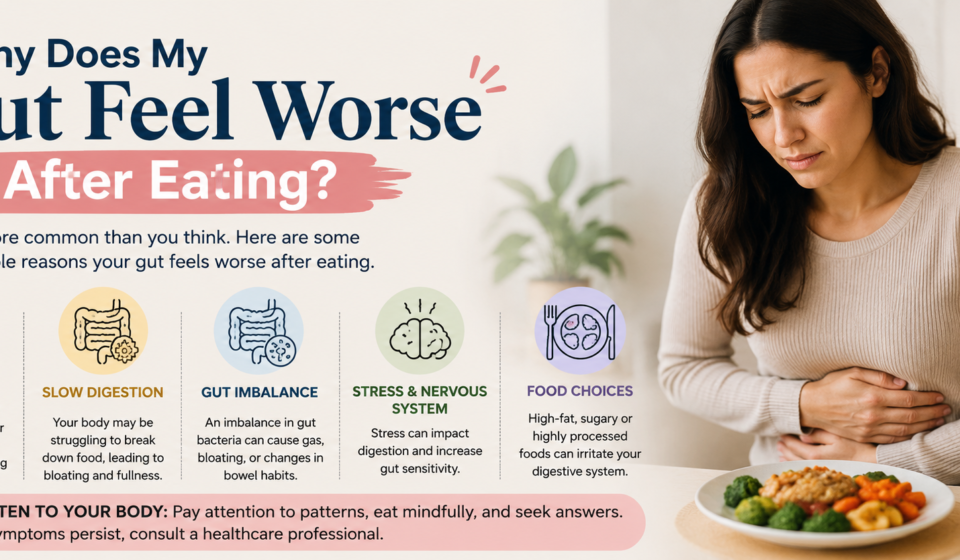
Why Does My Gut Feel Worse After Eating? 7 Hidden Triggers Explained
You sit down, eat a completely normal meal, and within twenty minutes your stomach feels tight, bloated, or just… off. No spicy food, no obvious culprit, nothing that should be causing a reaction. And yet here you are, loosening your waistband and wondering what just happened.
If this sounds familiar, you’re far from alone. Post-meal discomfort is one of the most common — and most under-discussed — health complaints people bring up in casual conversation but rarely mention to a doctor, mostly because it doesn’t feel “serious” enough. But the fact that it’s common doesn’t mean it’s normal, and it definitely doesn’t mean there’s nothing you can do about it.
Let’s walk through the real reasons your gut might be rebelling after meals, starting with the most overlooked ones.
1. You’re Eating Faster Than Your Body Can Keep Up With
This is the single most common cause of post-meal bloating, and it’s almost never the first thing people suspect. Your stomach doesn’t send a “full” signal to your brain instantly — it takes roughly 20 minutes for that message to fully register. If you’re finishing a meal in ten minutes flat, which is extremely common during a lunch break or a rushed dinner, you’re eating well past the point your body needed, and you’re also swallowing a lot more air in the process.
That swallowed air has to go somewhere, and it usually ends up as bloating or pressure in your upper abdomen within half an hour of finishing your plate. The fix here isn’t complicated, but it is genuinely hard to build as a habit: put your fork down between bites, chew more thoroughly than feels natural at first, and aim to stretch a meal to at least 15–20 minutes.
2. Low Stomach Acid — Not Too Much
Most people assume digestive discomfort means their stomach is producing too much acid. In reality, low stomach acid is just as common a culprit, and it tends to increase with age, chronic stress, and certain medications, including long-term use of acid reducers themselves — which is a bit of an ironic trap many people fall into.
When stomach acid is too low, food doesn’t break down properly before it moves into the small intestine. Protein in particular needs a strongly acidic environment to begin digesting. Without it, larger food particles move further down the digestive tract than they should, where they can ferment and cause bloating, discomfort, and even reflux — which feels like “too much acid” but is often the opposite problem in disguise.
3. FODMAP-Rich Foods Are Doing More Than You Think
FODMAPs are a group of fermentable carbohydrates found in foods like garlic, onions, wheat, apples, and certain legumes. You don’t need a diagnosed condition like IBS to react to them — sensitivity to FODMAPs exists on a spectrum, and plenty of people who’d never think to call themselves “sensitive” to anything still get noticeably bloated after a garlic-heavy pasta dish or an onion-loaded stir fry.
These carbohydrates aren’t fully absorbed in the small intestine. Instead, they travel to the large intestine, where gut bacteria ferment them, producing gas as a byproduct. If you notice a pattern where certain vegetables or grains reliably leave you uncomfortable, this is worth paying attention to — not because you need to eliminate them forever, but because understanding your personal threshold can save you a lot of guesswork.
4. How You’re Combining Foods Matters More Than You’d Expect
A plate loaded with a large portion of protein and a heavy dose of fat — think a big steak dinner with a rich sauce — takes considerably longer to move through your stomach than a lighter, more balanced meal. This isn’t inherently bad, but it does mean that heavy meal combinations will predictably leave you feeling weighed down for longer, sometimes for several hours.
This is especially noticeable at dinner, when a rich, protein-and-fat-heavy meal right before sitting or lying down gives your digestive system less help from gravity and movement, both of which normally support the process.
5. Your Nervous System Is Working Against You
Digestion is far more tied to your nervous system than most people realize. Your body has two broad operating modes: “fight or flight” and “rest and digest.” Digestion functions best in the second mode — when you’re relaxed, unhurried, and not mentally elsewhere.
Eating while scrolling through emails, rushing between meetings, or feeling anxious about something entirely unrelated to food pulls your body toward the “fight or flight” state, even subtly. Blood flow shifts away from the digestive tract, digestive enzyme production slows, and the whole process becomes less efficient — which often shows up as bloating, discomfort, or a heavy feeling after a meal that, on paper, should have been easy to digest.
6. You Might Be Quietly Dehydrated
Water plays a much bigger role in digestion than most people give it credit for. It helps break down food, keeps things moving through your intestines, and supports the mucosal lining of your digestive tract. When you’re mildly dehydrated — which is more common than people think, especially if you don’t drink much water with meals — digestion slows down and becomes less comfortable.
Interestingly, drinking a large amount of water right before or during a meal can also cause discomfort, since it dilutes stomach acid and adds volume on top of your food. The better approach is steady hydration throughout the day, rather than trying to catch up all at once around mealtimes.
7. An Undiagnosed Food Sensitivity
Unlike a true allergy, which triggers an immediate and often severe reaction, a food sensitivity tends to cause a delayed, low-grade response that’s much harder to pin down. Dairy, gluten, and certain food additives are common triggers. The discomfort might not show up until an hour or more after eating, which makes it easy to blame the wrong meal or dismiss the pattern entirely.
If you’ve noticed recurring discomfort after specific foods — even ones you enjoy and don’t want to give up — it’s worth tracking more deliberately rather than guessing.
What Actually Helps
The single most useful thing you can do is keep a simple, honest log for about two weeks: what you ate, roughly how fast you ate it, your stress level at the time, and how you felt over the following few hours. Patterns tend to jump out faster than people expect once it’s written down instead of just remembered.
From there:
- Slow down. This alone resolves a surprising percentage of everyday bloating.
- Separate your biggest meals from your most stressful hours of the day when possible.
- Hydrate consistently rather than in large bursts around meals.
- If you suspect a specific food group, remove it deliberately for two to three weeks and reintroduce it slowly, rather than cutting multiple things at once and losing track of what actually caused the improvement.
When to See a Doctor
Occasional bloating or discomfort is common and usually manageable with the changes above. But if you’re experiencing severe pain, unexplained weight loss, blood in your stool, or symptoms that are getting worse rather than better over time, those are signs to see a doctor rather than continue troubleshooting on your own. Chronic digestive discomfort is common, but “common” doesn’t mean it should be permanent — and a doctor can rule out conditions that need more targeted treatment than diet and habit changes alone.
Your gut is one of the most communicative systems in your body. It’s just often speaking in a language — bloating, heaviness, discomfort — that’s easy to tune out until you actually start listening.