
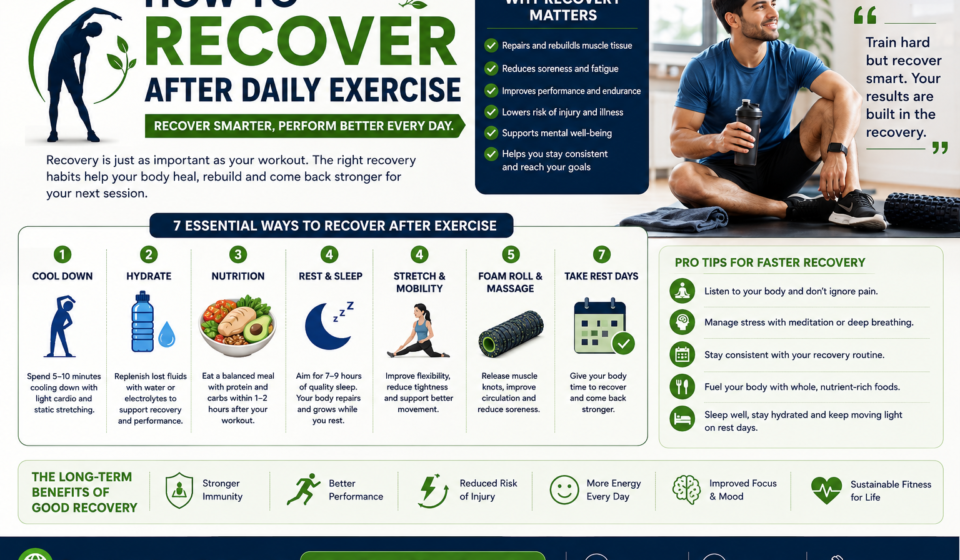
Okay, so a couple of years back, I was training six days a week, sometimes seven if I’m being honest, and I genuinely thought rest days were for people who weren’t trying hard enough. Then one morning, I went to wash my hair and physically could not lift my arm above my shoulder. Had to sit on the edge of the tub for a minute like an idiot, laughing at myself because what else do you do? That was the wake-up call. Recovery stopped being optional after that.
If you’re exercising daily and your body feels like it’s constantly one step behind, this is basically everything I wish someone had told me back then about how to recover after daily exercise. Not fluff, not the usual “drink water” nonsense repeated five different ways. Just what actually works when you’re training every day and need your body to keep cooperating.
The Workout Isn’t Actually Where You Get Stronger
Took me embarrassingly long to figure this one out. Exercise itself doesn’t build anything — it tears stuff down. Tiny fiber damage in your muscles, drained energy stores, a nervous system running on fumes. The improvement part, the getting-stronger part, happens later. While you’re asleep. While you’re eating a late dinner and not thinking about fitness at all.
For a long stretch I trained hard, ate whatever was around, slept maybe five hours, and did it again the next day. And weirdly it “worked” for a while, in that I didn’t collapse immediately. But that math doesn’t hold forever. It caught up with me, like it usually does with everyone eventually.
Sleep Does More Than You’d Guess
I don’t have some secret sleep trick to hand you, sorry. What I’ve got is a pretty unglamorous fact: skip enough sleep and none of your other recovery efforts pull their weight the way they should.
Most of your growth hormone release happens during deep sleep, and that’s when the actual muscle repair kicks in, when your body clears out whatever junk built up from training. Cut that short and you’re basically telling your body never mind, skip the repairs.
Somewhere around seven to nine hours works for most people. Train daily and you probably want to sit at the higher end of that, maybe past it honestly. I know that’s a hard ask with work and kids and errands eating up your evening. But even losing sixty minutes of sleep a night, night after night, starts showing up fast — reflexes get slower, lifts feel heavier than they should, that dragging feeling where three coffees don’t even touch it anymore.
Couple things that genuinely helped me here. Stopping hard training at least two or three hours before bed so my heart rate has time to settle back down. Keeping my room actually cold, not “kind of cool,” properly cold. And leaving my phone charging in the kitchen instead of next to the bed, because otherwise it’s midnight and I’m three videos deep telling myself I’ll sleep after this one.
What You Eat After Training Isn’t a Small Detail
For years I’d train hard and then eat whatever was fastest afterward, then wonder why I felt beat up the next morning. That window between finishing a workout and actually feeding yourself properly matters more than people give it credit for.
Protein first, always. Your muscles need amino acids to rebuild what just got broken down, and there’s no getting around that. Doesn’t need to be complicated — eggs, chicken, protein powder mixed into some milk, a tub of yogurt, whatever you’ll actually eat without dreading it. The best recovery meal isn’t some perfect macro-balanced plate you make once and never again. It’s the boring one you’ll eat every day without fail.
Carbs get unfairly trashed in a lot of fitness talk. Train daily and your glycogen stores — think of it as the fuel tank inside your muscles — get drained fast, and if you don’t top that back up, the next day’s session starts from a hole. You’ll feel flat and weak and you’ll probably blame it on motivation when really it’s just an empty tank.
And water. I know, boring, everyone skips past this part. But even being a little dehydrated makes soreness feel worse, stiffens your joints up, and slows down basically everything your body’s trying to repair. I don’t measure ounces or anything like that. I just keep a bottle nearby and drink out of habit more than discipline.
Rest Days Don’t Have to Mean the Couch
This surprised me when I first heard it. If you’re training daily, total rest isn’t always your best move. Sometimes it is, sure, especially when you’re genuinely wrecked. But most days, moving a little beats sitting completely still.
Active recovery just means low intensity movement on your easier days. A slow walk somewhere. An easy bike ride. Some gentle mobility work that barely resembles a workout at all. The point is keeping blood flowing through the muscles so it can clear out the stuff that causes soreness, without loading more stress onto a body that’s already carrying plenty.
Mine’s stupidly simple. Twenty minute walk, no headphones, no podcast, nothing. Just walking. Sounds too basic to matter but I notice a real difference the next morning between a walk day and a full couch day.
Stretching and Foam Rolling — Worth It or Not?
Gonna be straight with you instead of giving the tidy fitness-blog answer. The evidence that stretching speeds up muscle repair is honestly kind of weak. Probably doesn’t do as much as people claim. What it does seem to help with is mobility, and just generally feeling less like a rusted door hinge in the morning.
Foam rolling gets the same treatment from me. The whole “breaking up knots” thing isn’t as backed by science as fitness accounts online make it sound. But if it feels good and doesn’t hurt anything, why not keep doing it. I roll out my quads and calves most nights, not because a study told me to, just because I sleep better after.
If you want somewhere to start — a few minutes stretching whatever took the biggest hit that day, some rolling on the usual tight spots, nothing forced. If it feels like punishment you’re doing it wrong.
Soreness Is Normal, Pain Is Something Else Entirely
There’s a difference between the achy “yep, definitely worked out yesterday” feeling and your body waving an actual warning flag. First one’s got a name — delayed onset muscle soreness, DOMS — and it usually peaks a day or two after training then fades by itself. That’s normal. Kind of satisfying even, in a weird way.
Sharp pain, swelling that won’t quit, soreness sticking around a week or longer — that’s a different animal, and treating it like regular soreness is exactly how people end up hurt. I ignored a nagging ache in my knee once, told myself it was nothing, just soreness. Wasn’t. Turned into a real injury that had me sidelined over a month. So now I actually pay attention when something feels off instead of pushing through out of stubbornness.
Your Head Needs Recovery Too, Not Just Your Legs
This one caught me off guard when I first learned it. Recovery isn’t only physical. Your nervous system needs a break as much as your muscles do. Chronic stress keeps cortisol elevated, and elevated cortisol quietly gets in the way of the same repair processes sleep and food are trying to run.
So if you’re training hard daily on top of a stressful job or a schedule that never lets up, your body’s fighting a war on two fronts, and eventually something gives.
Nothing dramatic helped me here. Sitting quietly for a few minutes before bed instead of grabbing my phone immediately. Actually stepping away for lunch instead of eating over the keyboard mid-email. Being honest with myself about when a session needs to be dialed back because life already asked enough of me that day.
Building a Routine You’ll Actually Keep Doing
Knowing how to recover after daily exercise in theory is easy. Doing it on some random Thursday when you’re tired and don’t feel like it is the actual hard part. Here’s roughly what mine looks like, imperfect but realistic enough that I stick with it.
Right after training I focus on drinking water and getting protein in, plus a light cool-down if I’ve got the energy left for it. That evening, a proper meal, phone away from the bed, trying to sleep around the same time as always. Next morning I check in honestly with how my body feels before deciding if it’s a push day or a lighter one. And somewhere across the week, even with daily training, at least one day stays genuinely easy on purpose.
None of it’s complicated. The hard part was never knowing what to do. It’s actually doing it on the days you don’t want to.
Where This Leaves Us
Recovering after daily exercise was never about the right supplement stack or copying some athlete’s routine off social media. Mostly it’s boring stuff repeated over and over — enough sleep, enough food, enough water, and actually listening when your body says something’s off instead of pushing through out of pride.
I spent way too long treating recovery like an afterthought and paid for it with burnout and an injury that never needed to happen. Once I started taking it as seriously as the training itself, everything shifted — energy, performance, even how I felt day to day outside the gym.
Train hard if that’s your thing. Just put the same effort into the recovery side, because honestly, that’s the part that makes the training actually count for something.

-
-
-
-
-
-
Show Comments[…] big chunk of bloating comes down to bacteria imbalance in your gut — happens easily on days full of processed food or […]
[…] idea to ginger but peppermint’s real strength is headaches, and travel headaches are extremely common thanks to dehydration and […]
[…] up during the day and consolidates what you learned. Skimp on that process and the next day’s attention span pays for it directly — not in some abstract long-term way, but immediately, like trying to run a […]
[…] ten people to name an important vitamin, and you’ll get vitamin C, maybe D, maybe B12 if they’re paying attention. Vitamin K seldom comes up. And yet it’s doing […]
[…] bounds, jumping sideways one leg to the other, landing soft, holding a beat before jumping back. Mimics the sharp direction […]
[…] water on very long sessions with zero electrolytes, which is exactly how hyponatremia happens. Underestimating humidity too, when sweat can’t evaporate well your body works overtime to cool down even if you […]