
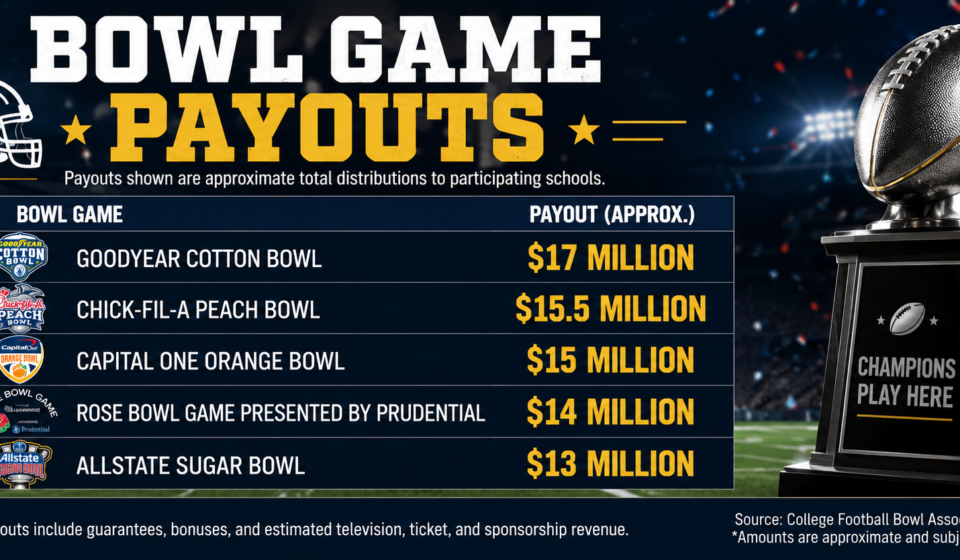

Every year around late December, my group chat fills up with the same question: “Wait, why is this random team playing in a bowl nobody’s heard of?” And every year, the answer comes back to the same thing — money. Bowl game payouts are the reason the whole postseason calendar looks the way it does, and once you actually dig into the numbers, a lot of confusing decisions start making sense.
So let’s just get into it. No filler, no rambling intro about “the magic of college football.” Just the actual breakdown of where bowl money comes from, who collects it, and why the size of the check changes so much from game to game.
What a Bowl Payout Actually Is
A bowl payout is the money a bowl game pays out to the conferences whose teams show up to play. Not the schools directly — the conferences. That’s a detail people miss constantly.
That money is supposed to cover basics like travel, hotels, and the team’s ticket allotment. In the smaller bowls, it barely covers that. In the bigger ones, it covers that and then some — by a lot.
Why Some Bowls Pay Millions and Others Pay Almost Nothing
This is where the gap gets wild. A small regional bowl game might be working with a total payout pool of $500,000 to $1 million, split between both teams. Meanwhile, a College Football Playoff game can pay out tens of millions to a single conference for one appearance.
It’s not really about prestige in some abstract sense — it’s about the TV contract attached to the game. Bigger TV deal, bigger ad revenue, bigger payout. Smaller bowl, smaller audience, smaller check. That’s basically the whole formula.
The College Football Playoff Bowls Sit at the Top
The Playoff bowls — Rose, Sugar, Orange, Cotton, Peach, Fiesta — are the heavyweight champs of bowl payouts. When one of these games is hosting a Playoff semifinal or quarterfinal, the payout to the participating conference can land anywhere from $20 million up to $40 million or more, depending on the round and that year’s broadcast revenue.
None of that goes straight into a player’s bank account, to be clear.
New Year’s Six Bowls Without a Playoff Game
Not Playoff money, but still a big deal for a conference’s bottom line.
The Middle of the Pack
Then you’ve got the mid-tier bowls — Citrus, Alamo, Music City, that whole group. These typically pay out $2 million to $4 million per team. Respectable money, decent TV slots, but nowhere near Playoff territory.
The Smaller Bowls Nobody Takes Seriously (Until They’re Invited)
And then there’s the bottom tier — the bowls with sponsor names that make people laugh, like the Potato Bowl or the Mayo Bowl. These games often total somewhere between $500,000 and $1.5 million combined. Sometimes a school barely breaks even once travel costs and mandatory ticket purchases are factored in.
Yeah — mandatory ticket purchases. A lot of smaller bowls require the participating schools to buy a set number of tickets upfront, whether fans actually show up to buy them or not. If a team’s fanbase isn’t local and ticket sales fall flat, the school can genuinely lose money going to a bowl game. It happens more than people realize.
So Why Do Schools Even Bother With the Smaller Bowls?
Because it’s not only about the payout. National TV exposure helps recruiting. A bowl trip rewards players for a winning season and keeps morale and retention strong. Alumni get excited, donations tend to pick up, and a program stays in the conversation instead of disappearing the second the regular season ends.
The check matters, sure. But sometimes the exposure matters more than the check itself.
Where the Payout Money Actually Goes
Here’s the part that throws people off the most — when a bowl pays out, that money usually goes to the conference office first, not directly to the school that played. Conferences then divide it up based on their own internal revenue-sharing rules.
How the Expanded Playoff Changed Bowl Payouts
The expanded College Football Playoff bumped up the size and complexity of bowl payouts across the board. More playoff rounds mean more games, more broadcast windows, and more ad revenue flowing through the system.
At the same time, that growth puts pressure on the bowls outside the Playoff structure. Attention — and ad dollars — keep drifting toward Playoff games, which raises a fair question about whether traditional, non-Playoff bowls will keep shrinking in relevance and payout size as the Playoff format keeps expanding.
Sponsorships Are the Backbone of Smaller Bowl Payouts
Without corporate sponsors, a huge chunk of these smaller bowl games wouldn’t exist at all. That sponsorship money is often what makes the difference between a bowl being financially viable or getting canceled outright. The sponsor gets their name in front of a national TV audience, and the bowl gets the funding it needs to actually pay out teams and cover operating costs.
This is also exactly why a bowl can vanish overnight — if a sponsor pulls funding and nobody steps up to replace it, the game just stops happening.
The Athlete Pay Question
The counterargument is usually that scholarships, NIL deals, and other benefits already provide value, and that bowl payout money keeps entire athletic departments running, including sports that don’t make money on their own. That debate isn’t settled, and it’s probably going to keep evolving as college athletics keeps changing.
Why Any of This Matters If You’re Just Watching at Home
Knowing how bowl game payouts work changes how you watch the whole postseason. It explains why a team treats a smaller bowl trip like a reward while critics call for scrapping the whole bowl system in favor of an all-Playoff format.
It also explains why more players are sitting out smaller bowl games to protect themselves for the NFL Draft — those games carry real money for the schools and conferences, but comparatively little direct stake for the players themselves.
Final Word
There’s TV money, conference revenue-sharing, sponsorship deals, and a payout structure that puts massive money behind Playoff games while leaving a lot of smaller bowls running on thin margins. Next time you’re watching a bowl game — Playoff semifinal or some sponsor-named matchup you’d never heard of before — you’ll know there’s a lot more riding on it than just the score.




[…] survivor pool is the leanest version. Pick one team to win each week. Lose, and you’re out for good. It runs […]
[…] felt a bit ridiculous doing this on my porch the first few mornings. My neighbor across the street probably still thinks it’s an odd little ritual I’ve got […]
[…] one caught me off guard when I first learned it. Recovery isn’t only physical. Your nervous system needs a break as much as your muscles do. Chronic stress keeps cortisol […]
[…] them out. A barbell squat spreads that load across both legs and kind of hides which side is weaker. Bodyweight training doesn’t let you […]