
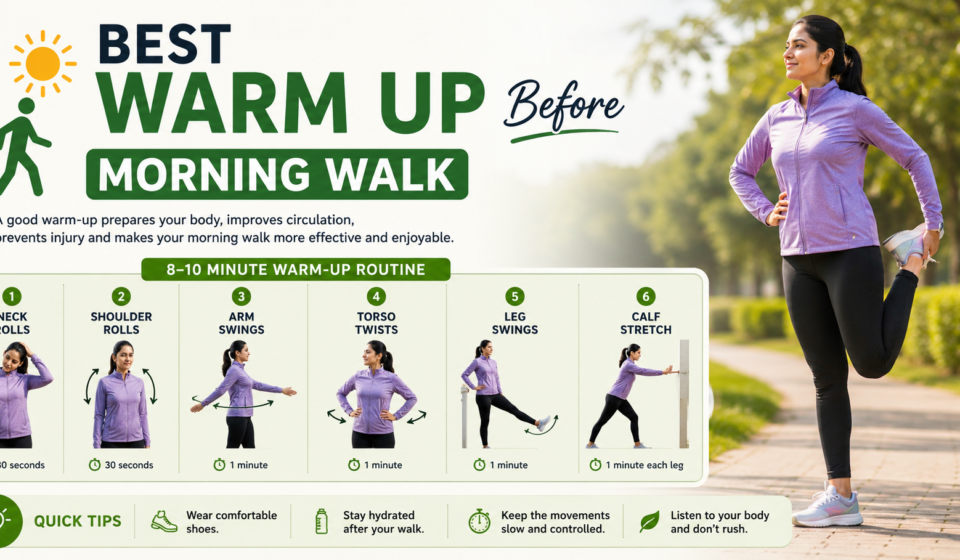
I skipped warming up for years. Didn’t see the point. Then my knee locked up mid-walk one cold morning and I ended up sitting on a stranger’s garden wall for five minutes just trying to breathe through it. That was the morning I finally started paying attention to the best warm up before morning walk, instead of brushing it off as an extra step nobody actually has time for.
Turns out it takes less time than the kettle needs to boil. Seven minutes, maybe ten on a stiffer day. And it’s the difference between walking well from the very first step and limping through the first mile wondering why your legs feel like someone else’s.
I’ve talked to a few other regular walkers about this over time, at the park, in line at the corner shop, wherever the topic comes up. Most of them either skip warming up entirely or do something vague and half-hearted, a couple of stretches while still holding their coffee. Almost none of them have an actual routine. And almost all of them, when pressed, admit to some recurring ache that shows up early in their walk and never fully goes away until they’re halfway done. That’s not a coincidence.
Why Warming Up Before a Morning Walk Matters
Think about what your body’s just been through. Seven, eight hours lying flat, not moving. Muscles shorten a little overnight. Joints stiffen. Blood isn’t circulating the way it does once you’re upright and moving around. So when you step straight out the door into a brisk pace, you’re asking cold, half-asleep muscles to behave like they’ve already been working for twenty minutes. They haven’t. Not even close.
That gap — between what your body’s ready for and what you’re asking of it — is where most morning walk niggles show up. The tight calf. The sore knee. That lower back twinge that creeps in around the ten-minute mark, right when you’re finally getting into a rhythm. A short warm up closes that gap before it turns into something that actually stops you.
There’s the heart, too. It’s been resting all night at its lowest point of the whole day. Ask it to jump straight into a brisk pace and it has to climb several gears at once, no warning. A proper warm up lets that happen gradually instead. I noticed this myself, once I actually paid attention to it — on mornings I warmed up first, my breathing stayed even from the first block. On mornings I skipped it, I’d be slightly out of breath way earlier than made sense, even walking the exact same pace.
This isn’t about being overly cautious. It’s just giving your legs, and your heart, a fair head start before you ask them to carry you a mile or two.
Marching in Place
Stand where you are. Lift your knees, one after the other, like marching without going anywhere. Swing your arms while you’re at it — nothing stiff, nothing forced, just natural movement. A minute or two is enough to send blood into your legs without jolting your whole system awake too fast.
I do this right by my kitchen counter, usually while the kettle’s still going. Sounds too simple to matter. I thought so too, at first. Skip it though, and you’ll feel it in your first few hundred steps outside — your legs just don’t respond the same way when nobody’s warned them first.
Ankle and Calf Movement
Ankles take a beating on uneven ground. Cracked pavement, gravel, whatever your street decides to throw at you that day. So give them a minute before you trust them with all that.
Rise onto your toes, lower back down. Maybe fifteen times. Then roll each ankle slowly, both directions, one foot and then the other. I started doing this after twisting my ankle on a bit of sidewalk I’d walked past a hundred times without a second thought. Cold ankles just don’t move the way you expect them to — and uneven ground doesn’t wait around for your body to catch up. This one habit alone has kept me from rolling an ankle since. Takes barely a minute. If your street has any dips, loose gravel, or a broken curb here and there, that minute matters even more, because your ankle needs to adjust to the ground faster than a cold, half-asleep joint really can.
Hip Circles
Hands on your hips, slow circles, like a hula hoop. Thirty seconds one way, thirty the other. Your hips do more work in a walking stride than people give them credit for, and first thing in the morning, they’re stiffer than most of us realize until we actually try to move them.
I used to carry a dull ache in my lower back for the first ten minutes of nearly every walk. Every single one. Then I added this step, and now that ache barely shows up — and when it does, it fades fast instead of hanging around the whole way through. Small movement. Almost too small to count as exercise. But that’s exactly why it fits so easily into a routine you’re doing half awake.
Leg Swings
Grab a fence, a wall, the back of a chair — anything for balance. Swing one leg forward and back, controlled, about ten times. Switch legs. This loosens the hamstrings and hip flexors, the exact spots that feel tightest right after you crawl out of bed.
I felt a bit ridiculous doing this on my porch the first few mornings. My neighbor across the street probably still thinks it’s an odd little ritual I’ve got going. Doesn’t matter. It works, and honestly, that’s really all that counts at six in the morning when nobody else is even awake to judge. Ten swings a side is plenty — you’re not stretching further each time, just reminding those muscles they’re about to get used.
Gentle Forward Bend
Knees soft, slight bend, let your upper body fold forward from the hips. Don’t reach for your toes. Don’t force it. Just hang there, arms loose, for twenty or thirty seconds, and let gravity do the actual work.
This one opens up the lower back and the backs of your legs before you ask them to carry you down the road. When you’re done, come back up slowly — snapping upright too fast can leave you a bit lightheaded, especially before breakfast.
Shoulder and Arm Movement
People forget walking uses your arms too. Balance, rhythm, all of it. Roll your shoulders back a few times, then forward. Swing your arms across your chest and overhead for about a minute, loose rather than stiff.
I ignored this for the longest time. So focused on my legs I forgot the rest of me was involved at all — until I noticed my shoulders felt tight and hunched by the halfway point of nearly every walk. That tightness disappeared almost completely once this became part of the warm up instead of something I only stretched out afterward, if I remembered to at all.
Deep Breaths Before You Start
Stand still a moment. Breathe in slow through your nose, five or six times, each exhale a touch longer than the inhale. Not a stretch, technically. Doesn’t matter. It belongs here just as much as the rest.
It pulls you out of that groggy half-asleep fog that lingers even after you’re technically awake, and gets your mind as ready as your body already is. I close my eyes for this part, usually right at the front door before stepping out. Under a minute. Changes how alert I feel for the whole walk, not just the first few steps out the gate. There’s a real difference between stepping outside still half in a fog and stepping outside actually present in your body — this small pause is usually what makes that shift happen.
Starting the Walk Slow
Don’t launch into your usual pace the second your foot hits the pavement. Walk slow for the first three to five minutes. Let your speed build up on its own from there.
This last piece is really the warm up finishing itself while the walk’s already underway. I used to rush through this bit, eager to hit my normal stride because slowing down felt like wasting time. Ended up feeling stiff and out of rhythm until nearly the halfway point most days. Slowing down on purpose at the start gets me moving well far sooner than rushing ever did.
How Long This Whole Routine Takes
Start to finish, somewhere between seven and ten minutes. That’s the marching, the ankle work, the hip circles, the leg swings, the forward bend, the shoulder movement, the breathing — plus those first slow minutes of the walk itself once you’re actually out the door.
Not a huge commitment. Once it’s part of your morning, you stop thinking of it as a separate task at all. It just becomes the start of the walk, not something bolted on before it. I’ve been doing this same routine a while now — it’s about as automatic as tying my shoelaces at this point. Some mornings I’m through it in under seven minutes without watching the clock. Other mornings, when my body feels stiffer than usual, it stretches closer to ten. Either way works.
If you only take one thing from all this, let it be the order — legs first, hips next, a gentle bend, then your upper body, then your breath, and only then your first slow steps outside. Follow that order and the rest tends to take care of itself. It’s not a complicated system, and it was never meant to be one. It’s just seven small things, done in the right order, before you go do the bigger thing you actually got up for.


[…] don’t have some secret sleep trick to hand you, sorry. What I’ve got is a pretty unglamorous fact: skip enough sleep and none of your other recovery efforts pull their weight the way they […]
[…] works as a natural diuretic — pushes your body toward releasing water instead of holding onto it. It’s also got prebiotic fiber, which feeds the good […]