
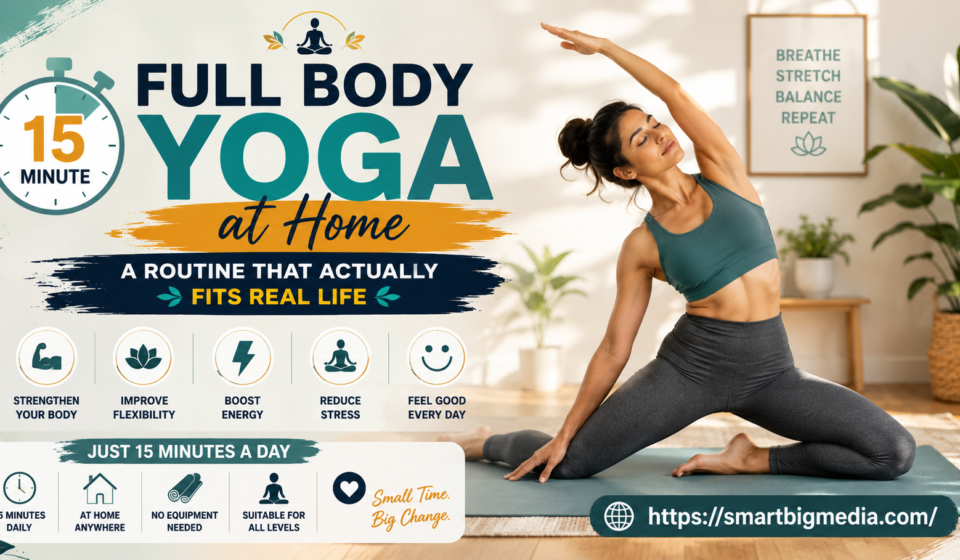

No time. That was the excuse, every time, for years honestly. Ninety minute classes sounded lovely in theory, sure, but who’s got an hour and a half floating around most mornings. Then a friend mentioned fifteen minutes, just fifteen, before her kids woke up, and I remember thinking that sounded almost too small to bother with. Tried it anyway. Mostly out of curiosity, not real commitment.
Fifteen minutes, done every day, ends up beating ninety minutes done occasionally by a wide margin. Wasn’t expecting that honestly. This is a 15 minute full body yoga at home routine built around actual mornings, not some idealized schedule nobody actually lives.
Why Fifteen Minutes Actually Works
People assume short means weak. Mostly wrong assumption. Fifteen focused minutes hits your major muscle groups, opens hips and shoulders, gets your heart rate up a bit, leaves you noticeably more awake than you were a quarter hour earlier. That’s not nothing. Compressed version of most of what a longer session does anyway.
Real advantage isn’t the physical output though, not really — it’s that you’ll actually do it. Ninety minutes gets skipped constantly, there’s always a reason today isn’t the day. Fifteen minutes rarely gets skipped for the same reasons. Just fits.
What’s Actually In This Routine
Efficient movement, no long-winded pose explanations, no endless holding through transitions. Covers spine, hips, shoulders, hamstrings, core — moving through each without lingering too long anywhere specific.
Mat helps, not required strictly. No blocks or straps needed, a towel substitutes fine if something calls for one.
Warm-Up (2 Minutes)
Cat-Cow
Hands and knees, wrists under shoulders, knees under hips. Inhale, drop belly, lift chest — cow. Exhale, round the spine, chin tucks — cat. Slow, synced with breath. Six, eight rounds.
Child’s Pose
Hips back toward heels, arms forward or resting alongside you, whichever feels right today. Breathe here thirty seconds. Not wasted time — settling the nervous system before actually moving harder.
Standing Sequence (5 Minutes)
Mountain to Forward Fold
Stand tall, feet hip-width, arms at sides. Inhale, reach overhead. Exhale, fold from the hips, knees soft. Let the head hang. Three breaths, roll back up slow, one vertebra at a time.
Downward Dog
Step back from the fold, hips high, hands and feet pressing down, upside-down V shape roughly. Pedal your feet, loosen the calves. Five breaths.
Low Lunge
Right foot steps forward between your hands, back knee lowers. Torso lifts, arms reaching up if comfortable. Opens the back hip flexor — usually tight from sitting all day, let’s be honest. Three breaths, switch.
Warrior II
From the lunge, straighten the back leg, open hips sideways, arms extended parallel to the floor, front knee over the ankle. Builds leg strength and opens the hip simultaneously. Three breaths, switch.
Core and Balance (3 Minutes)
Plank Pose
Solid plank, shoulders over wrists, straight line head to heels, twenty to thirty seconds. Don’t sag the hips or pike up. Short but effective, especially breathing steady through it instead of holding your breath the whole time like most people instinctively do.
Tree Pose
Weight shifts to the left foot, right foot against the inner calf or thigh, never the knee joint directly. Hands at chest or overhead. Fifteen, twenty seconds, switch. Matters more than people think and gets skipped constantly since it feels less like “real exercise” somehow.
Boat Pose
Sitting, lean back slightly, feet lift off the floor, shins parallel or legs extended if your core allows. Arms reach forward. Fifteen, twenty seconds. Real core work, no crunches needed at all.
Cool Down (5 Minutes)
Seated Forward Fold
Legs extended forward, fold from the hips, reaching toward feet or shins, wherever you land without straining. Full minute. This is where the day’s tension in hamstrings and lower back actually starts letting go.
Supine Twist
On your back, knees bent, drop both knees right, gaze turns left, arms out in a T. Thirty seconds, switch. Gentle spinal twist, genuinely relaxing after standing work.
Legs Up the Wall
Wall space nearby, hips scoot close, legs extend straight up it, lying flat. Minute or two. Almost universally called the best part of any short routine and it costs you literally nothing but a wall.
Final Savasana
Flat on your back, arms at sides, palms up, eyes closed. Just breathe the last minute or so. Tempting to skip this and jump into your day — don’t. It’s where the nervous system actually integrates what you just did.
Making It an Actual Habit
Hardest part isn’t the routine, it’s doing it consistently, obviously. Same time daily helps, right after waking works for a lot of people since the day hasn’t had a chance to get in the way yet. Keep the mat visible, not shoved in a closet you’ll forget exists. And don’t skip because you’re tired — tired fifteen minutes still beats zero minutes, every single time.
Modifying for Where You’re At
Some poses feel like too much on day one, completely normal, expected even. Low lunge, support the back knee with a folded blanket if the floor’s uncomfortable. Tree pose, start with the foot against your ankle instead of higher, build gradually rather than forcing it. Plank from the knees instead of toes until core strength catches up.
Modifying isn’t cheating. Just meeting your body where it’s actually at today, not where you wish it was.
Why Mornings Tend to Work Best
Can do this any time honestly, evening works too, especially if work tension builds up in your body by dinnertime. But mornings have an edge worth mentioning — doing it before your brain fully wakes up and starts generating excuses means it actually happens. By evening, willpower’s usually already spent on everything else the day threw at you.
What Fifteen Minutes Daily Actually Adds Up To
A week, under two hours total, less than one long class. A month, roughly seven hours. Doesn’t sound dramatic written out like that and that’s honestly fine — the value’s not really in any single session. It’s the consistency, the daily signal that movement’s just part of how the day starts now, not some occasional event you plan around and dread.
People sticking with fifteen-minute daily routines for a few months consistently report less stiffness, better balance, better posture, without ever carving out a huge chunk of schedule for it.
Questions People Ask
Is fifteen minutes actually enough? Yes, particularly for flexibility, balance, general mobility. Strength gains happen slower with bodyweight yoga alone, sure, but for most people’s actual goals, fifteen consistent minutes daily beats occasional longer sessions by a lot.
Do I need experience first? No. Every pose here has a modification, going slow matters more than perfect form on day one. Improvement comes naturally with repetition.
What if I miss a day? Pick it back up tomorrow. One missed day doesn’t undo anything. Missing weeks in a row is what actually matters, don’t let one skipped morning spiral into quitting entirely.
Bottom Line
You don’t need ninety minutes, a studio membership, or a perfectly silent house to get real benefit here. Fifteen minutes, at home, consistently, covers your whole body and fits into mornings that already feel too full as it is. Start tomorrow. Just fifteen minutes. That’s genuinely the entire ask.


[…] off a curb wrong. Nothing dramatic, small stumble really, but it rattled me more than it should have. Forties by then, and it was the […]
[…] not exactly a secret. A shelf of neatly lined bottles. A pill organizer in soft colors. A “get ready with me” that includes popping a capsule between the serum and the […]