
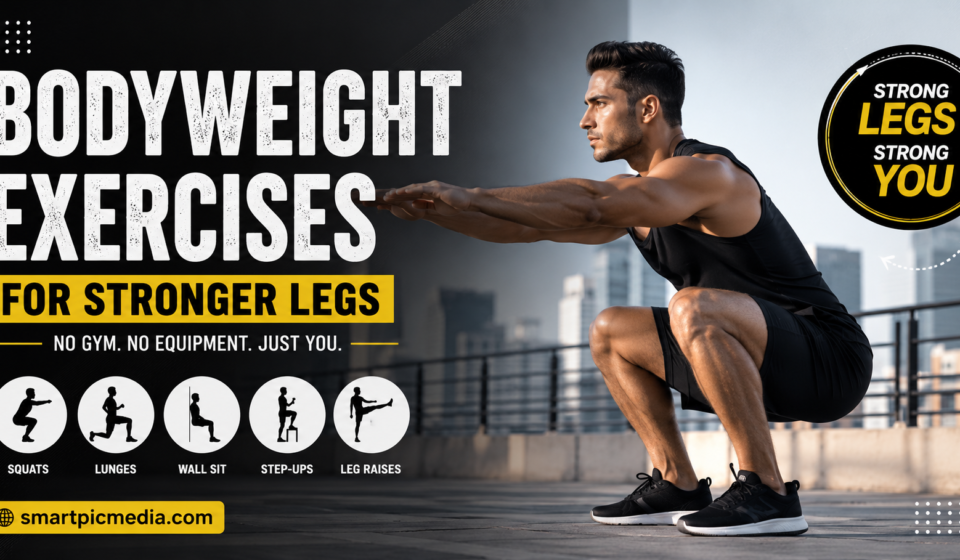
Okay so a few years back my gym shut down for renovations. Two whole months, no warning really, just a sign on the door one Monday morning. I was annoyed. Legs day was the next day and I’d been building up to a decent squat number and now what, I just stop training? No. I ended up doing leg work on my apartment floor with a kitchen chair as my only piece of equipment, and by week three my quads were more sore than they’d been in months at the gym. That threw me off honestly. I’d always assumed bodyweight work was the thing you did when you couldn’t do “real” training.
Turns out that’s not really true. Bodyweight exercises for stronger legs can absolutely build real strength, if you actually do them right and stop treating them like a warm-up.
Why This Stuff Actually Works
Strength is force production. That’s it, that’s the whole definition really. It’s not about how heavy the bar is, it’s about how much force your muscle fibers can generate against resistance, and your own bodyweight provides plenty of resistance for most people, especially anyone who isn’t already deep into advanced lifting.
Try a single-leg squat sometime if you haven’t. Right now, actually, stand up and try one. Hard, right? And it’s not just your quads screaming at you. Your ankle’s working overtime, your hip is fighting to keep you level, all these tiny stabilizer muscles are suddenly doing real work because there’s no second leg there to bail them out. A barbell squat spreads that load across both legs and kind of hides which side is weaker. Bodyweight training doesn’t let you hide.
There’s a joint-friendliness angle too that I think gets underrated. You’re the one controlling the resistance here. Knee feels a little off today? Don’t go as deep. Nobody’s forcing you under a bar loaded to a number you committed to last week.
The Warm-Up Part (Don’t Skip This)
I’ll be honest, I used to skip warm-ups constantly. Paid for it more than once with a tweaked hip flexor that took weeks to fully calm down. Five to eight minutes now saves you that entire mess later.
Slow bodyweight squats, maybe fifteen reps. Leg swings, front to back and side to side, ten each leg. A handful of walking lunges. Ankle circles — actually do these, most people skip them and then wonder why their ankles feel stiff mid-workout. Glute bridges to finish, fifteen reps.
That’s really all it takes to get your hips and knees ready.
The Actual Exercises
Bodyweight Squats
Start here, obviously. Feet about shoulder width, chest up, hips sink back like you’re lowering into a low chair that isn’t quite there yet. Heels stay planted. Go as deep as your mobility lets you without your form falling apart.
If it feels too easy — and for a lot of people it does after a couple weeks — slow it way down. Three seconds down, brief pause at the bottom, one second up. Suddenly it’s not easy anymore.
Walking Lunges
This is where imbalances show up. Step forward, drop the back knee toward the ground, drive through the front heel to bring your legs back together. Keep your chest tall through the whole thing. Watch that front knee doesn’t drift inward, it’s a small detail but it matters over hundreds of reps across weeks and months.
Bulgarian Split Squats
I didn’t take these seriously for years and that was a mistake. Prop your back foot on a chair, step, whatever’s around and sturdy. Lower until your front thigh gets close to parallel with the floor. Your quads will absolutely let you know about this one the next morning. Single leg movement means there’s nowhere for a weaker side to hide.
Step-Ups
Any sturdy bench, box, staircase works. Step up, drive through your heel, bring the other leg to meet it, step back down. Sounds too simple. Do three sets of fifteen and get back to me.
Glute Bridges
Everyone thinks this is just a glute move and calls it a day, but your hamstrings and lower back are grinding through this too. Feet flat, knees bent, push hips toward the ceiling, squeeze hard at the top. For more, try it single leg — one leg extended straight out while the other does all the lifting.
Wall Sits
Simple. Miserable. Effective. Slide your back down a wall until your thighs sit parallel to the floor and just hold there. Twenty, thirty seconds to start if you’re new to this. Your legs will start shaking before you expect them to.
Jump Squats
Once regular squats stop being much of a challenge, add the jump. Squat down, explode up into a jump, land soft back into the squat position. This is more about power than raw strength, which matters if you play anything involving sprinting or quick direction changes.
Single-Leg Romanian Deadlifts
Stand on one leg, hinge forward at your hips, let the free leg extend behind you for balance, lower your torso toward the floor. Half balance drill, half hamstring exercise if I’m being honest about it.
Calf Raises
The one everybody forgets. Stand on a step edge, rise up onto your toes, then lower your heels below the step level for a full range stretch. Calves matter way more than people give them credit for, especially for ankle stability and any kind of sprinting.
Pistol Squats
The end goal for a lot of people. Single-leg squat, other leg extended forward. Genuinely difficult, most people can’t do one cold, and that’s completely fine. Use a doorframe or chair for support while you work toward it. This one takes actual time, don’t rush it.
Putting Together a Week
Three days a week, spaced out with rest between, works fine for most people who aren’t training for something specific.
Day one, strength focused: bodyweight squats three sets of fifteen to twenty, Bulgarian split squats three sets of ten per leg, glute bridges three sets of fifteen, calf raises three sets of twenty.
Day two, endurance: walking lunges three sets of twelve per leg, wall sits three sets held as long as possible, single-leg deadlifts three sets of ten per leg, step-ups three sets of twelve per leg.
Day three, power: jump squats four sets of ten, regular lunges three sets of twelve per leg, pistol squat progressions three sets of five to eight per leg, calf raises three sets of twenty.
Give yourself at least a day between sessions. Recovery is where the actual adaptation happens, not the workout itself.
Mistakes I Keep Seeing (And Made Plenty Myself)
Rushing through reps is probably the biggest one. Slow down on the way into the movement especially, that’s honestly where most of the real work happens and people just blow through it to get to more reps. Knees caving inward, small thing, adds up badly over time. And skipping single-leg work because it’s harder and more humbling than the two-leg version — don’t do that, that’s exactly the point of including it.
Getting Harder Without Weight
You can absolutely progress this stuff without ever touching a dumbbell. Slow the tempo. Add a pause where it’s hardest. Go deeper if your mobility allows. Move from two legs to one. Throw in a jump. More reps, less rest between sets. Write it down somewhere, a notes app, a notebook, whatever, so you can actually see the progress instead of guessing at it.
Don’t Skip Recovery
Muscles grow while you’re resting. Not during the set, not right after, during actual recovery time later. Sleep matters here more than most people want to admit. Give your legs two full days minimum before hitting them hard again, drink enough water, eat enough protein to actually rebuild what training tore down.
Quick Questions
Can bodyweight training really build muscle? Yes, particularly if you’re not already lifting heavy weights regularly. Slower tempos and single-leg work get you there.
How long until I see a difference? Strength shows up within a few weeks usually. Visible changes, the kind you notice in the mirror, tend to take two or three months depending on consistency and what you’re eating.
Do I actually need rest days? Yes. Two or three sessions a week with real rest between beats daily training that eventually burns you out or leads to an overuse injury.
Bottom Line
You don’t need a gym membership to build legs that actually work for you. Show up, focus on form before speed, keep finding small ways to make things harder as weeks go by. That’s really it. Your own bodyweight handles the rest.



[…] Resistance band work, pulling your toes toward your shin, pointing them away, moving your foot inward then outward against light resistance. Four directions, and they target exactly the muscles responsible for controlling the rolling motion behind most sprains. […]
[…] stroke is genuinely an emergency. Confusion, very high body temperature, skin either hot and dry or completely drenched, rapid […]
[…] cross-legged or in a chair, place one hand behind you for support, the other on your opposite knee, and gently twist your torso, letting your neck follow the […]