

Guy sitting next to me on a delayed flight once showed off a suitcase that could follow him around the airport on its own. Like a small motorized pet trailing behind him. Genuinely impressive to watch, not gonna lie. Also, turned out a bit later in the conversation, banned by most airlines because of the battery and motor packed inside, and he’d already had it confiscated once at check-in somewhere else on this same trip. That’s smart luggage in a nutshell honestly. Some of it’s genuinely useful. Some of it’s a cool party trick that airlines actively won’t let you use. Figuring out which is which before you spend the money matters more than most of these buying guides ever bother explaining.
Walking through what smart luggage tech actually includes right now. What’s worth paying for. What’s mostly marketing. And the airline rules that quietly make some of the flashiest features basically unusable.
What “Smart Luggage” Even Means
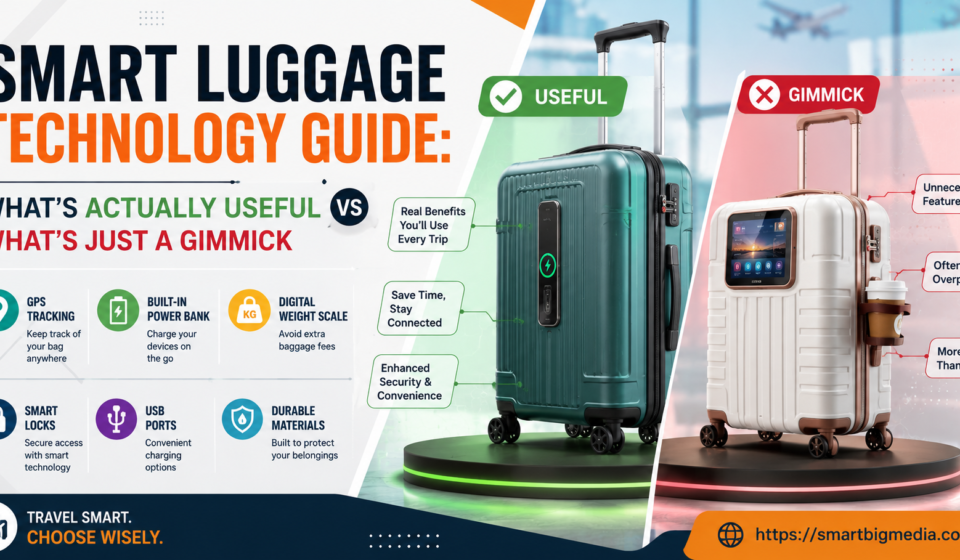
Term gets used loosely for anything from a suitcase with one USB port bolted onto the side, all the way up to genuinely sophisticated bags with GPS tracking, digital weight sensors, biometric locks, and — in some cases — that self-driving thing the guy on my flight had. Doesn’t all deserve equal enthusiasm. A lot of what gets marketed as cutting-edge is honestly a solved problem with extra steps bolted on and a bigger price tag attached.
Breaking it down by actual function helps more than lumping “smart luggage” into one category, since a bag with just tracking and a bag with actual robotics are barely the same product despite getting sold under identical marketing language.
GPS Tracking. Probably the Genuinely Useful One
Lost luggage’s still a real, common problem, and knowing exactly where a bag physically is — rather than filing a claim and just waiting, anxious, refreshing an app that tells you nothing — changes the whole experience of dealing with it. Built-in trackers, or luggage designed with a slot for a separate popular consumer tracking tag, let you watch your bag’s location in real time on your phone.
Worth noting, though. A built-in, permanently attached tracker with its own battery runs into the exact same airline battery restrictions as anything else with a lithium battery in checked luggage, which gets confusing fast; more on that below. A separate small tracking tag tucked into an external pocket, running on a coin-cell battery well under the airline threshold, tends to be the more practical route for most people rather than a bag with tracking built permanently into its structure.
Hard to overstate the usefulness here for anyone who’s actually had a bag lost or badly delayed. Instead of vague uncertainty, you can see exactly where the thing physically is, and airlines tend to move faster once you hand them a specific verified location instead of a general complaint over the phone.
Built-In Charging. Useful, Slightly Overhyped
A USB port built into a suitcase sounds convenient, and it genuinely can be, letting you top off a phone while the bag sits under a seat or in the overhead bin. Catch worth understanding — this only works because of an internal battery pack, and that battery follows the exact same restrictions as any portable power bank you’d carry separately.
Most airlines require these removable.
Genuinely useful for carry-on-only travel, where the whole bag, battery and all, stays with you the entire trip. Less useful — kind of pointless, actually — for anyone checking bags regularly, since the charging function becomes unusable the moment the suitcase disappears into cargo with the battery sitting uselessly in your carry-on instead.
Digital Weight Sensors. Small Feature, Genuinely Handy
Built-in scales, usually in the handle, let you check a bag’s weight before heading to the airport instead of discovering it’s over the limit at check-in and repacking awkwardly in front of a line of strangers watching you shove socks into your jacket pockets.
Small, cheap feature relatively speaking, solves a real common problem for very little cost. Doesn’t need much beyond a small replaceable battery, doesn’t run into any airline restrictions at all, accuracy’s reliable enough for practical purposes even without laboratory precision. Worth putting on a checklist of stuff actually worth the small extra cost, unlike some of the flashier things further down.
GPS Locks and Biometric Locks
Combination locks are standard now, TSA-approved versions letting security open a bag without cutting the lock off entirely. Smart luggage takes it further — app-controlled locks, fingerprint locks, locks that ping your phone if the bag opens unexpectedly.
Genuine usefulness here is more modest than marketing suggests, honestly. Not worth a real premium as a standalone selling point on its own.
Self-Driving, Motorized Luggage. Cool, Mostly Impractical
This is the category the guy on my flight had, and it’s the most impressive on paper and the least practical in real-world use, by a wide margin. Motorized suitcases that follow you through an airport, or that you ride like a small scooter across a terminal — they exist, and they genuinely work about as well as the promo videos show.
Problem’s almost entirely regulatory, not technical. Most airlines classify these under “smart bag” battery and motor limits that fall outside what’s acceptable for checked baggage, and increasingly restrict them from carry-on too depending on the exact battery configuration involved.
Unless you’ve specifically verified compatibility with every airline you’re likely flying, and then double-checked again since policy on this shifts pretty often as more of these products hit the market, this whole category’s more of a genuine gimmick for most people than a purchase actually worth making.
Airline Battery Rules, Which You Need to Understand First
Deserves its own section because it undercuts a huge chunk of what smart luggage even claims to offer in the first place. Airlines generally restrict lithium battery capacity, typically limiting devices in checked baggage fairly significantly, requiring anything above a certain threshold to travel in carry-on only, and sometimes requiring advance airline notification for bigger power banks specifically.
Before buying any smart luggage feature involving a battery — tracking, charging, motorized movement, any of it — check the specific battery capacity against current airline rules, and confirm specifically whether the battery’s removable. Matters more than any single other factor in whether the feature’s actually going to be usable on your specific trips. A removable pack solves most restriction issues instantly, since you just carry the battery separately in your carry-on rather than trying to check it inside the suitcase. A permanently built-in battery that can’t be removed is where people run into real problems, sometimes discovering the whole issue while standing at the counter, with a line building up behind them and a flight boarding in twenty minutes.
What’s Actually Worth the Money
Cutting through the marketing — GPS tracking through a small removable tag, a built-in weight sensor, and a bag genuinely built from durable material tend to deliver the most real-world value per dollar spent. These solve actual common travel problems — lost luggage, overweight fees, bags that fall apart after a handful of trips — without running into airline restrictions or forcing you to carry an extra battery separately everywhere.
Charging ports make sense specifically for carry-on-only travelers, where the bag and its battery stay together with you the whole trip regardless. Smart locks add a little peace of mind for barely any added cost if they’re bundled into a bag you’re buying anyway. Motorized, self-driving luggage remains, for now, more novelty than practical purchase for the overwhelming majority of travelers — however genuinely fun it looks gliding across the store floor in a demo.
Final Thoughts
Smart luggage tech genuinely has useful stuff buried among the gimmicks, but figuring out which is which means looking past the marketing and specifically checking airline compatibility before spending anything on battery-dependent features. GPS tracking and weight sensors reliably solve real, common problems. Motorized, heavily battery-dependent stuff tends to create more airport hassle than it’s worth for most people’s actual travel patterns. The smartest move, a little ironic really, is picking the boring reliable features over the impressive ones, and confirming compatibility with your specific airlines before checking out — rather than finding out the hard way at the counter, with a line of people waiting behind you and a flight boarding soon.




[…] a client once at what I was sure was 2 pm their time. Turned out I’d done the math backward. It was 2 am. Nobody picked up, obviously, and I spent the […]
[…] already fairly advanced, the way we didn’t until a friend visiting the house actually asked, genuinely concerned, if she’d gotten hurt somehow. She […]