
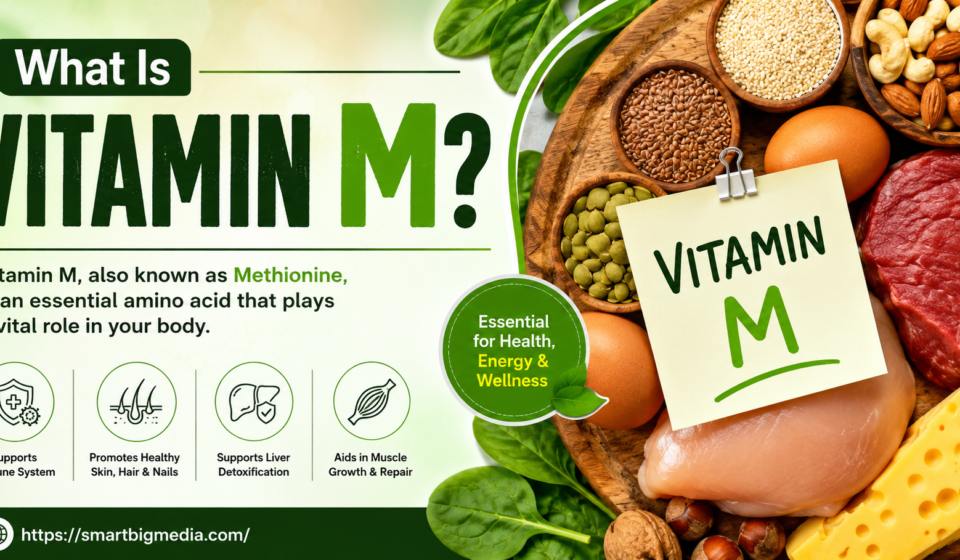
I used to think every vitamin letter mapped to something I’d recognize. A, C, D, the B-complex crew. Then someone in a nutrition forum mentioned “Vitamin M” as if it were common knowledge, and I had nothing. No idea. Turns out that’s fine, because almost nobody alive today learned this one in school.
Here’s the short version, and then I’ll get into why it matters. Vitamin M is an old name — mostly retired by the 1940s — for folic acid. Which is the same thing as folate. Which is the same thing as Vitamin B9. One nutrient, at least four names, depending on which decade and which textbook you’re reading. It’s not a separate compound with its own job. It’s folic acid wearing a costume from a hundred years ago.
There’s also a totally unrelated slang use floating around online, where people say “Vitamin M” and mean money. Not going to spend much time on that one, but I’ll touch on it near the end because it’s genuinely why a lot of people land on this page in the first place.
Where the Name Actually Came From
Vitamin research in the early 1900s was messy. Not organized, messy, actually chaotic. Labs in different countries were isolating compounds, testing them on whatever animals they had access to, and slapping letters on things almost as fast as they found them. Nobody was coordinating. So the same nutrient sometimes got two or three names depending on who found it first and what they happened to be studying that week.
Folic acid is maybe the best example of this. A British doctor, Lucy Wills, was in Bombay in the 1930s trying to figure out why pregnant textile workers kept developing a nasty form of anemia. She found that a yeast extract cured it — and for a while, this mystery substance was just called the “Wills factor,” named after her, which is a nice bit of scientific history that most people never hear about.
Around the same time — and this part I find kind of funny — other researchers were running similar experiments on monkeys. They found something almost identical that prevented anemia in primates. And because of that monkey connection, some scientists started calling it Vitamin M. M for monkey. That’s genuinely it. Not the most elegant naming convention science has ever produced.
And Then There Were Chickens Too
At more or less the same time, yet another group was working with chicks (as in baby chickens, not the slang) and found that the same or a very similar compound cured anemia in them too. So it also got called Vitamin Bc. C for chick. So now you’ve got the Wills factor, Vitamin M, and Vitamin Bc, all more or less describing the same thing, all coined independently, all in use simultaneously. Nobody had cross-checked their work yet.
The mess didn’t get sorted out until 1941, when a different team pulled a similar compound out of spinach leaves. Since the Latin word for leaf is “folium,” they went with folic acid. That name eventually won, and by the mid-1940s chemists had confirmed folic acid, the Wills factor, Vitamin M, and Vitamin Bc were all the same substance or close enough that it didn’t matter. Once the international B-vitamin numbering system got standardized, folic acid became Vitamin B9, and all those older nicknames — M included — quietly fell out of use. You’ll still find them in old textbooks. Nowhere else, really.
What Folic Acid Actually Does Once You’re In Your Body
Okay, so why did three separate research groups care so much about this thing that they each gave it a name? Because it does real work, and it does it constantly, whether you’re thinking about it or not.
Cell Division, Basically Nonstop
Every time a cell divides, it has to copy its entire genetic code, accurately, under time pressure. Folate is central to that — DNA synthesis and repair depend on it. Skimp on folate, and cell division slows or starts producing errors, and this hits fast-turnover tissues hardest: bone marrow, the gut lining, and places where cells are constantly being replaced.
Red Blood Cells
This is the one that got everyone’s attention originally. Without enough folate, your bone marrow still tries to churn out red blood cells, but they come out too big and not fully mature. Doctors call this megaloblastic anemia. It’s exactly what Lucy Wills was staring at in her Bombay patients, decades before anyone had a name for what was actually happening.
Pregnancy — The Big One
If you’ve heard of folic acid at all in a modern context, it’s probably tied to pregnancy. Getting enough folate before conception and through the early weeks dramatically cuts the risk of neural tube defects — serious birth defects involving the brain and spinal cord. That’s the whole reason doctors push folic acid supplements on women who are pregnant or even just thinking about it, and it’s why so much of the grain supply in countries like the U.S. is fortified with it as a baseline public health measure.
Heart and Brain, Sort Of, Still Being Studied
Folate also helps regulate homocysteine, an amino acid that’s been linked to cardiovascular issues when it runs high. There’s ongoing research into folate’s role in mood and cognition too — it’s involved in producing certain neurotransmitters — though I’d call that area less settled than the pregnancy and anemia stuff, which is pretty well nailed down at this point.
Folate vs. Folic Acid — People Mix These Up Constantly
Quick distinction, because these two terms get used interchangeably even though they’re not identical.
Folate is what you get from actual food — spinach, beans, oranges, whatever. Your body has to break it down before it can use it, and that process isn’t perfectly efficient.
Folic acid is the synthetic version. The stuff in supplements and fortified bread and cereal. Oddly enough, it’s usually absorbed better than the natural form, which is part of why fortification programs have worked so well at reducing deficiency rates on a large scale.
Where You’ll Actually Find It
If pills aren’t your thing, food covers this pretty easily.
Leafy greens are the obvious one — spinach, kale, romaine, broccoli, Brussels sprouts. Makes sense given the name comes from the word for leaf.
Legumes matter a lot here too. Lentils, chickpeas, black beans, kidney beans — genuinely some of the best plant sources out there, which is good news if you’re vegetarian or vegan and need reliable options.
Citrus fruit helps. Oranges and grapefruit, plus their juices, contribute a decent amount alongside their vitamin C.
Fortified grains are probably where most people in fortification countries get a big chunk of their intake without even trying — flour, rice, pasta, breakfast cereal. Since fortification became standard in the late ’90s in places like the U.S., rates of neural tube defects measurably dropped. That’s not a small result.
Also worth a mention: asparagus, avocado, eggs, beets, nuts. None of these are going to be your main source, but they add up.
What Happens If You’re Low
Deficiency doesn’t usually hit overnight. It builds over weeks or months, and by the time it’s noticeable, it’s usually been going on a while.
Fatigue that doesn’t go away. Weakness. Pale skin. Getting winded doing things that shouldn’t wind you. Irritability, trouble concentrating. The annoying part is that these symptoms overlap heavily with iron deficiency, so you usually need bloodwork to actually tell which one you’re dealing with — you can’t just guess from symptoms alone.
People at higher risk: pregnant women, obviously; people whose alcohol use interferes with nutrient absorption; folks with digestive conditions like celiac or Crohn’s; and people on certain medications that mess with folate metabolism specifically.
Left unchecked for long enough, the consequences get more serious — higher risk of neural tube defects if it happens during pregnancy, and in adults, the megaloblastic anemia mentioned earlier, plus possibly elevated homocysteine over time.
How Much You Actually Need
Guidelines use something called Dietary Folate Equivalents, which accounts for the fact that natural folate and synthetic folic acid don’t absorb at the same rate.
Most adults land around 400 micrograms a day, and honestly that’s not hard to hit if you’re eating a reasonably varied diet with some vegetables and legumes in the mix.
Pregnant women are usually told to bump up to around 600 micrograms, given how much is riding on it developmentally. Breastfeeding drops that number a bit, but it’s still above the general adult baseline.
So Does the Name “Vitamin M” Matter Today?
Not really, practically speaking. You won’t find it on a supplement label. Your doctor isn’t going to bring it up. If you’re reading a modern nutrition label or a doctor’s note that says folate or folic acid, that’s the exact nutrient that used to go by Vitamin M, just under its current name.
But I think the history is worth knowing anyway. It explains why older nutrition sources can feel inconsistent or confusing compared to what you read now — the letter system was never as clean as it looks in hindsight. Several letters besides M got used temporarily and then abandoned once scientists realized they were duplicates or impurities or not real standalone vitamins at all. F, G, H, J — all had their moment and then quietly disappeared from use.
The Money Thing, Briefly
Separately from all of this, you’ll sometimes see “Vitamin M” used as a joke, meaning money — as in, money fixes a lot of problems the same way a vitamin fixes a deficiency. It’s wordplay, nothing more, shows up in casual conversation and business slang and social captions. Mentioning it here mainly because I know it’s why a chunk of readers searched this in the first place, and I didn’t want to leave that unanswered.
Bottom Line
Vitamin M isn’t some hidden nutrient you’ve been neglecting. It’s just the old name for folic acid — Vitamin B9 — a nutrient that’s been doing the same essential work since long before Lucy Wills gave it her attention in Bombay nearly a century ago. Cell division, red blood cells, protecting against birth defects in pregnancy — that’s the job, regardless of what letter got stapled to it along the way. Eat your leafy greens, keep legumes and citrus in the rotation, lean on fortified grains, and talk to a doctor if you fall into a higher-risk group like pregnancy, where extra supplementation actually makes a difference.



[…] for instance, are often born a completely different color — bay, black, chestnut — and only gradually turn gray as they age, sometimes not reaching their final color until several years in. So the foal […]
[…] Leading with water gives your body a head start on rehydrating before caffeine even enters the picture — rather than asking your system to fight dehydration and process a caffeine hit at the exact same […]
[…] core body temperature naturally drops as part of the process of falling asleep. Things that keep your body warm right […]