
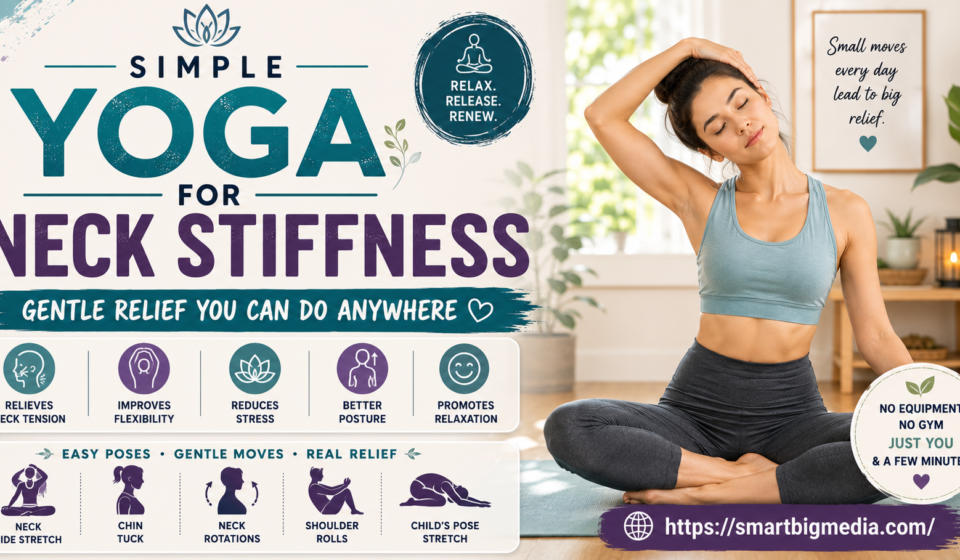
Woke up one morning genuinely unable to turn my head to the left without a sharp pinch stopping me halfway. Slept wrong, apparently, though I still don’t really know what that means exactly, slept wrong. Spent the whole day turning my entire torso instead of my neck just to look at things beside me, which if you’ve never done it, looks about as ridiculous as it sounds.
That particular episode faded after a few days on its own, the way these things usually do. But it got me actually paying attention to my neck for once, and paying attention revealed it was tight essentially all the time, not just that one dramatic morning. Desk work, phone scrolling, just general life apparently adds up in your neck more than anywhere else for a lot of people. This is simple yoga for neck stiffness, the stuff that actually works, gentle enough to do even on a bad day.
Why Necks Get So Tight
Your neck holds up a surprisingly heavy head, roughly ten to twelve pounds for most adults, and that weight increases dramatically the further forward your head tilts. Looking down at a phone can effectively multiply that load several times over, which is part of why “tech neck” has become such a common, genuinely accurate complaint.
Stress adds to it too, similar to shoulders. A lot of people hold tension directly in their neck and upper traps without any conscious awareness, especially during focused work or stressful moments throughout a normal day.
And then there’s just plain lack of movement. Necks are built to move through a wide range, tilting, turning, extending, but modern life mostly asks them to stay locked in one forward-facing position for hours at a stretch.
A Few Things Before Starting
Go slow, always, especially with neck work specifically since this area is more delicate than shoulders or hips generally. Never force a stretch here. If anything feels sharp rather than a normal gentle pull, stop immediately rather than pushing through it. And if you’re dealing with a genuine injury or recent trauma to the neck, check with a doctor before trying any of this on your own.
Neck Rolls, Modified
Traditional full neck rolls, the kind that go all the way around including tilting the head back, have actually fallen out of favor with a lot of physical therapists because that backward tilt can compress the cervical spine in a way that’s not particularly helpful. Modified version works better and is genuinely safer.
Start with your chin dropped toward your chest. Slowly roll your head toward your right shoulder, pause, roll back to center, then toward your left shoulder, pause, back to center. Skip the backward tilt entirely. Five slow rounds each direction.
Ear to Shoulder Stretch
Sitting or standing tall, let your right ear drop toward your right shoulder, keeping both shoulders relaxed and down rather than hunching up toward your ear to close the gap. You should feel a stretch along the left side of your neck. For a deeper stretch, gently rest your right hand on top of your head, adding very light additional weight, never yanking or forcing it.
Hold twenty to thirty seconds, switch sides.
Chin to Chest Stretch
Simple, drop your chin toward your chest, feeling a stretch along the entire back of your neck and into your upper back. For more, gently place both hands on the back of your head, adding light weight, breathing slowly.
Hold twenty to thirty seconds.
Look Up and Look Down
Slowly tilt your head back to look toward the ceiling, gently, without straining, then slowly bring it back down to look at the floor. This moves your neck through its natural forward-back range in a controlled, gentle way, unlike the harsher backward-tilt neck roll mentioned earlier.
Five slow rounds.
Look Left and Look Right
Turn your head slowly to look over your right shoulder as far as comfortably possible, hold briefly, return to center, then turn left. This maintains rotational range of motion, which gets lost surprisingly fast if you spend all day facing a screen directly in front of you.
Five rounds each direction.
Thread the Needle for the Neck and Upper Back
From hands and knees, slide your right arm underneath your left, lowering your right shoulder and the side of your head toward the floor. This one technically targets the upper back and shoulder primarily, but the neck genuinely benefits too since so much neck tension is actually connected tension from the upper back and shoulders rather than being isolated purely to the neck itself.
Hold twenty to thirty seconds, switch sides.
Cat-Cow With Neck Awareness
Standard cat-cow, hands and knees, arching and rounding your spine with your breath, but pay specific attention to letting your neck follow the movement naturally rather than holding it rigid. In cow, let your gaze lift gently. In cat, let your chin tuck naturally toward your chest rather than forcing it.
Six to eight rounds, moving slowly.
Seated Spinal Twist
Sitting cross-legged or in a chair, place one hand behind you for support, the other on your opposite knee, and gently twist your torso, letting your neck follow the rotation naturally rather than staying rigid and disconnected from the rest of the movement. This releases tension through the whole spine, neck included, in a way that isolated neck stretches alone sometimes miss.
Hold twenty seconds, switch sides.
Shoulder Rolls to Support the Neck
Not a neck stretch directly, but genuinely helpful since neck and shoulder tension are so closely connected in most people. Roll shoulders backward in large circles, ten times, then forward, ten times, breathing deep and intentionally throughout.
A Simple Daily Routine
Morning: chin to chest, ear to shoulder both sides, look up and down, five rounds. Takes about two minutes, genuinely quick.
Midday, especially if you’re at a desk: shoulder rolls, look left and right, a quick modified neck roll. One minute, does wonders during a long stretch of desk work.
Evening or whenever you have a slightly longer window: the full sequence, including thread the needle and the seated spinal twist. Eight to ten minutes total.
Desk Breaks Matter As Much As the Stretches Themselves
Doing these stretches once a day genuinely helps, but if you’re then sitting hunched over a screen for eight straight hours afterward, the benefit gets undone fairly quickly by the posture that caused the stiffness in the first place. Setting a reminder every hour to just check your posture, roll your shoulders, glance away from the screen for thirty seconds, makes a real difference alongside the actual stretching routine.
Pillow and Sleep Position Matter Too
A lot of neck stiffness, including my own memorable episode, actually originates from sleep position and pillow height rather than daytime posture alone. A pillow that’s too high or too flat can hold your neck at an awkward angle for six to eight hours straight, which no amount of daytime stretching can fully counteract on its own. If neck stiffness is a recurring, persistent issue for you specifically, it’s genuinely worth evaluating your pillow and general sleep position as part of the actual solution here.
When to See a Professional Instead
Occasional stiffness from posture or sleep responds well to gentle stretching like this. But numbness or tingling radiating down an arm, stiffness that doesn’t improve after a week or two of consistent effort, or pain following any kind of injury or accident needs an actual medical evaluation rather than a home stretching routine. Don’t push through those particular signals hoping stretching alone will resolve them.
What to Expect
Immediate relief after even a single short session is fairly common, genuinely, neck tension responds quickly to gentle movement in a way some other areas of the body honestly don’t. Longer term, doing this daily for a couple weeks tends to reduce how often stiffness builds up at all in the first place, rather than just treating it after it’s already there and bothering you.
Frequently Asked Questions
How often should I do neck stretches?
Daily ideally, even if it’s just two or three minutes. Little and often beats one long session weekly for an area that tightens up as quickly as the neck does.
Is cracking my neck the same as stretching it?
No, not really the same thing at all. Cracking can feel temporarily satisfying but doesn’t address underlying tightness or build any actual range of motion the way gentle, controlled stretching genuinely does over time.
Can poor posture alone cause neck stiffness, or is something else usually happening too?
Posture’s a huge factor, arguably the biggest one for most people, but sleep position, stress, and general lack of movement throughout the day all contribute as well. Usually it’s a genuine combination rather than any single isolated cause.
Bottom Line
Neck stiffness is incredibly common and, thankfully, usually quite responsive to simple, gentle, consistent stretching. You don’t need special equipment or a studio, just a few minutes daily and some real attention to your posture and sleep setup alongside the actual stretches themselves. Start with something small today. Your neck, and honestly your whole upper body, will likely thank you within just a few days.



[…] is the one that got everyone’s attention originally. Without enough folate, your bone marrow still tries to churn out red blood cells, but they come […]