Ask ten people to name an important vitamin, and you’ll get vitamin C, maybe D, maybe B12 if they’re paying attention. Vitamin K seldom comes up. And yet it’s doing something your body genuinely cannot function without — helping your blood clot when you’re injured, and keeping your bones properly mineralized. Most people never think about it because they get enough without trying. But when levels actually drop, the early signs are the kind of thing you’d normally shrug off. That’s the problem.
So here’s what to actually watch for, before it turns into something bigger.
What Vitamin K Is Doing for You
Your liver uses vitamin K to make several proteins called clotting factors — the things that let your blood form a clot and stop bleeding after even something minor like a paper cut. Not enough vitamin K, and your liver can’t build these efficiently, which means bleeding sticks around longer than it should.
There’s a second job too that gets ignored constantly: vitamin K activates proteins that bind calcium into your bones. So long-term deficiency isn’t just a clotting issue — it can weaken bone density over time, which is part of why low vitamin K has been linked to higher fracture risk, especially in older adults.
Two main types exist. K1, or phylloquinone, mostly comes from leafy greens and is what most people’s diets rely on. K2, or menaquinone, shows up in fermented foods and animal products, and your gut bacteria make a bit of it on their own too.
Who’s Actually at Risk
For a healthy adult eating a decent variety of food, this deficiency is genuinely rare — leafy greens alone cover it, and your body doesn’t need much. But certain groups face real risk.
Newborns are born with very low vitamin K stores, which is exactly why they get a vitamin K shot right after birth. People with celiac disease, Crohn’s, ulcerative colitis, or cystic fibrosis often struggle to absorb fat-soluble vitamins in general. Long-term antibiotic use can wipe out the gut bacteria that normally produce some vitamin K. Anyone on blood thinners like warfarin is a special case, since that drug works by directly interfering with vitamin K’s clotting function. Liver disease matters too — the liver’s literally where clotting factors get made. And then there are very restrictive diets missing greens entirely, plus anyone who’s had bariatric or intestinal surgery affecting nutrient absorption.
What Shows Up First
Since vitamin K’s main job is clotting, almost every early symptom traces back to bleeding or bruising in some form.
Bruises That Come Out of Nowhere
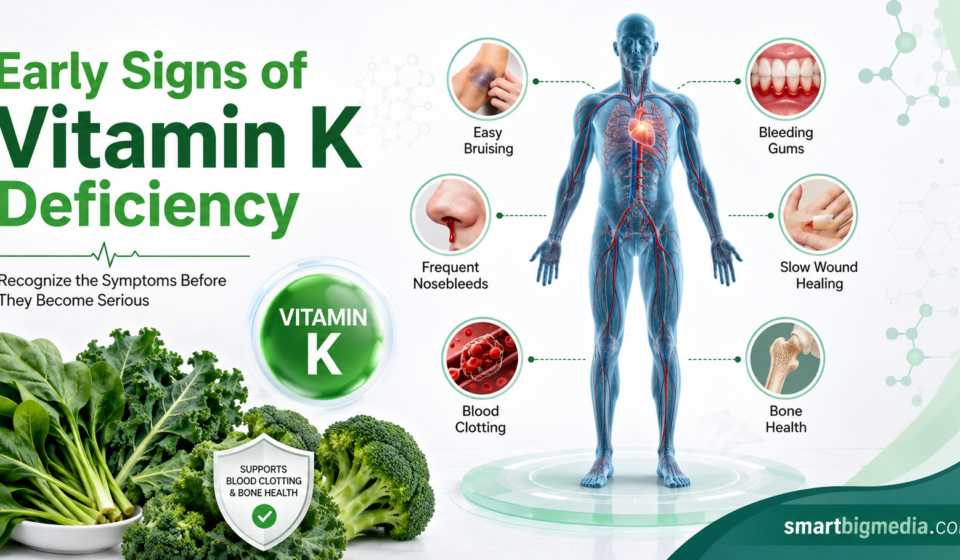
Usually the first thing people notice. A bruise shows up on your arm or leg and you genuinely can’t remember bumping anything. If this keeps happening — bruises from bumps so small you didn’t even feel them — pay attention to that.
Gums Bleeding More Than They Should
Bleeding during brushing or flossing, even with a light touch, can point toward poor clotting. Gum disease is the more common explanation, though, so check with your dentist first. If your oral health checks out and the bleeding keeps happening, vitamin K is worth a second look.
Nosebleeds Showing Up Out of Nowhere
If you almost never get nosebleeds and suddenly they’re regular, or they take way longer to stop than they used to, that’s a pattern, not a coincidence.
Periods Heavier or Longer Than Normal
For women, a change in menstrual flow is one of the lesser-known signs — periods becoming heavier or dragging on longer. Clotting factors help regulate that bleeding, so low vitamin K throws it off.
Blood Where It Really Shouldn’t Be
This one’s more serious and needs quicker attention — blood in your urine (pink, red, sometimes cola-colored) or in your stool (red, or black and tarry). Not subtle. Get this checked promptly.
Tiny Red or Purple Spots Under the Skin
Called petechiae — small pinpoint spots from minor bleeding just under the skin’s surface. They usually show up in little clusters and are an easy-to-miss but genuinely useful clue.
Cuts That Won’t Stop Bleeding
A small cut that should stop bleeding in a couple minutes and instead keeps going — that’s a fairly direct sign your clotting mechanism isn’t working right.
Bleeding More Than Expected During Surgery or Dental Work
Some people find out entirely by accident, during a routine dental cleaning or a minor procedure, when the bleeding is way more than anyone expected. Not a fun way to learn, but it gets the issue on the table.
Bone Discomfort, Long Term
This one shows up later, not early, but worth knowing about. Since vitamin K helps regulate calcium in bone, ongoing deficiency can eventually contribute to weaker bones or a higher chance of fractures.
How This Actually Gets Diagnosed
If your symptoms and risk factors line up, a doctor will usually order a prothrombin time test — a PT test — which measures how quickly your blood clots. A longer-than-normal time is a strong signal, though not the only possible cause, so doctors typically look at the fuller picture too, sometimes checking liver function or ruling out absorption issues alongside it.
Fixing It
Here’s the good part — once you know what’s going on, this is usually pretty easy to correct, especially if it’s diet-related rather than tied to another condition.
Eat More of the Right Foods
For most people, this alone does it. K1-rich foods: kale, spinach, collard greens, broccoli, brussels sprouts, swiss chard, parsley. K2-rich foods: natto (fermented soybeans — genuinely one of the richest sources anywhere), egg yolks, cheese, grass-fed butter, and various meats, chicken especially.
You don’t need a full diet overhaul. Even a modest serving of greens most days of the week usually keeps levels where they should be.
Deal With Whatever’s Actually Causing It
If your deficiency traces back to a malabsorption issue or liver disease, food changes alone won’t fully solve it. Treating the underlying cause matters just as much.
Supplements, When Needed
For more significant deficiency, or when diet changes aren’t enough, a doctor might recommend a supplement — oral, or by injection in more urgent situations. Don’t self-manage this one, especially if you’re on blood thinners. Vitamin K interacts directly with those medications, and taking it without guidance can actually backfire.
Check Your Medications
If long-term antibiotics or another drug seem to be playing a role, talk to your doctor about whether something needs adjusting or extra monitoring.
When to Actually See a Doctor
One stray bruise isn’t a reason to panic. But get checked if you’re seeing a pattern — bruising that doesn’t match any bump you remember, bleeding that lingers longer than it should, blood in urine or stool, periods that have gotten noticeably heavier, or a few of these symptoms overlapping at the same time.
These deserve real evaluation, not just to confirm vitamin K deficiency but to rule out other causes of abnormal bleeding, like a clotting disorder or liver problem.
Bottom Line
Vitamin K doesn’t get much credit, but it’s doing something you genuinely can’t live without — stopping bleeding, keeping bones strong. The early signs — easy bruising, bleeding gums, more frequent nosebleeds, cuts that won’t stop, heavier periods — are your body flagging that something needs attention.
For most people, more leafy greens closes the gap completely. But if several of these signs are showing up together, or you’re in one of the higher-risk groups, don’t just brush it off — bring it up with your doctor. Caught early, this is usually a simple fix, well before it turns into something bigger.