
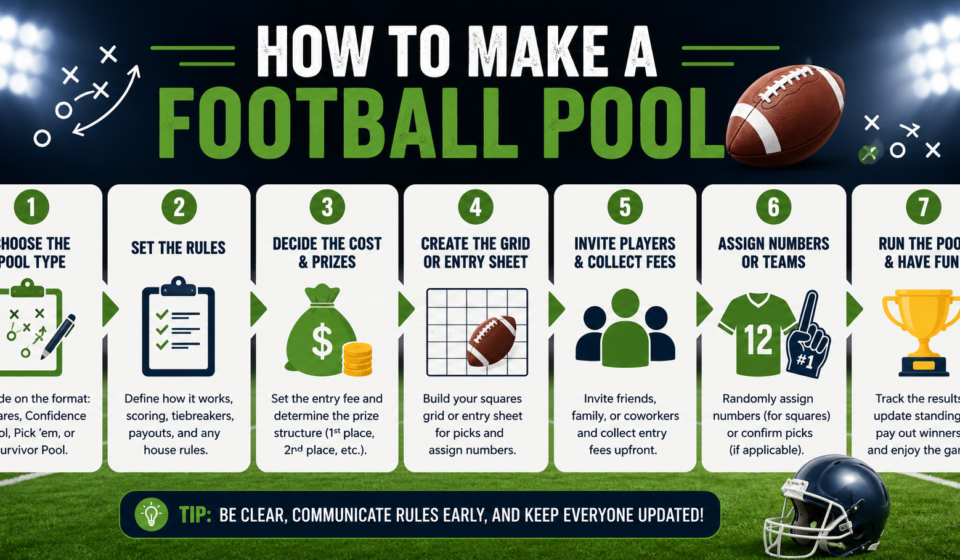
The first football pool I ever ran, I got it wrong. Not disastrously wrong, but wrong enough that two people in the office were annoyed with me for a week, and I had to explain, more than once, why the numbers on the grid weren’t the numbers people thought they’d picked. That’s the thing nobody tells you before you volunteer to organize one of these — it looks simple from the outside, and it mostly is, but there are two or three small decisions that determine whether your pool runs smoothly or turns into a mess of “wait, that’s not fair” texts during the fourth quarter.
So this is the guide I wish someone had handed me back then. Just how to make a football pool, laid out the way it actually happens, not the way it looks on a template you download and never quite understand.
What a Football Pool Actually Is
Strip away the terminology and a football pool is just this: a group of people put in a small amount of money, everyone gets assigned or picks something — a number, a team, a combination of both — and whoever’s pick lines up with what happens in the game wins a cut of the money. That’s it. There’s no skill requirement, which is exactly why it works so well for mixed groups. The person in accounting who’s never sat through a full game has the same shot at winning as the guy who’s been tracking fantasy stats since August.
Most offices, families, and friend groups run some version of this once a year, usually tied to the Super Bowl, though plenty of people run smaller pools every week of the season too. The version you pick depends mostly on how much effort you want to put in and how long you want the game to last.
Picking the Right Type of Pool for Your Group
Before you make anything, you need to decide what kind of pool you’re actually building, because “football pool” covers a few different formats and they’re not interchangeable.
A squares pool is the one most people picture — a hundred-box grid, numbers assigned randomly, winners determined by the score at the end of each quarter. This is the easiest one to run for a single game. If your whole goal is a Super Bowl party pool, this is almost certainly what you want.
A pick’em pool stretches across a season or at least several weeks. Everyone picks the winner of each game on the schedule, and whoever gets the most correct picks by the end of the stretch wins. This takes more ongoing management — you have to track it every week — but it keeps people engaged for months instead of one Sunday.
A survivor pool is the leanest version. Pick one team to win each week. Lose, and you’re out for good. It runs itself once it starts, because half the work is just watching people get eliminated.
If this is your first time running one, start with a squares pool. It’s contained, it’s over in one night, and it teaches you the mechanics without committing you to a season-long spreadsheet.
Setting Up a Squares Pool
Building the Grid
You need a hundred boxes, arranged ten rows by ten columns. You can do this with an actual poster board and a marker — which, honestly, I’d recommend for an in-person group, because there’s something about physically writing your name in a square that gets people invested. If your group is remote or spread out, a Google Sheet with a hundred cells works fine too. Either way, the grid itself is the easy part.
Assigning the Teams
Once the two teams are set, put one across the top of the grid and one down the side. It genuinely doesn’t matter which team goes where. This just decides which axis represents which team’s score digits later on.
Selling the Boxes
Here’s where you set your price. Five dollars a square is common for casual groups; ten is common for offices where people expect a bigger payout. Whatever you land on, multiply it by a hundred so you know exactly what the total pot will be before you even start collecting. If you’re charging five dollars a box, you’re working with a five-hundred-dollar pot. That number matters because it shapes how you split the winnings later.
People write their names into open boxes until the grid is full, or until you hit your sign-up deadline. This part is important: don’t let anyone see the numbers before the boxes are filled. If people know their box’s numbers ahead of time, you’ve basically let them pick their own odds, and the whole point of a squares pool is that nobody gets to do that.
Drawing the Numbers
Once every box has a name in it, it’s time to assign numbers zero through nine to each row, and zero through nine to each column. The cleanest way to do this is with slips of paper in two separate containers — one for the row numbers, one for the columns — drawn one at a time and written onto the grid as they come out. Some people use a random number generator instead if they’re running things digitally, and that works too, as long as everyone can see it happen and knows it wasn’t rigged in advance.
This is the step that turns a hundred names into a hundred number combinations, and it’s also the step most likely to get you accused of favoritism if you skip doing it out in the open. Do it live, in front of people, or on a shared screen if you’re remote.
Reading the Score at the End of Each Quarter
When the first quarter ends, look at the last digit of each team’s score. Say the score is 10 to 7 — you’re looking at 0 and 7. Find where the row with 0 crosses the column with 7 (or vice versa, depending on how you set it up), and whoever’s name is in that box wins that quarter.
Repeat that same process at the end of the second quarter, third quarter, and the final score. Most groups pay out four times total, once per quarter, though some weight the final score heavier than the others — giving each of the first three quarters twenty percent of the pot and the final score forty percent is a pretty standard split if you want to reward the ending more than the middle.
Running a Pick’em Pool Instead
If a single-game pool feels too small for what your group wants, a pick’em pool covers a much longer stretch of the season.
Pull the schedule for whatever weeks you’re covering, and list out every game. Each player picks a winner for every matchup before that week’s games kick off. At the end of the week, tally up how many picks each person got right. Whoever has the most correct picks across the stretch — whether that’s a full season or just the second half — takes the pot.
The tricky part with pick’em pools isn’t the picking, it’s the tracking. You need somewhere everyone can see the standings update week to week, so a shared spreadsheet or a simple shared doc is worth setting up before week one, not after. And you need a tiebreaker rule decided in advance, because eventually two people will finish with the exact same number of correct picks, and “total points scored in the final game” is a common and easy way to settle that without an argument.
Rules Go First, Money Goes Second
I said earlier that my first pool went a little sideways, and the reason was simple — I collected money before I’d actually written anything down. People assumed things about the payout split that weren’t true, because I hadn’t told them otherwise.
So before anyone hands you a dollar, put the rules in writing and send them to the whole group. It doesn’t need to be formal. A text or a group email covering these five things is enough:
- How much it costs to get in
- Exactly how a winner is determined
- How the pot gets split among winners
- The deadline to join or submit picks
- What happens in a tie
Five minutes of typing saves you a lot of grief three weeks in, when someone’s convinced the rules were different than what you meant.
Handling the Money Itself
Cash works fine if everyone’s in the same building or the same house on game day. For groups spread across different cities, something like Venmo or Cash App handles it without anyone needing to track down cash. Whatever method you use, get all the money in before the grid locks or the season starts — chasing down late payments after the game has begun is its own kind of headache.
Keep the pool’s money separate from your own everyday spending, even if that just means a labeled envelope in a drawer or a dedicated line in a budgeting app. It sounds like overkill for a fifty-dollar office pool, but it keeps the accounting simple and it means you’re never guessing whether that twenty in your wallet is pool money or grocery money.
When it’s time to pay out, do it the same day the outcome is final. People remember, and trust builds fast when the person running the pool actually pays promptly.
Mistakes Worth Avoiding
A few things trip up almost every first-time organizer, so it’s worth naming them directly.
Revealing numbers before the grid fills up. This one comes up constantly. If people can see the numbers ahead of time, they’ll only buy squares with digits they like, and the whole grid stops being random.
Skipping the written rules. Verbal agreements get remembered differently by everyone involved. Write it down, even briefly.
Losing track of who’s paid. A simple checklist next to the sign-up sheet — paid or not paid — saves you from awkward reminder texts later.
Setting the buy-in too high for the group. A ten-dollar entry might be nothing for one crowd and a real ask for another. Match the price to the people actually playing, not to what sounds exciting.
Waiting too long to draw numbers. The longer the grid sits half-filled with the numbers already visible, the more chance someone sees them by accident. Fill the grid, then draw immediately.
Wrapping It Up
Making a football pool isn’t complicated once you’ve done it, but the details matter more than they look like they will at first glance. Pick the format that fits your group — squares for a single game, pick’em or survivor for something that runs longer. Set the rules before you take a single dollar. Draw the numbers where people can see it happen. And pay out quickly when it’s over.
Run it once, and the second time takes you a fraction of the effort. That first pool I botched turned into something my office asked for every year after, mostly because I fixed the two things that had gone wrong and never had a problem again.



[…] on your hips, slow circles, like a hula hoop. Thirty seconds one way, thirty the other. Your hips do more work in a walking […]
[…] bodyweight squats, maybe fifteen reps. Leg swings, front to back and side to side, ten each leg. A handful of walking […]