
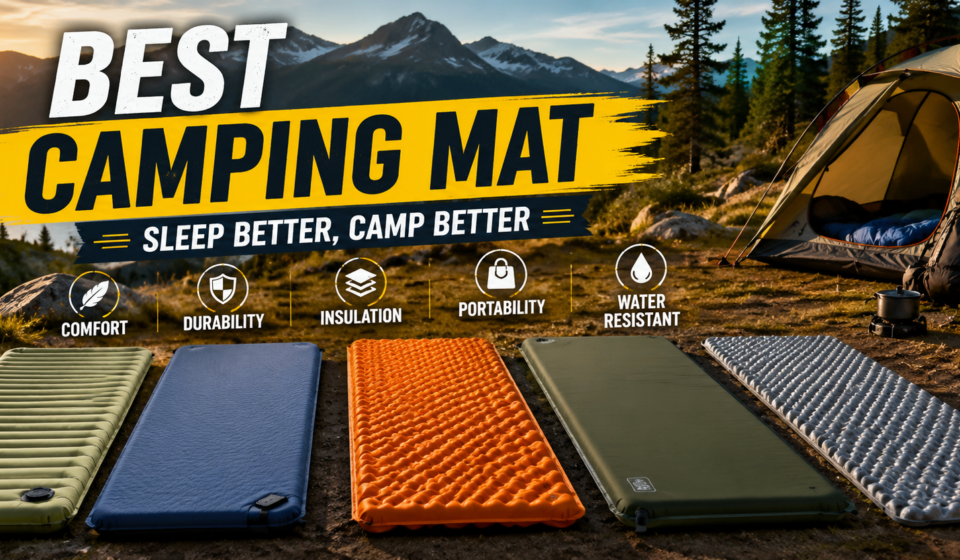
Okay so. I need to talk about camping mats, because I got this wrong for years and nobody warned me.
The short version: I used to think a sleeping bag was the thing that kept you warm at night and the mat underneath was just… padding. A nice-to-have. Something you throw in if there’s room in the car. Turns out that’s backwards, and it took one genuinely miserable night in a tent in October to figure that out. I was cold from the ground up, not the air down, and my bag rated to 20°F did absolutely nothing about it. The mat is doing more work than people give it credit for.
So this isn’t a “top 10 mats ranked” post. Those exist everywhere and they all say the same five things about the same five products. I want to talk through how to actually pick a camping mat that fits you, because “best” changes depending on whether you’re driving to a campsite or hauling this thing eleven miles into the backcountry.
Why the mat matters more than people think
Here’s the thing about lying on the ground — your body weight squishes whatever’s under you. If that’s a sleeping bag, the down or synthetic fill gets flattened out and stops trapping air, which means it stops insulating. The ground just pulls heat straight out of you. It’s called conductive heat loss and it happens fast, way faster than losing heat to cold air around you.
A mat exists specifically to break that contact. Good insulation underneath, and suddenly the same sleeping bag performs completely differently.
And then there’s just… comfort, which is its own thing entirely. Rocks, roots, that one lump of dirt you swore you cleared away before setting up the tent — none of that goes away on its own. A mat is the difference between actually sleeping and just lying there until sunrise.
The basic types, and I mean basic
There are three real categories. Everything else is a variation.
Foam mats are the cheap, simple, nearly-impossible-to-break option. Closed-cell foam, no air, no valves, nothing to fail. You unroll it and you’re done. Downside — they’re bulky, they strap to the outside of a pack awkwardly, and they’re not exactly plush. I still keep one in my car trunk because it refuses to die.
Self-inflating mats are foam and air together. Open the valve, the foam expands and pulls air in on its own, then you blow in a few extra breaths to firm it up. This is probably the most “I don’t want to think about it too hard” option, and honestly for most casual campers it’s the right call.
Air pads are the ultralight ones — just air chambers, no foam. You inflate manually or with a pump sack. These pack down tiny, which is why backpackers use them, but they’re the ones most likely to get a slow leak from a stick you didn’t notice under the tent floor. Worth it for the weight savings, annoying when it happens.
What actually separates a good one from a bad one
R-value
This is the number nobody explains properly on product pages. R-value is insulation — how much the mat resists losing your body heat to the ground. Higher number, warmer mat, simple as that.
Summer camping, nothing crazy, you can get away with an R-value around 1–2. Three season camping, most people want 3–4. Winter, or anywhere the ground actually gets cold, you want 5 or higher, and some people just stack two mats to combine their ratings instead of buying an expensive dedicated winter pad.
Thickness
This is the comfort number more than the warmth number. Under two inches and side sleepers are going to feel their hip against the ground eventually, no matter how good the material is. Get into the 2.5 to 4 inch range and it starts feeling like an actual mattress instead of a mat. If you’re car camping and weight isn’t a factor, there’s no real reason not to go thick.
Weight
Doesn’t matter if you’re driving. Matters a lot if you’re walking. Ultralight air pads can weigh under a pound. A comparable foam pad might be triple that. Be honest with yourself about how far you’re actually carrying it before you pay extra for the light one.
Denier / durability
Look for the “D” number in the specs — 40D, 75D, whatever. Higher usually means tougher fabric, slightly heavier. If you camp somewhere rocky, don’t skip this to save a few dollars. A patch kit helps after the fact, but it’s better to not need it.
Noise
Genuinely underrated problem. Some air pads sound like a chip bag every single time you roll over. If you’re sharing a tent, or you’re a light sleeper, or your partner is a light sleeper and will absolutely mention it to you at 2am — check for this before buying.
Shape
Rectangular mats give you room to move and are usually a bit heavier. Mummy-shaped mats taper at the feet to match a mummy bag, saving weight but feeling narrower if you like to sprawl out.
Matching it to the actual trip you’re taking
I think this is where most people mess up — they buy one mat expecting it to work for everything.
Car camping — go thick, go heavy if you want, comfort wins here, weight is irrelevant.
Backpacking — weight and pack size first, but don’t drop the R-value below 3 unless you know for sure it’s staying warm.
Winter or high altitude — R-5 or above, non-negotiable, or double up mats.
One night at a festival or a low-key overnight — a basic foam or self-inflating mat is honestly fine. Don’t overspend for a single easy trip.
Mistakes I’ve personally made, so you don’t have to
Bought the cheapest one once. Regretted it within one trip. Cheap usually means thin material or a valve that fails early.
Ignored R-value completely on that October trip I mentioned earlier. Learned my lesson the hard way, at 3am, awake, cold, annoyed.
Never tested a mat at home before a trip. Now I always inflate it in the living room first and lie on it for ten minutes minimum.
Assumed my sleeping bag’s temperature rating would save me regardless of what was underneath it. It won’t. The rating assumes a decent mat is doing its job too.
Skipped the repair kit more than once. A tiny puncture from a stick you never even saw can end a trip early if you’re not carrying a patch.
A quick way to test one before you commit to it
Lie on it at home on a hard floor, same position you sleep in, for at least ten minutes.
Pay attention to your hip and shoulder if you sleep on your side — that tells you more than any spec sheet will.
Test it with your actual sleeping bag, not on its own.
Roll over a few times and listen. If it’s loud now, it’ll be loud in the tent.
If it’s inflatable, leave it filled overnight and check it in the morning for slow leaks.
Taking care of it so it actually lasts
Use a groundsheet if you’re on rocky or rough ground — it protects the bottom of the mat from things you can’t see under the tent floor.
Don’t store an inflatable one tightly rolled and fully deflated for months at a time. Loosely rolled or flat is better long-term.
Wash with mild soap if needed, dry it completely before packing it away, or you’ll deal with mildew eventually.
Let air out slowly instead of sitting on it to force it out fast — that stresses the seams over time.
Keep anything sharp away from your sleeping area. Sounds obvious until you forget your knife is in your pocket.
Where I’ve landed on all this
There isn’t one best camping mat. There’s the one that matches how you camp, and pretending otherwise is how people end up with three mats in a closet that never quite worked out.
If there’s one thing worth taking from all this, it’s don’t guess on R-value, and don’t assume your sleeping bag is covering for a mat that isn’t doing its job. Everything else — thickness, weight, shape — is really just personal preference once you get the warmth part right.
Test it at home first. Take care of it once you own it. And maybe don’t do what I did and bring a yoga mat camping thinking it’ll be fine. It will not be fine.


[…] of these are essential the way meds or your ID are. But leave them out and you’ll […]