
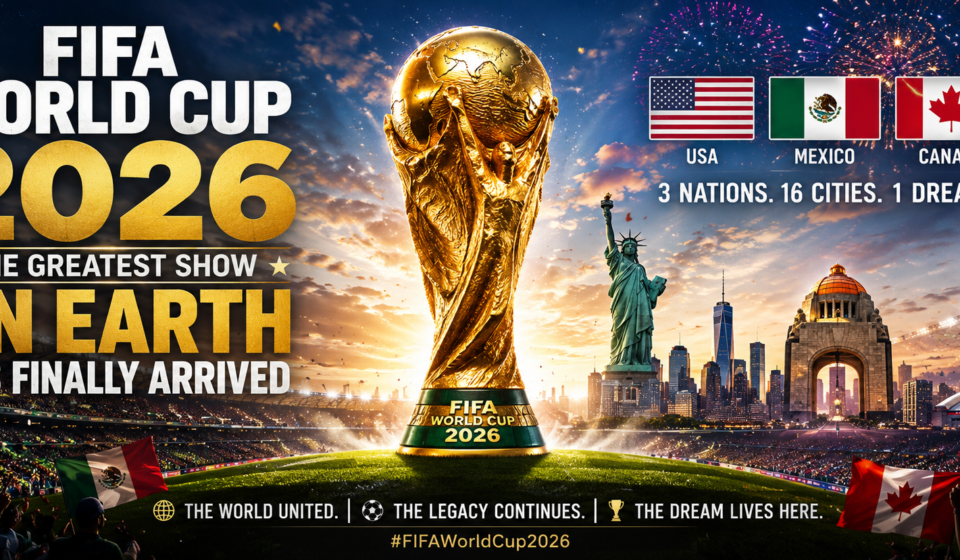

The Greatest Show on Earth Has Finally Arrived
There’s something different about this one. You can feel it in the air — not just the North American summer heat, but an electricity that comes around only once every four years, now stretching from the streets of Mexico City all the way up to the stadiums of Toronto. The 2026 FIFA World Cup is here, and it is already shaping up to be one for the ages.
This is the 23rd edition of the tournament, but in almost every meaningful way, it’s the first of its kind. Forty-eight teams instead of thirty-two. Three host nations — the United States, Canada, and Mexico — sharing the responsibility and the pride. Sixteen cities. A hundred and four matches spread across five weeks of football that has already left fans breathless, heartbroken, and on their feet cheering at all hours of the day and night. If there’s a World Cup worth staying up until 3 a.m. for, this is it.
A Tournament Built for the Ages
Before diving into the matches themselves, it’s worth pausing to appreciate what FIFA has put together here. The expanded 48-team format was always going to be a gamble. Critics worried the group stage would be diluted — too many easy games, not enough at stake. Those critics have largely been silenced.
With 12 groups of four teams each, and the top two from every group plus the eight best third-place finishers advancing to a Round of 32, the stakes in every single match have felt real. A draw is no longer a comfortable result. A single loss doesn’t necessarily end your tournament, but it does put you right on the edge. That tension has made for some genuinely thrilling football, and we’re only just past the group stage.
The venues have been spectacular. From the iconic Estadio Azteca in Mexico City — where the tournament kicked off on June 11 — to the MetLife Stadium in New Jersey, where the final is scheduled for July 19, the settings have matched the occasion.
Group A: Mexico’s Dominance
Mexico came into this tournament with something to prove on home soil, and they delivered. Three wins from three — 2–0 against South Africa, 1–0 against South Korea, and a dominant 3–0 against Czechia in the final group game — saw El Tri top Group A with authority. The atmosphere at their home games has been electric, and the pressure on them will only grow from here. But right now, they look like a team playing with genuine belief.
South Korea finished second despite losing their final group match to South Africa, their earlier wins proving enough to see them through. It was a bittersweet end to the group stage for them, but they’re through, and that’s what matters.
Group B: Canada’s Bumpy Ride
Canada’s group stage was the footballing equivalent of a rollercoaster. After the opening draw with Bosnia, they did exactly what was needed — absolutely demolished Qatar 6–0 in their second game, one of the most lopsided results the tournament has seen so far. But their third game ended in a tense draw, leaving their qualification as group runners-up dependent on goal difference. They’re through, but the knockout rounds will demand far more consistency.
Group D: The USMNT’s Bittersweet Journey
The United States had the perfect start, the perfect middle, and then a painful stumble at the end. After that barnstorming 4–1 win over Paraguay on opening day, they followed up with a composed 2–0 victory over Australia, looking every inch the group winners in the making.
Then came June 25, and Türkiye happened. In a match the USA needed only to avoid a heavy defeat, they were beaten 3–2 in what turned out to be a genuinely entertaining game. It stung. It dampened what had been a triumphant home group stage. But they still topped Group D, and they move into the Round of 32 with enough in the tank to hurt anyone. Australia, who bounced back from their opening loss to Türkiye with a disciplined draw against Paraguay in the final game, also progressed.
Group E: Germany’s Rollercoaster
Perhaps no story in the group stage has been as compelling as Germany’s. They opened with a jaw-dropping 7–1 hammering of Curaçao — seven goals, vintage German efficiency, the kind of result that makes you think they might just win the whole thing. Then they beat Ivory Coast 2–1, looking every bit the tournament favourites some had tipped them to be.
And then Ecuador happened. In one of the genuine upsets of the tournament so far, the South Americans beat Germany 2–1 in the final group game, a result that stunned everyone watching. Germany still advanced, but the manner of that defeat raised questions that will need answering in the knockout rounds.
Group F: Netherlands and Japan
Group F gave us some of the most enjoyable football of the tournament. Japan drew 2–2 with the Netherlands on matchday one, a result that immediately signalled Japan’s intentions. Sweden thrashed Tunisia 5–1 on the same day, setting up a group that felt genuinely open.
By the end, the Netherlands had asserted themselves as group winners — beating Sweden 5–1 in a second match that showed their full attacking capability — while Japan drew 1–1 with Sweden in the final round to book their place as runners-up. If Japan play Brazil in the knockouts, it will be a fascinating test of just how far they’ve come.
Group H: Cabo Verde and the Shock of the Tournament
Let’s take a moment here for Cabo Verde, because they deserve it. A small island nation with a population of fewer than 600,000 people — and they have held Spain to a 0–0 draw, beaten Saudi Arabia, and qualified for the Round of 32. They then have a fixture against Argentina in the knockout stage, and nobody is treating that as a foregone conclusion anymore.
Groups I through L: Messi, Mbappe, Ronaldo, and Haaland
The star power at this tournament has been absurd, and the later groups are where most of it is concentrated.
Lionel Messi turned 39 during this tournament and has been nothing short of extraordinary. He scored a hat-trick in Argentina’s opening group game and has continued adding to his tally, currently leading the Golden Boot race and inching ever closer to records that may never be broken. Watching Messi at a World Cup on this continent, with this kind of fanfare, has been genuinely special.
France’s Kylian Mbappe became his country’s all-time leading scorer during the group stage, finding the net against Senegal in a game France eventually won 3–1. France have been in imperious form — they beat Norway 4–1 in their final group game, with Ousmane Dembele scoring a hat-trick. They look like the team most likely to stop Argentina lifting the trophy again.
Cristiano Ronaldo, now 41 years old and still finding ways to make headlines, scored twice in Portugal’s 5–0 win over Uzbekistan. Whether it was the right call to start him — that debate has already been raging — but the goals silenced his detractors, at least for a moment. Portugal drew with Colombia in their final group game, leaving some unfinished business heading into the knockouts.
And then there’s Erling Haaland. Norway were beaten 4–1 by Iraq in their opener in one of the early surprises of the tournament, and Haaland has carried a heavy burden ever since. He scored twice against Senegal and hit the post when clean through in another match — the kind of near-miss that haunts strikers. Norway’s knockout hopes are alive, though precarious.
England, meanwhile, have been the source of the usual mixture of cautious optimism and familiar anxiety among their supporters. A goalless draw against Ghana in their opener, followed by mixed performances, left Thomas Tuchel’s side heading into the final group game against Panama needing a result. England going deep into a tournament always generates enormous global attention, and this edition is no different.
The Round of 32: What Comes Next
As of June 28, the group stage is wrapping up and the Round of 32 is taking shape. Some of the confirmed matchups already look mouth-watering.
The United States will face Bosnia and Herzegovina on July 1 in Santa Clara, California — a home crowd behind them, the pressure of expectation enormous, but a squad that has genuinely looked capable of going deep in this tournament.
Mexico face Egypt in Mexico City, which ought to be an atmospheric cauldron of noise. Canada meet South Africa in Los Angeles. The Netherlands face Morocco in Monterrey. France will play Sweden in New York.
The Bigger Picture
What this World Cup has reminded us, more than anything, is that football is at its most powerful when it crosses borders. The sight of Cape Verde fans in full voice, the Mexican supporters at the Azteca, the American crowds discovering something entirely new to love about soccer — all of it speaks to what makes this tournament unique among sporting events.
There have been 196 goals scored in 66 group stage matches so far, working out to an average of almost three goals per game. That figure alone tells you this is not a defensive, cautious tournament. Teams have come here to play, and the results have been gloriously unpredictable. Germany demolished seven goals and then lost to Ecuador. Belgium stuttered and then exploded. The United States won big, lost small, and are still in the hunt.
The smart ball, the hydration breaks, the expanded format — none of it has diminished what matters most about the World Cup, which is the football itself. If anything, having more teams and more matches has simply given us more moments: more upsets, more heroes, more reasons to stay glued to a screen at whatever hour your time zone demands.
Looking Ahead to the Final
Before we get there, there are 32 knockout matches still to play. Teams will rise and fall. Stars will illuminate or disappoint. There will be penalty shootouts in the early hours of the morning that leave fans emotionally destroyed and strangely alive at the same time.
What we know for certain is this: the 2026 FIFA World Cup has already delivered on its enormous promise. The football has been thrilling, the stories have been compelling, and the best is still to come.
Somewhere in the next few weeks, a player will score a goal that people talk about for decades. A small nation will achieve something nobody thought possible. A favourite will go home too early. And eventually, on July 19, a team will lift the trophy in New Jersey while confetti fills the air and the world, briefly and beautifully, shares the same feeling.
That’s what the World Cup does. That’s why we watch.