
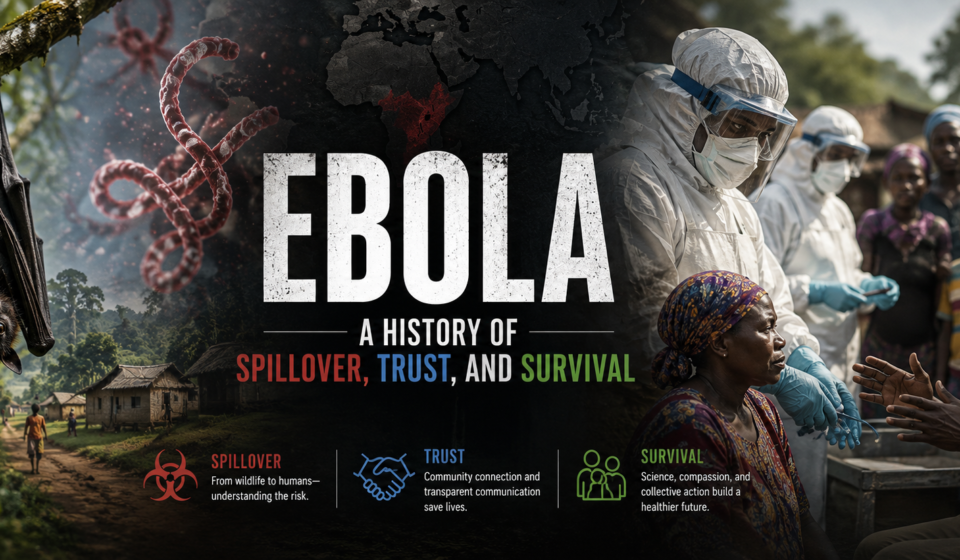
Where It Begins
My aunt used to say that some things don’t need to be knocked twice. They just walk in and take whatever they want. I didn’t understand what she meant until I read about what happened in a small village in Guinea back in 2013. A two-year-old boy got sick. They were all dead within days. Nobody in that village knew what was happening. The local health workers didn’t know. The regional government didn’t know. By the time anyone figured it out, the virus had already slipped into the next town, and then the next one.
The Index Case
That little boy — Emile Ouamouno — is considered the index case of the worst Ebola outbreak the world has ever seen. His mother had no idea. And the disease that started with one toddler in one village in the corner of one African country eventually infected 28,000 people across three nations and killed more than 11,000 of them.
I think about Emile a lot when people talk about Ebola like it’s just a news story.
A Brief History of the Virus
The virus was first identified in 1976, and even then it came twice at once — two separate outbreaks, one in Congo, one in Sudan, happening almost at the same time with slightly different strains. Scientists named it after the Ebola River in Congo, close to where one of the outbreaks was centered. From 1976 all the way through 2013, there were roughly 20 outbreaks recorded. Bad ones, some of them. Villages destroyed, health workers dead. But they stayed contained — remote areas, limited movement, the fire burning out before it could spread too far.
Nobody got complacent exactly. But nobody fully imagined 2014 either.
2014: When It Reached the Cities
When the West Africa epidemic hit, it hit differently because of where it hit. Guinea, Sierra Leone, Liberia — countries that had already been through years of civil war, countries where the health systems were thin on a good day, where there weren’t enough doctors, where hospitals in rural areas were sometimes just a building with a few beds and not much else. The virus didn’t just find victims. It found an open door.
And then it found another thing that nobody expected: cities. Previous outbreaks had mostly burned through remote areas and stopped. This one reached Conakry, Freetown, Monrovia. Dense populations. Markets with hundreds of people. Motorcycles and minibuses crossing borders every day. The normal containment playbook didn’t work. Nothing worked fast enough.
How Ebola Spreads
Here is something that doesn’t get said enough about how Ebola spreads: it travels through love.
Not in a poetic sense. In a literal, biological sense. You catch Ebola from contact with the blood or fluids of someone who is already sick. And who is most likely to be in close contact with someone who is sick? Their family. The person who stays up all night mopping their forehead. The children sleeping in the same bed. The neighbor who comes over with food. The community that gathers around someone dying because that is what communities do — they show up.
In West Africa in 2014, traditional burial rites meant washing the body of the deceased, touching them, being close. This wasn’t ignorance. This was love, and it was centuries old. It was how you honored someone. It was how you said goodbye. And the virus — which remains highly contagious in a dead body — used every moment of that grief as a bridge to the next person.
Health teams coming in and saying you cannot touch your dead — you cannot wash them, you cannot hold them, strangers in plastic suits will take them away and bury them — were not wrong to say it. But you can imagine what it felt like to hear it. You can imagine why people didn’t trust them. You can imagine why some families hid their sick relatives, why rumors spread that the treatment centers were places people went to die, why some communities turned health workers away or worse.
What the Disease Does to the Body
Distrust isn’t irrational when it comes from somewhere real. And in communities that had lived through colonialism, through wars, through decades of being failed by outside institutions — the distrust was coming from somewhere very real.
The disease itself is brutal in a way that feels almost personal, like the virus is going out of its way to undo you.
It starts soft. Fever. Tired. Headache. The kind of thing you tell yourself is probably nothing. Then your muscles start to ache in a way you can’t ignore. Then vomiting. Diarrhea. A rash across the skin. Your body starts losing fluids faster than you can replace them, and if you’re in a rural village in Guinea without IV drips and trained nurses, dehydration alone can kill you.
Organ Failure and Survival Odds
In severe cases, the virus interferes with how the body handles clotting. Things start to bleed that shouldn’t bleed. The liver struggles. The kidneys start to shut down. Some people bleed outwardly — the hemorrhaging that made Ebola famous in the worst possible way — though this is less common than movies made people think. Most people who die from Ebola die from the collapse of basic organ function, from shock, from a body that ran out of ways to cope.
The window from first symptoms to death can be less than ten days. Ten days from feeling like you have a bad flu to being gone.
Survival rates have historically ranged from around 25 percent to 90 percent depending on the strain and the quality of care available. That gap — 25 to 90 — tells you everything about how much access to basic medical support matters. Ebola with an IV drip, with electrolytes, with monitoring, is survivable for many people. Ebola in a village with nothing is something else entirely.
The people who went toward it — I don’t know what to do with them, honestly. Not in a bad way. I just mean I don’t know how to hold what they did.
Local Health Workers
There were international doctors and aid workers, yes. But the ones who bore the most risk were local. Nurses from Sierra Leone who kept showing up after colleagues died. Community health workers in Guinea who went door to door in villages where people didn’t want them there, tracking contacts, explaining symptoms, doing the slow and unglamorous work of containment one conversation at a time. Doctors in Liberia who slept in their cars because they were too worried about bringing something home to their families.
More than 500 health workers died in the 2014–2016 outbreak. Five hundred people who had trained to heal people, who understood exactly what this virus did, and who showed up anyway.
The international response eventually came, though it took too long. The United States, the United Kingdom, Cuba, China — countries sent teams, supplies, money, field hospitals. The WHO got its act together, eventually. Experimental treatments got fast-tracked. A vaccine that had been sitting in early trials for years got pushed into emergency use.
By the time the West Africa epidemic was declared over in 2016, it had reshaped how the world thinks about outbreak response. Not perfectly. Not permanently. But meaningfully.
Vaccinating in a War Zone
Ebola came back in Congo in 2018. Another massive outbreak, the second-largest ever recorded, and this one in the eastern part of the country where armed militias were actively attacking health workers and burning clinics. People were trying to vaccinate in a war zone. Some of them were killed doing it.
The vaccine — rVSV-ZEBOV, now licensed as Ervebo — had shown real promise in trials during that outbreak. A ring vaccination strategy, where everyone in close contact with a confirmed case gets vaccinated, then everyone in contact with those people, building outward, had genuine impact. The outbreak ended in 2020, more than two years after it started, in circumstances that made containment seem almost impossible.
There are now treatments too, actual antivirals, drugs that target the virus directly instead of just trying to keep the body alive long enough to fight it off. Survival rates in treatment centers with these drugs have been dramatically better than anything seen before. This is what progress looks like — slow and expensive and paid for partly in the lives of people who died before it arrived, but real.
Why It Will Come Back
Ebola will emerge again. Nobody who studies it seriously believes otherwise. Somewhere in the forests of Central Africa, the virus persists in animal reservoirs — bats most likely, though the natural host hasn’t been definitively confirmed after decades of research. The spillover into humans happens when that boundary breaks, when someone encounters an infected animal, when that first chain of transmission starts somewhere remote and quiet before anyone notices.
What happens after that first case depends on things we actually have some control over.
The Harder Problem
The science has gotten better. The vaccines and treatments exist now in ways they didn’t a decade ago. But the social conditions — the broken trust, the gutted health systems, the inequality that makes some populations infinitely more vulnerable than others — those haven’t been fixed. Those are harder than a vaccineThe Harder Problem.
Emile Ouamouno was two years old. He was playing outside near a tree. The world he was born into didn’t protect him, and the fire that started with him took eleven thousand more people before it burned out.
That’s what Ebola is. Not just a virus. A question we keep failing to answer about who we decide to protect, and when, and how seriously we mean it.