
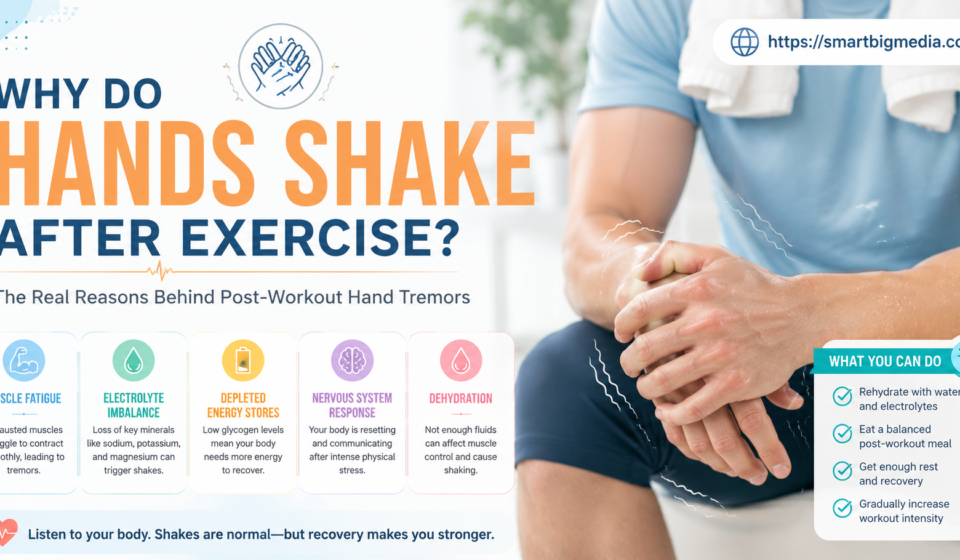
Finished a set of pull-ups once, dropped off the bar, went to grab my water bottle, and my hand basically had a mind of its own. Couldn’t hold the bottle still to save my life. Water everywhere. For about five seconds, I genuinely thought something was wrong with me. Then it clicked — I’d just gripped a bar for three straight minutes, and my forearms were done.
That’s the short version of what’s usually going on. Not always, but usually. Let’s get into it properly.
The Muscle Fatigue Thing
This is the one that explains most cases, by a wide margin. Your muscles don’t contract as one smooth block — they’re made of thousands of tiny motor units, each firing in sequence to produce a controlled movement. Push a muscle group hard enough, and those units start getting tired. Tired units no longer fire in sync. Some fire late, some fire early, some just misfire, and what you see from the outside is that fast little tremor.
Hands and forearms get hit with this constantly because they’re small muscles doing outsized work. Think about it — your forearm is maybe the size of a soda can, and you’re asking it to hold onto 200+ pounds during a deadlift, or support your entire bodyweight on a climbing hold. Of course it shakes. I’d be more surprised if it didn’t.
Climbers know this feeling better than almost anyone. So do people who do a lot of rowing, or farmer’s carries, or honestly anyone who just moved a couch by themselves.
Or Maybe You Just Didn’t Eat
Skipped breakfast, went straight into a workout, and by the last few minutes, your hands are trembling and you can’t stop thinking about food? That’s probably your blood sugar, not your muscles.
Exercise chews through glycogen — your body’s stored carb fuel — pretty fast, especially anything intense or long. Drop your blood sugar low enough and shakiness is one of the first symptoms, usually paired with feeling a little foggy or short-tempered. I do this to myself more than I’d like to admit. Fasted HIIT class, no snack, twenty minutes in and I’m shaky and irrationally annoyed at the instructor.
Adrenaline Doesn’t Just Turn Off Immediately
You know that shaky feeling right after a near-miss on the highway? Or right before you give a speech? Same system. Intense exercise — heavy lifting, sprinting, competing in something — dumps adrenaline into your bloodstream because your nervous system treats hard physical effort a lot like danger. One of the side effects of that adrenaline is a fine tremor in the hands.
This one’s usually harmless and short-lived. Give it twenty, thirty minutes and it settles on its own as your body comes back down from the spike.
You Sweated Out More Than Water
Sweat carries sodium, potassium, magnesium, calcium — the electrolytes your nerves actually need to talk to your muscles properly. Sweat a ton without replacing any of that, and you can end up with twitching, cramping, or shaking, hands included. Hot yoga people, outdoor summer runners, anyone who trains in a non-air-conditioned garage gym in July — this one’s for you.
Pre-Workout Might Just Be the Answer
Worth checking honestly: does this only happen on days you take pre-workout? A lot of those products pack 200mg+ of caffeine per scoop, sometimes way more, plus other stimulants stacked on top. That’s a legitimate jolt to your nervous system, and shaky hands are a well-documented side effect of exactly that. If the pattern lines up, that’s your culprit, not some mystery condition.
Training Too Much, Too Often
Different category entirely, this one. If you’re going hard almost every single day with no real recovery, your nervous system can end up stuck in an overstimulated state. People dealing with this notice shaking that doesn’t fully disappear even on rest days, plus stuff like restless sleep, a resting heart rate that’s crept up, and just generally feeling wrung out all the time. Not a single-workout problem — a pattern problem.
Is Any of This Actually Normal?
Yeah, for most people, most of the time. A bit of trembling after you’ve pushed hard isn’t a red flag. It’s honestly kind of a badge of effort. You’re probably fine if the shaking starts around when you finish, calms down within the hour, only shows up on harder or longer sessions, and you otherwise feel like your normal post-workout self — tired, sure, but not off in any other way.
When It’s Not Just “You Worked Hard”
A few situations are genuinely worth paying attention to instead of shrugging off.
If it’s still going hours later, or you wake up the next day and it hasn’t fully stopped, that’s outside the range of normal exertion tremor. Could be electrolytes, could be thyroid, could be a blood sugar regulation issue worth checking.
If other stuff shows up alongside it — dizziness, chest tightness, an irregular heartbeat, confusion, sweating way more than the workout would explain, numbness in your fingers — mention that combination to a doctor. Don’t just wait it out.
If it’s happening outside of exercise too, that’s a different conversation entirely. Shaky hands during regular daily life can point toward anxiety, thyroid issues, essential tremor, or blood sugar problems that have nothing to do with your gym sessions.
And if you’ve got diabetes and you’re on insulin or other blood sugar meds, take this seriously. Shaking plus sweating, confusion, or weakness after a workout could mean your blood sugar dropped too low. Keep something with fast-acting sugar on hand during training, always.
What Actually Cuts Down on the Shaking
None of this requires a total lifestyle overhaul. Small stuff, mostly.
Eat something before you train. Doesn’t need to be big — half a banana with some peanut butter, a small handful of nuts, whatever. Just enough to keep your blood sugar from bottoming out mid-workout.
Drink water throughout your whole day, not just during the session itself. If you’re sweating a lot, especially somewhere hot, add electrolytes in.
Don’t slam the brakes at the end of a hard set or run. Give yourself a few minutes to wind down — light movement, some stretching, slower breathing. Your nervous system needs that transition period.
If pre-workout’s the trigger, cut the dose or skip it on your lighter training days.
Take actual rest days. Not “active recovery that’s basically another workout” — real rest.
If you’re newer to heavy grip-dependent lifts, ease into them. Don’t max out week one. Let your grip build up the way the rest of your body does.
Bottom Line
Most of the time, shaky hands after exercise are just your body’s normal reaction to being pushed — tired muscles, adrenaline, a blood sugar dip, some lost electrolytes, or all four at once. It’s not a malfunction. If anything, it means the workout actually did something.
Still, pay attention to your own patterns. Shaking that lingers, comes with other symptoms, or shows up when you haven’t even exercised — that’s worth a real conversation with a doctor, not a guess based on an article. But for the vast majority of people reading this, those shaky hands after a hard session are exactly what they look like: proof you gave it real effort.



[…] bit of background first. As you get closer to sleep, your core body temperature naturally starts dropping — that drop is actually part of what tells your brain it’s time to sleep. […]