
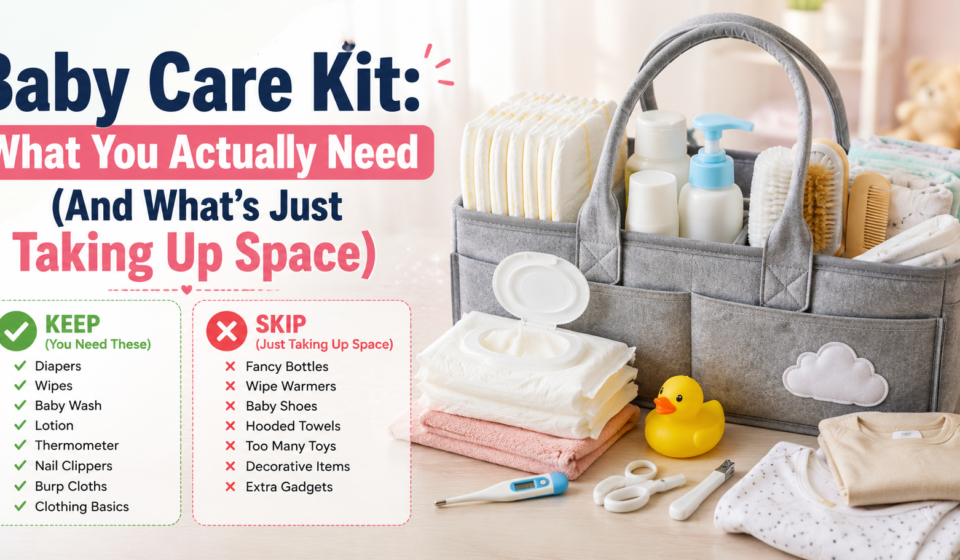
Baby Care Kit: What You Actually Need (And What’s Just Taking Up Space)
Week thirty of my pregnancy, I ordered one of those baby care kits everyone’s registry list tells you to get. Little zip-up case, twenty-something pieces inside — clippers, a nasal thing, a thermometer, brushes, a comb, that rubbery gum massager. I opened it up and thought, great, done, box checked.
Wrong. By week two of actually having a baby I was out buying four things I didn’t have, at 11pm, half asleep, panicking a bit. And about six things from that fancy kit never left the case. So no, this isn’t a copy-paste registry list. This is what I actually reached for, and what just sat there looking nice.
What A Baby Care Kit Actually Is
It’s a small bundle of grooming and basic health stuff, scaled down for someone who weighs less than a bag of flour. Clippers small enough that you don’t nick a fingertip that’s basically the size of a grain of rice. A thermometer meant to work on a baby who will absolutely not hold still for it. A nasal aspirator, because babies get congested constantly in year one and have zero ability to blow their own nose. Soft brush, comb, sometimes a weird little mitt with bristles on it for cradle cap.
Some kits throw in a toothbrush too, or emery boards instead of clippers, for parents who’d rather file than clip — which, fair, filing feels less like defusing a bomb. And there’s almost always a case, which might genuinely be the best part. One spot for everything instead of hunting through a diaper bag half-asleep.
Why This Stuff Matters More Than It Sounds Like
Before I had a kid I thought this whole category was overblown. They’re tiny. How much upkeep can a tiny person need?
A surprising amount, in small doses. Newborn nails grow fast — fast enough that you’ll spot little scratches under their eyes within days if you’re not on top of it, because their arms flail around and their nails are sharp. Their noses clog constantly since the passages are so small, and a stuffy nose messes with feeding and sleep almost immediately. Fevers need actual numbers, not guessing with the back of your hand, because the “call the doctor” line sits much lower for infants than it does for the rest of us.
None of it is hard once the right tool’s in your hand. It’s just fiddly, and having it all together instead of scattered across the house saves you from losing your mind during those first exhausted weeks.
What Got Used Constantly
The nasal aspirator. Not the bulb kind — we switched to the tube-suction kind you control with your own mouth through a filter, and it worked so much better it wasn’t even close. Congestion hit early and often, and clearing it before a feed or before bed made a real difference every time.
Nail clippers, right behind it. I was legitimately sweating the first time I used them on my son’s fingers, sat there for ten minutes just staring at his hand trying to work up the nerve. Became routine within a couple weeks though. If clippers freak you out, filing works fine too, especially in month one when nails are still soft and thin.
The thermometer, non-negotiable. Rectal, for the first several months, because that’s what pediatricians actually recommend for infants even though it sounds awful before you’ve done it. Switched to forehead later on for convenience, but early on, accuracy won over comfort every time.
Soft brush, daily, though not for hair — mine barely had any for months. Mostly used on the scalp, easing mild cradle cap, and it became this weirdly calming part of the bedtime routine.
What Never Left The Case
The gum massager. Tried it twice. My son hated anything near his mouth that wasn’t food, and most babies get through teething fine without one anyway.
The comb. Sure, if your baby’s got hair. Mine didn’t have enough to comb until he was almost a year old.
Emery boards. Some parents love these. I tried filing his nails once and gave up halfway through — takes forever with a squirming baby.
The little sponge thing meant for baths. Regular washcloth did the job. Didn’t need a specialty item for that one.
None of this means these items are useless across the board — more hair, different comfort level with clipping versus filing, all of it varies by kid. But go in knowing you probably won’t touch everything in the box, and that’s fine.
Skipping The Pre-Made Kit And Building Your Own
If you’d rather just buy what you know you’ll use instead of a bundled kit, here’s roughly what covers it.
A digital thermometer, ideally one made for infant or rectal use in the early months. A nasal aspirator — tube-suction over bulb, if you can find one, seriously. Clippers or an emery board, whichever you’ll actually stick with. A soft-bristled brush for the scalp. Baby-safe cotton swabs for the outer ear only, never inside the canal. Saline drops to pair with the aspirator, since dry congestion is much harder to clear than loosened mucus. And a small first aid stash — infant pain reliever for their age, a couple bandages, something for diaper rash.
That covers most of it, and it usually costs less than the pre-made kit anyway, minus all the stuff you won’t touch.
If You’d Rather Just Buy A Kit
Fair enough, sometimes you just want the decision made for you. A few things worth checking first.
What’s the case made of, and can it be wiped down easily — it’s going to live in a diaper bag or a drawer getting grabbed by tired hands at weird hours. Is the thermometer actually rated for infants or just something generic tossed in to bulk up the box. Look closely at the clippers specifically, since some cheaper kits include blades that are too small or oddly shaped, which makes an already nerve-wracking job worse.
Also worth skimming reviews for anything about sharp edges or small pieces coming loose. Infant products don’t always get checked as carefully as they should before landing on a shelf.
When You’ll Actually Reach For Each Thing
First two weeks, it’s mostly the thermometer and clippers or file. Newborn nails grow shockingly fast, sometimes needing a trim every few days.
Weeks two through eight, congestion tends to ramp up, especially once you’re out more or if there’s an older sibling bringing germs home from school. Aspirator time.
Three to six months, cradle cap tends to show up for a lot of babies, which is when the soft brush stops being decorative and starts being useful.
Past six months, teething kicks in, and suddenly that gum massager you ignored for half a year might actually get some use. Every baby’s on their own timeline though, so don’t stress if yours doesn’t match up exactly.
Things I Wish Someone Had Told Me
Buy two sets of clippers or files. One will get left in a diaper bag, lost under a car seat, or vanish during a 3am feed, and you don’t want to be hunting for it while your baby’s finally asleep and your hands are free.
Practice with the aspirator before your baby’s actually sick. Do it once or twice while they’re calm, so you’re not fumbling through it for the first time while they’re congested and upset and you’re both frustrated.
Keep the kit in one exact spot, every time, somewhere you walk past a lot — a changing table drawer works well. Hard to overstate how many middle-of-the-night searches this saves you.
And don’t feel like you have to use every single item just because it showed up in the box. Treat it like a starting point, not a checklist.
Last Thing
A baby care kit looks like one of those forgettable little registry items buried under bigger stuff like the crib and the car seat, but it ends up being something you touch nearly every day for months. You don’t need the fanciest version, and you shouldn’t feel bad if half of it sits untouched. Figure out what your baby actually needs — congestion relief, nail care, a thermometer that works — and build around that. Everything else is just extra plastic taking up space in a drawer.



[…] the repair kit more than once. A tiny puncture from a stick you never even saw can end a trip early if […]
[…] genuinely hard is the loss of touch. A surgeon operating traditionally feels tissue resistance directly through […]