
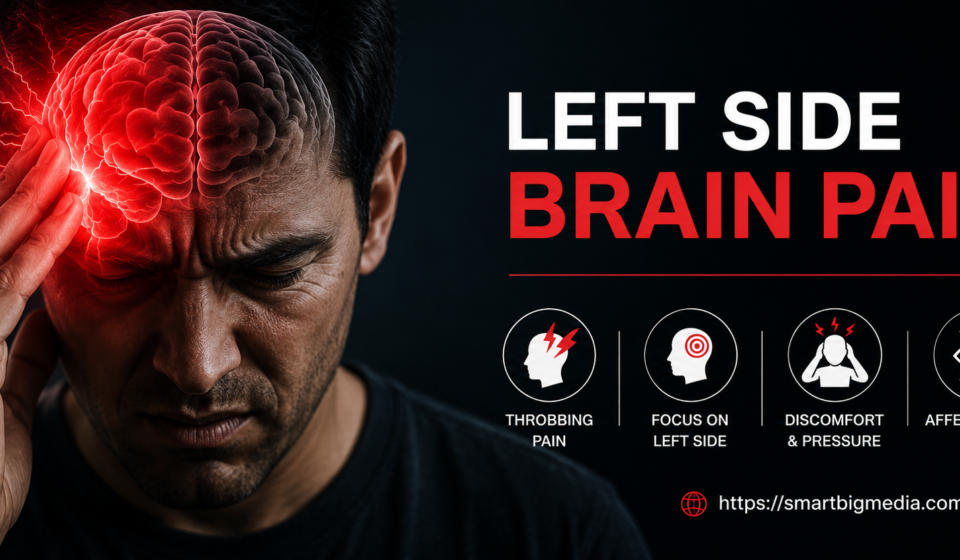

You’re sitting there, and it hits — that ache on the left side of your head. Maybe it’s a dull pressure, maybe it’s sharp enough to make you stop mid-sentence. Either way, your first instinct is probably to Google it, because “left side brain pain” sounds a lot scarier than “headache.”
Here’s the thing worth knowing right away: the brain itself doesn’t actually feel pain. It has no pain receptors. So when people say “brain pain,” what they’re really feeling is pain from the tissue around the brain — muscles, blood vessels, nerves, sinuses, the scalp. That distinction matters, because it means most left-side brain pain isn’t your brain “hurting” in the way it sounds. It’s something nearby acting up.
Why It’s Happening on the Left Side Specifically
There’s no single answer here, and that’s honestly the frustrating part. A handful of things tend to show up on one side of the head more than the other.
Migraine is probably the biggest one. It’s not just “a bad headache” — it usually throbs, gets worse when you move around, and is accompanied by nausea or sensitivity to light. A lot of migraine sufferers will tell you it almost always picks the same side, and for plenty of people, that side is the left.
Tension headaches are the other frequent visitor. These feel less like throbbing and more like someone’s slowly tightening a strap around your skull. They’re usually tied to stress, bad posture, or one of those days where your shoulders have been up around your ears without you noticing.
Then there’s the less common but more intense option: cluster headaches. These tend to camp out behind one eye, hit hard, and come in waves — sometimes for weeks at a stretch before disappearing for months. If your left eye gets red or watery along with the pain, this could be why.
A few other everyday culprits: not drinking enough water, skipping meals, bad sleep, too much caffeine one day and none the next, sinus pressure on that side of the face, or tight neck muscles referring pain upward. Even a minor bump to the head days ago can leave a lingering ache.
When Left Side Brain Pain Isn’t “Just a Headache”
Most of the time, this kind of pain is annoying but harmless. But there are moments where it’s your body waving a flag, and it deserves attention right away:
- The pain came on suddenly and feels like the worst headache you’ve ever had
- One side of your face, arm, or leg feels weak or numb
- You’re struggling to speak or find words
- Your vision is blurry, doubled, or partly gone
- You’ve got a stiff neck along with a fever
- The pain gets worse when you cough, strain, or bend over
- You black out, or have a seizure
None of these are things to sit on. If any of them show up alongside the pain, skip the home remedies and get seen.
What Actually Helps
If nothing on that warning list applies, there’s a decent chance rest and a little patience will do the job. Water helps more than people expect — plain dehydration causes more headaches than most of us realize. A cool or warm compress, whichever feels better, on the neck or scalp can ease things too. So can just sitting somewhere dark and quiet for a bit, away from screens.
If your neck and shoulders feel like concrete, a slow massage there sometimes untangles the pain faster than any pill. And if you keep getting this on a regular basis, jotting down when it happens, what you ate, how you slept, what was going on that day — it sounds tedious, but patterns show up fast once you start tracking them.
The Bottom Line
Left side brain pain is common, and in almost every case it’s not your brain that’s the problem — it’s something around it, whether that’s tension, dehydration, sinus pressure, or migraine. Pay attention to how it feels and what comes with it. If it’s just an ache that fades with rest, you’re probably fine. If it’s sudden, severe, or paired with anything on that warning list, don’t wait it out — get it checked.
This is general information, not medical advice. If your pain is severe or unusual, talk to a doctor.




[…] the short version: if a tool is designed to cut, hold, lift, or remove tissue or bone in the mouth, it’s surgical. That’s different from your everyday check-up tools like mirrors and probes, which are just […]
[…] about what a nurse actually does in a twelve-hour shift. Standing, bending, lifting, running when something goes wrong, sitting on the floor next to a patient […]