
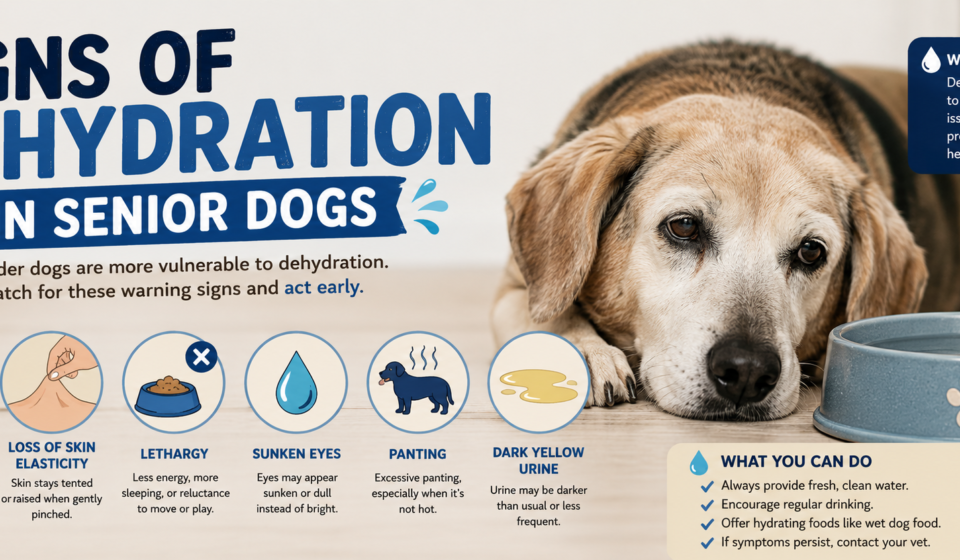
Signs of Dehydration in Senior Dogs: What Every Owner Should Know
As dogs age, their bodies become less efficient at a lot of things most owners never think much about until there’s a problem — and fluid regulation is one of the biggest ones. Senior dogs are considerably more prone to dehydration than younger, healthier dogs, for reasons that go beyond simply “not drinking enough water,” and the signs often show up in ways that are easy to miss or mistake for normal aging.
Understanding why senior dogs are more vulnerable, and what dehydration actually looks like in an older dog, can make the difference between catching an issue early and letting it progress into something more serious.
Why Senior Dogs Are More Prone to Dehydration
Several age-related changes stack together to increase dehydration risk in older dogs. Kidney function naturally declines with age in most dogs, reducing the body’s ability to conserve water efficiently, which means senior dogs often need more water intake, not less, to maintain the same hydration status they had when younger. At the same time, many senior dogs develop conditions — arthritis, reduced mobility, dental pain, or cognitive changes — that make it physically harder or less appealing to get up and walk to the water bowl as frequently as they used to.
Some common medications prescribed for senior dogs also affect fluid balance, either increasing fluid loss or reducing thirst drive, adding another layer to an already increased baseline risk. None of this means dehydration is inevitable in senior dogs, but it does mean the margin for error is smaller, and it’s worth being more deliberately attentive than you might have needed to be with a younger, healthier dog.
The Skin Tent Test: Useful, But Not Foolproof in Seniors
Most people are familiar with the classic “skin tent” test for dehydration — gently pinching the skin at the back of the neck or between the shoulder blades and observing how quickly it snaps back into place. In a well-hydrated dog, skin should return to normal almost immediately. In a dehydrated dog, it stays tented or returns slowly.
This test is genuinely useful, but it becomes less reliable specifically in senior dogs, since skin elasticity naturally decreases with age regardless of hydration status, meaning an older dog’s skin may return more slowly even when they’re adequately hydrated. This doesn’t mean the test is useless in seniors — a dramatic difference from your dog’s own normal baseline is still meaningful — but it does mean relying on this test alone, without considering other signs, can give a misleading picture in an aging dog.
Gum Color and Moisture Are More Reliable in Older Dogs
Checking gum moisture and color tends to be a more consistently reliable indicator across age groups, including seniors. Healthy, hydrated gums should be moist and slick to the touch, with a healthy pink color. Dehydrated gums often feel tacky or dry rather than slick, and in more significant dehydration, gum color can become pale.
Capillary refill time — gently pressing on the gum until it turns white, then timing how quickly the color returns, which should be under two seconds in a healthy dog — is another useful check that holds up reasonably well as a hydration indicator in senior dogs, though it’s also affected by other underlying health conditions, so it’s most useful as part of a broader picture rather than a single definitive test.
Lethargy That’s Different From Normal Senior Slowdown
This is one of the trickiest signs to interpret, because senior dogs naturally have less energy than younger dogs, which makes it easy to write off increased lethargy as simply normal aging rather than a potential warning sign. The distinction worth paying attention to is a noticeable, relatively sudden change from your own dog’s established baseline, rather than a gradual decline over months or years, which is more consistent with normal aging.
A senior dog who’s usually alert and responsive during the parts of the day they’re normally active, but who suddenly seems unusually flat, unresponsive, or difficult to rouse, is showing a pattern worth investigating rather than dismissing as “just getting older,” particularly if it appears alongside any of the other signs covered here.
Loss of Skin and Coat Quality
Chronic, ongoing mild dehydration — as opposed to a sudden, acute episode — often shows up gradually in coat and skin quality. A coat that’s become noticeably drier, duller, or more prone to flaking, without an obvious grooming or seasonal explanation, can be a sign that hydration status has been suboptimal for a while rather than a single recent event. This is a slower, more cumulative sign than most of the others on this list, but it’s worth factoring in as part of the broader picture of your senior dog’s hydration over time, not just in the moment.
Reduced Urination or Notably Concentrated Urine
Changes in urination patterns are a genuinely useful and often overlooked indicator. Reduced urination frequency, or urine that appears notably darker and more concentrated than your dog’s normal baseline, is a fairly direct signal that the body is conserving water more aggressively than usual, which typically indicates inadequate fluid intake or excessive fluid loss.
This is particularly worth monitoring in senior dogs with known kidney concerns, since kidney function and hydration status are closely intertwined, and changes in one often show up as changes in the other.
Dry Nose Isn’t a Reliable Indicator (Despite the Common Belief)
It’s worth explicitly debunking a widely repeated but inaccurate piece of folk wisdom: a dry nose is not a reliable indicator of dehydration in dogs of any age, including seniors. Nose moisture fluctuates for a wide range of unrelated reasons — sleep, temperature, and simple individual variation — and using it as a hydration checkpoint, while common advice, isn’t well-supported by how nose moisture actually behaves in practice. It’s better to rely on the gum, skin, urination, and behavioral indicators covered above rather than nose texture.
Practical Steps to Support Hydration in Senior Dogs
Given the increased baseline risk, a few proactive habits go a long way for senior dogs specifically:
- Place multiple water bowls throughout the house, particularly if mobility or joint pain makes it harder for your dog to travel to a single water source, especially across multiple floors.
- Consider a wider or shallower bowl if your senior dog has any neck or joint discomfort that makes reaching into a deep, narrow bowl uncomfortable.
- Monitor water intake roughly, noting if the amount your dog drinks in a day changes noticeably from their normal pattern.
- Incorporate wet food or water-rich treats into their diet if you notice reduced drinking, since dietary moisture contributes meaningfully to overall hydration.
- Keep a general sense of your dog’s normal gum color, skin response, and energy pattern, so you have an accurate baseline to compare against if something seems different.
When to See a Vet
Mild, occasional dehydration can often be corrected simply by encouraging more water intake and monitoring closely over the following day. But if you notice several of the signs above appearing together, if symptoms don’t improve with increased water access, or if your senior dog has known kidney, heart, or other chronic conditions, dehydration should be treated as a reason for a vet visit rather than something to manage at home alone, since senior dogs have a smaller physiological margin for error and can decline more quickly than a younger, healthier dog would in a similar situation.
Catching dehydration early in a senior dog is almost always more manageable than addressing it once it’s become more advanced, which is exactly why understanding the subtler, easy-to-miss signs matters as much as knowing the obvious ones.



[…] well run farm stable needs a plan for horses coming from outside. New boarder, horse back from a show, fresh purchase, whatever the situation. Setting aside a separate area, […]