

If you have ever checked an internet plan, network specification, or data-transfer rate, you may have come across terms such as Mbits, Kbits, Mbps, and Kbps. Understanding the relationship between these units makes it much easier to compare internet speeds and calculate data-transfer rates.
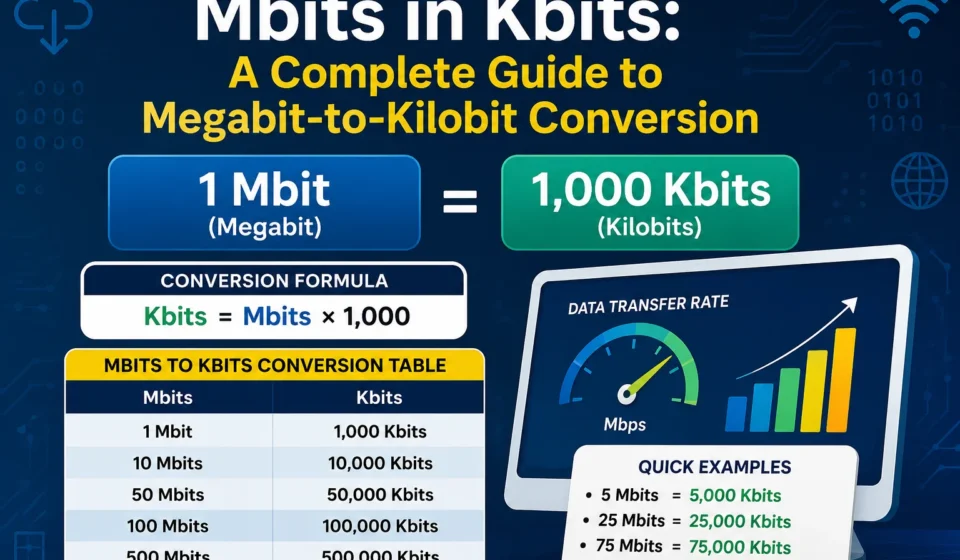
The good news is that converting Mbits in Kbits is straightforward. In the standard decimal system used for networking, 1 megabit (Mbit) equals 1,000 kilobits (kbit).
What Are Mbits?
A megabit (Mbit) is a unit used to measure digital information. The prefix “mega” represents one million in the decimal system, so:
1 Mbit = 1,000,000 bits
Megabits are especially common when discussing internet and network speeds. For example, an internet package may advertise a connection speed of 100 Mbps, meaning 100 megabits per second.
It is important not to confuse megabits (Mb) with megabytes (MB). A lowercase b represents bits, while an uppercase B represents bytes. One byte contains eight bits.
What Are Kbits?
A kilobit (kbit) is a smaller unit of digital information.
1 kbit = 1,000 bits
Kilobits are commonly encountered when measuring lower data-transfer rates or when expressing network speeds in smaller units. The standard decimal relationship means that 1,000 kilobits make one megabit.
Mbits in Kbits: The Basic Conversion
The main formula is simple:
Kbits = Mbits × 1,000
Therefore:
1 Mbit = 1,000 Kbits
For example, if you want to convert 5 Mbits to Kbits:
5 × 1,000 = 5,000 Kbits
So, 5 Mbits equals 5,000 Kbits.
Mbits to Kbits Conversion Table
| Mbits | Kbits |
|---|---|
| 1 Mbit | 1,000 Kbits |
| 2 Mbits | 2,000 Kbits |
| 5 Mbits | 5,000 Kbits |
| 10 Mbits | 10,000 Kbits |
| 25 Mbits | 25,000 Kbits |
| 50 Mbits | 50,000 Kbits |
| 100 Mbits | 100,000 Kbits |
| 500 Mbits | 500,000 Kbits |
| 1,000 Mbits | 1,000,000 Kbits |
This conversion follows directly from the decimal definitions of megabit and kilobit.
How to Convert Mbits in Kbits
You only need to follow three simple steps:
Step 1: Identify the Mbit value
Start with the number of megabits you want to convert.
For example:
25 Mbits
Step 2: Multiply by 1,000
Use the conversion formula:
25 × 1,000
Step 3: Add the Kbit unit
The result is:
25,000 Kbits
Therefore, 25 Mbits = 25,000 Kbits.
Examples of Mbits to Kbits Conversion
Here are several practical examples:
- 3 Mbits = 3,000 Kbits
- 8 Mbits = 8,000 Kbits
- 15 Mbits = 15,000 Kbits
- 20 Mbits = 20,000 Kbits
- 75 Mbits = 75,000 Kbits
- 150 Mbits = 150,000 Kbits
- 250 Mbits = 250,000 Kbits
The same multiplication rule works regardless of whether the number is small or large.
What About Mbps and Kbps?
The terms Mbps and Kbps include “per second,” so they describe data-transfer rates.
The relationship remains the same:
1 Mbps = 1,000 Kbps
For example, a 50 Mbps connection is equivalent to:
50 × 1,000 = 50,000 Kbps
This is why network specifications can be expressed using either Mbps or Kbps without changing the underlying connection capacity.
Mbits vs. MBytes: Why the Difference Matters
One of the most common sources of confusion is the difference between bits and bytes.
- 1 byte = 8 bits
- Mb = megabit
- MB = megabyte
- Mbps = megabits per second
- MB/s = megabytes per second
For example, a connection advertised as 80 Mbps does not mean it can download 80 MB of data every second. Since eight bits make one byte, 80 Mbps corresponds to a theoretical maximum of about 10 MB/s before accounting for networking overhead and other factors.
Microsoft also distinguishes Mbps, Kbps, MB, and KB in its technical terminology guidance.
Is 1 Mbit Equal to 1,024 Kbits?
For standard decimal networking measurements, no. The accepted relationship is:
1 Mbit = 1,000 Kbits
The number 1,024 belongs to binary prefixes such as kibibit (Kibit) and mebibit (Mibit). These are different units from kilobits and megabits.
So it is useful to remember:
- 1 kbit = 1,000 bits
- 1 Mbit = 1,000,000 bits
- 1 Mbit = 1,000 kbits
- 1 Kibit = 1,024 bits
Using the correct terminology prevents confusion when comparing networking and computing measurements.
Why Mbits in Kbits Conversion Is Useful
Knowing how to convert Mbits to Kbits can help when:
- Comparing different internet plans
- Understanding router and network specifications
- Converting bandwidth measurements
- Checking data-transfer rates
- Working with networking software
- Understanding technical documentation
- Comparing older Kbps measurements with modern Mbps connections
For everyday internet use, Mbps is generally easier to interpret because modern broadband connections commonly operate at hundreds or even thousands of megabits per second.
Quick Formula to Remember
If you need to convert Mbits to Kbits, remember this one-line formula:
Mbits × 1,000 = Kbits
For the reverse conversion:
Kbits ÷ 1,000 = Mbits
For example:
75 Mbits × 1,000 = 75,000 Kbits
And:
75,000 Kbits ÷ 1,000 = 75 Mbits
Final Thoughts
Understanding Mbits in Kbits is simple once you remember the decimal conversion factor. One megabit equals 1,000 kilobits, so converting Mbits to Kbits only requires multiplying the Mbit value by 1,000.
Just be careful when comparing bits with bytes and decimal units with binary units. These distinctions are important when interpreting internet speeds, network specifications, and data-transfer measurements.
Frequently Asked Questions
How many Kbits are in 1 Mbit?
There are 1,000 Kbits in 1 Mbit.
How do I convert Mbits to Kbits?
Multiply the number of Mbits by 1,000.
How many Kbits are in 10 Mbits?
10 Mbits equals 10,000 Kbits.
Is 1 Mbps the same as 1,000 Kbps?
Yes. Under the standard decimal networking convention, 1 Mbps = 1,000 Kbps.
Is Mbit the same as MB?
No. A megabit is measured in bits, while a megabyte is measured in bytes. 1 byte equals 8 bits.
Does 1 Mbit equal 1,024 Kbits?
Not in the standard decimal system. 1 Mbit equals 1,000 Kbits. Binary units use different names, such as Mibit and Kibit.