
My cousin rang me three times during the first week
First call: “Why is Ghana still in it? They lost two games?“
Second call: “What’s a Round of 32, did they just invent that?“
Third call: “Bro just explain it to me like I’m five.“
He’s 34. Watched every World Cup since 2002. Still couldn’t work out what was happening. And look, I don’t blame him at all — FIFA changed pretty much everything about how this tournament works and then acted like it was obvious. It wasn’t obvious. Half the people I know spent the first ten days just nodding along pretending they understood.
So here’s the actual explanation. No padding, no waffle.
Start here if you’re lost
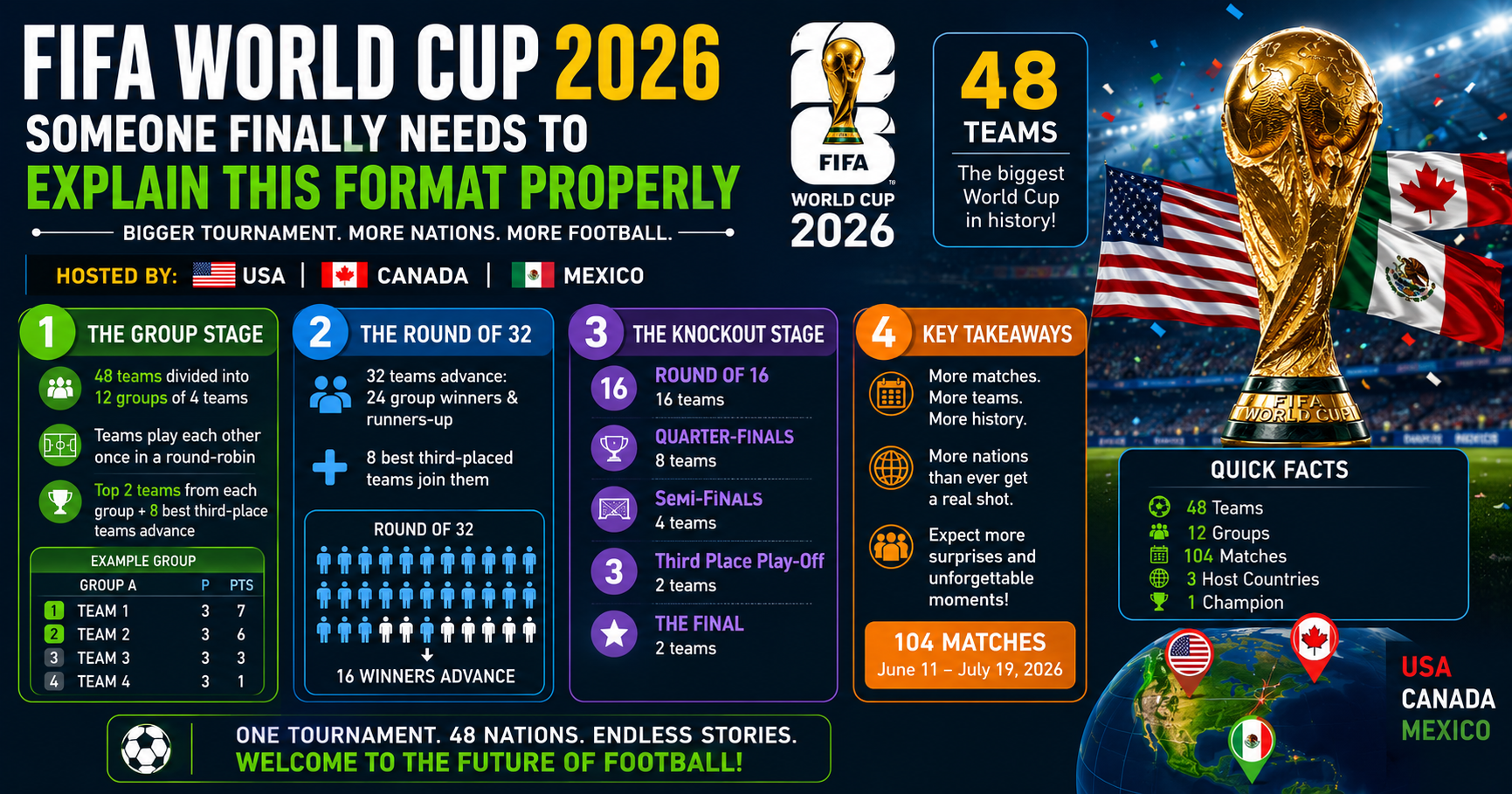
32 teams became 48. Those 48 go into 12 groups. Two teams per group go through automatically — same as always. But now eight of the third-place teams also go through, the best eight across all groups combined. That takes you to 32 teams in the knockouts. Then it’s a Round of 32 nobody’s ever seen before, then Round of 16, quarters, semis, final. Final’s July 19, New Jersey.
Got it? Good. The rest fills in the gaps.
Nothing changed for 28 years. Then everything did.
France 1998 — that’s when the World Cup moved to 32 teams. And from that tournament all the way through Qatar 2022, not a single thing about the format changed. Seven tournaments. Same structure every single time.
Anyone who’s been watching football their whole life built their entire understanding of a World Cup around that format. Eight groups, two teams go through per group, 16 teams left, knockout rounds, done. That’s it. That’s all most people have ever seen.
This year was different in a way that actually matters. 48 countries. 12 groups. A knockout round that has genuinely never been part of a World Cup in its entire history. 104 matches total — Qatar had 64. That’s not a minor adjustment. That’s 40 extra games and seven extra days of tournament. At some point you have to stop calling it the same competition.
The group stage itself — not that different actually
Win gets you three points. Draw gets you one each. Loss gets you nothing. Everyone in your group plays each other once. Points decide the table. Same as 1998, same as Qatar.
The change is just scale. Eight groups of four teams turned into twelve groups of four. Letters go all the way to L now — Group A through Group L. Six games per group, same as before, but with twelve groups running you get 72 matches just in the group stage. Before the knockouts even begin.
They also fixed kick-off times this year — every game has a set slot that doesn’t move. Small thing but actually useful. You could plan your week around it.
Group stage: June 11 to around June 27.
The part nobody understood — third place qualifiers
Right. This is what caused all the confusion.
Old system: 16 teams advance from groups. Two per group, eight groups, 16 total. Nobody argues with that, it’s clean.
New system: 32 teams advance. And the extra 8 spots are where it gets complicated.
24 spots go to the top two finishers in each of the 12 groups — straightforward. But then there are 8 spots left, and FIFA fills them from the teams that finished third in their groups.
At the end of the group stage you’ve got 12 teams who all finished third — one from each group. FIFA lines up all 12, compares them on points, then goal difference, then goals scored, and takes the best eight. Those eight go through. The other four go home.
What that means practically: a team with one win, one draw, one loss — four points — can absolutely still be in this tournament. If their numbers are better than at least four of the other third-place teams, they advance. Under the old format, they’re done. Here, they’re not.
And what that does to the group stage is make the late games actually tense. I watched matches in the final round of three different groups where the entire group was still unsettled going into the last 20 minutes. That almost never happened under the old system. Teams that were mathematically eliminated before the last game just… don’t really exist here anymore.
Tied on points — how it gets settled
It happens. When teams end up level, FIFA goes down this list:
- Goal difference
- Total goals scored
- Head-to-head result between the tied teams
- Cards — fewer bookings ranks you higher
- Drawing of lots if somehow all of the above is identical
Goal difference first means teams never really have a reason to stop attacking. A 3-0 in a game you’ve already clinched might be the thing that keeps you in the tournament if points end up level with someone else. It’s not poor sportsmanship — it’s survival.
How the draw was done
Las Vegas, December 2025. Four pots of 12 teams each, arranged by FIFA rankings. USA, Mexico, Canada — as hosts — all put into Pot 1 automatically and placed into separate groups. They couldn’t meet in the group stage no matter what.
Rules also stopped any one group from being four European teams or four South American teams. Mix was required. Mix is what they got.
The Round of 32 — brand new, never happened before
Lose a game from here and your tournament is over. One match, win or go home.
This round has never existed at a World Cup. Not once in the history of the competition. The round of 16 was always the first knockout stage — now there’s an entire extra round before it.
If you follow American college basketball, the energy is familiar. March Madness runs a 64-team bracket where the first round is basically pure carnage — big names lose, small teams win, nothing goes to script. The World Cup Round of 32 had something of that feel. Big squads playing careful, teams who scraped through in third place with nothing to lose going at them.
Bracket matchups were partly set in advance based on group finish. Winning your group got you a particular slot that’s different from finishing second or scraping through in third. There’s an actual reward for topping your group now beyond just feeling good about it.
After the Round of 32:
- Round of 16
- Quarter-finals
- Semi-finals
- Third-place match
- Final — July 19, 2026, MetLife Stadium, New Jersey
Extra time if level after 90. Penalties after that. None of that changed.
Spain and Argentina, ranked first and second going in, were put in opposite halves of the draw. If both keep winning they can only meet in the final. Deliberate. Nobody at FIFA wanted those two meeting in the quarters.
The water breaks — what was actually going on
Around the 22-minute mark, referees were stopping games with no obvious reason. No foul, no injury, no VAR review. Players grabbed water bottles. Coaches ran onto the pitch. Three minutes passed. Then play resumed.
That’s a mandatory hydration break. One per half, every game, no exceptions. Doesn’t matter what the weather is. Doesn’t matter if it’s an indoor stadium in a city with a mild climate. They happen.
Previously at World Cups these breaks only happened when heat crossed certain thresholds. Referees had to wait for specific temperature readings before calling one. 2026 made them automatic regardless of conditions.
The reason goes back to the 2025 Club World Cup, which was also held across the US. Some players were genuinely struggling — humidity in certain cities caught people off guard, and there were matches where it showed. FIFA’s response was to just build the rest in every game rather than try to predict when conditions would be bad enough to warrant it.
Side effect nobody really planned for: coaches started treating the 22-minute stoppage as a tactical timeout. Which football basically doesn’t have. Three minutes, whole squad in front of you, game officially paused — managers worked out pretty fast that’s an opportunity you don’t waste. Substitution patterns, pressing triggers, marking adjustments — things usually saved for halftime started happening at 22 minutes.
Venues — three countries, sixteen stadiums
First World Cup ever hosted by three nations at once. First time North America has hosted since the US did it alone in 1994.
United States — 11 cities: New York/New Jersey with MetLife Stadium hosting the final, then Los Angeles, Dallas, Miami, Seattle, San Francisco, Boston, Kansas City, Atlanta, Houston, Philadelphia.
Mexico — 3 cities: Mexico City hosted the opening game June 11 (Mexico vs South Africa), plus Guadalajara and Monterrey.
Canada — 2 cities: Toronto and Vancouver.
The distances involved in this tournament are genuinely staggering. Some teams have flown further between group games than the entire width of certain countries. It’s a logistical operation that makes previous World Cups look simple.
Africa and Asia — finally got proper representation
| Confederation | Qatar 2022 | 2026 |
|---|---|---|
| UEFA — Europe | 13 | 16 |
| CAF — Africa | 5 | 9 |
| AFC — Asia | 4 + 1 playoff | 8 |
| CONMEBOL — South America | 4 + 1 playoff | 6 |
| CONCACAF — N/Central America | 3 + 1 playoff | 6 + 3 hosts |
| OFC — Oceania | 0 + 1 playoff | 1 |
Africa went from 5 to 9 spots. Asia near enough doubled. For nations with strong football traditions that kept missing out under the old allocation, this is significant. Not symbolic significant — actually significant. Some of those teams showed up this year and made life very difficult for sides that probably expected to coast.
Money
$871 million total prize pool versus Qatar’s $440 million.
| Finish | Earnings |
|---|---|
| Champions | $50M |
| Runners-up | $33M |
| Third place | $25M |
| Fourth place | $22M |
| Quarter-finalists | $17M |
| Round of 16 | $15M |
| Round of 32 | $13M |
| Group stage exits | $12.5M |
Last row is the one worth noting. Three losses, zero wins, home after the group stage — still $12.5 million. Ten of that is just for qualifying. Two and a half is preparation funding paid in advance. For smaller federations that operate on shoestring budgets, that’s not consolation prize money. That funds years of development work.
Questions
Team finished third — are they out? Not necessarily. Eight of the twelve third-place finishers go through. If your team’s record puts them in the top eight when FIFA compares all third-place teams together, they advance. Three losses almost certainly ends it. One win usually keeps you alive depending on what everyone else did.
Why not 16 groups of three teams? Collusion. Three-team groups create situations where two sides play the last game knowing exactly what result sends both through. They can engineer it. Four-team groups run their final matches simultaneously so you can’t coordinate like that.
Hosts — easier draw? Structurally yes, they were seeded and kept apart. That’s not the same as getting easy opponents though.
Games played by the champion? Eight. Previous champions from 1998 through 2022 played seven.
Coaches on the pitch during breaks? The stoppage is official — they’re allowed. Three minutes of direct access to the whole squad during a live game is something football coaches basically never get. They noticed.
Dates
| Kicked off | June 11, 2026 |
| Groups ended | ~June 27 |
| Round of 32 | Late June |
| Round of 16 | Early July |
| Quarter-finals | ~July 5–6 |
| Semi-finals | ~July 10–11 |
| Third-place | ~July 18 |
| Final | July 19 — MetLife Stadium, NJ |
Worth it?
Yes. With one real complaint.
More countries, more upsets, groups that stay alive deep into the final round of matches, a knockout stage that starts with pure chaos — all of that is better than what we had. The Round of 32 specifically delivered moments that wouldn’t have existed under the old format.
The one legitimate gripe is 72 group stage games before a single team gets knocked out. That’s a long time to wait for stakes. If you’re casually following along rather than living it, the first two weeks can feel stretched.
But nobody with a team still alive in late June is complaining about the format.
Sources: FIFA.com, ESPN, Al Jazeera, World Soccer Talk — June 14, 2026