
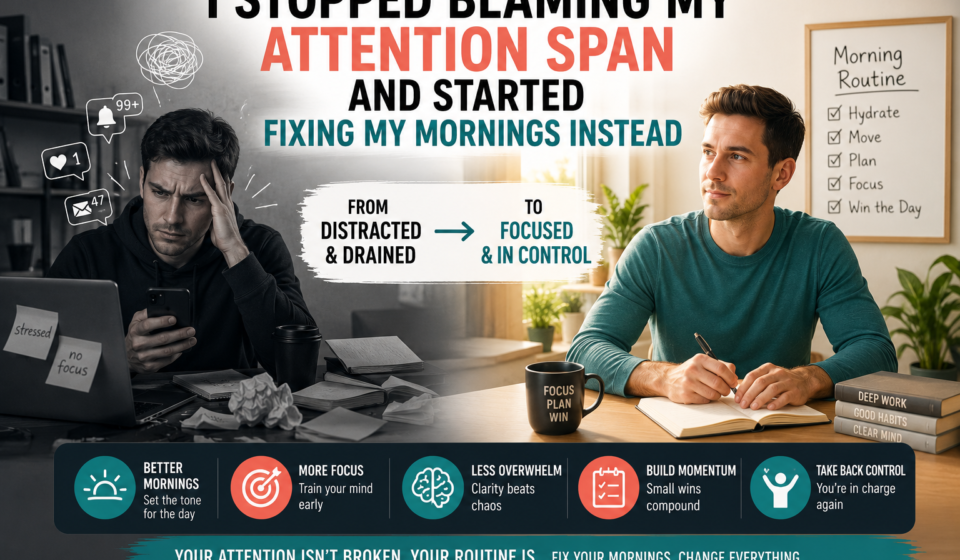
A few months ago I convinced myself I had some kind of attention disorder. I’d sit down to write, get four sentences in, and suddenly I’m reading about the migratory patterns of some bird I’ve never heard of. This happened maybe six times a day. I blamed my phone, then my job, then genetics, then coffee, then not enough coffee.
Turns out the actual problem was a lot more boring than any diagnosis. I was going to bed too late, barely moving during the day, and asking my brain to focus in fifteen-minute bursts between notification pings. Nobody’s brain does well under those conditions. Mine wasn’t special.
Fixing it wasn’t dramatic either. No brain supplements, no productivity app, no elaborate morning routine with cold plunges. Just a handful of boring, repeatable habits that, stacked together, actually moved the needle. Here’s what they were and why they seem to work.
Sleep Is Doing More Than You Think
I used to treat sleep like a luxury I’d get to eventually. Six hours, sometimes five, and I told myself I was one of those people who “functions fine on less.” I was not one of those people. Nobody really is.
During deep sleep, your brain clears out metabolic waste that builds up during the day and consolidates what you learned. Skimp on that process and the next day’s attention span pays for it directly — not in some abstract long-term way, but immediately, like trying to run a laptop with too many background tabs open. Even one short night noticeably dulls reaction time and working memory.
The fix isn’t complicated, just consistent: same rough bedtime and wake time, most days, even on weekends. That consistency does more for focus than any amount of “catching up” on sleep later.
Move Before You Try to Think
This one surprised me the most. I always assumed exercise was for physical health and had nothing to do with whether I could concentrate at my desk. Wrong, apparently.
Physical activity increases blood flow to the brain and triggers the release of chemicals involved in attention and mood — dopamine and norepinephrine among them. You don’t need an hour at the gym for this. A fifteen-minute walk before starting work does something a coffee alone doesn’t: it wakes up the systems your brain actually uses to filter distractions and stay on task.
I started taking a short walk before opening my laptop instead of reaching straight for my phone. Small change. Noticeable difference, especially in that first hour of the day when focus usually feels hardest to find.
Single-Task, Even Though Everything Tells You Not To
Multitasking feels productive. It isn’t, really — it’s just switching between tasks fast enough that it feels like you’re doing them simultaneously. Every switch costs you a little bit of mental “reset” time, and those costs add up fast over a day full of tab-switching and half-finished tasks.
What’s helped more than any app or hack is embarrassingly simple: closing everything except the one thing I’m working on. One tab. Phone in another room, or at least face-down and silenced. It feels uncomfortable at first, like something’s missing, and then after ten minutes or so it doesn’t anymore.
Feed Your Brain Something Other Than Sugar Crashes
I’m not going to pretend I’ve got a perfect diet — I don’t. But there’s a pattern I noticed once I started paying attention: a sugar-heavy breakfast means a sharp focus spike followed by a crash around 10:30am that no amount of willpower fixes.
Meals with protein, some fat, and fiber tend to keep blood sugar steadier, which in turn keeps attention steadier. Hydration matters more than people expect too — even mild dehydration has been linked to reduced concentration and a foggier mental state. Most days I don’t even notice I’m dehydrated until I’ve had a glass of water and suddenly feel like a slightly better version of myself.
Give Your Brain Actual Breaks
Here’s the part that felt counterintuitive: taking breaks improved my focus more than pushing through ever did. Sustained attention isn’t infinite. It drains, the same way a muscle gets tired, and pretending otherwise just means you’re working at declining quality without realizing it.
A short break every hour or so — stepping away from the screen, stretching, staring out a window and thinking about nothing in particular — resets that drained attention faster than another cup of coffee does. The mistake I used to make was treating breaks as the enemy of productivity instead of a requirement for it.
Practice Sitting With Boredom
This is the habit that’s hardest to explain to people and probably matters the most. Constant stimulation — phone in every idle moment, podcast during every walk, video during every meal — trains your brain to expect input at all times. Then when you sit down to do focused work with none of that, your attention rebels because it’s not used to the quiet.
I started leaving small gaps unfilled on purpose. Waiting in line without pulling out my phone. Eating without a show playing. It’s uncomfortable at first — genuinely uncomfortable, not exaggerating — and then it isn’t anymore, and something in my ability to just sit and work seemed to loosen up as a result.
None of This Requires Perfection I still get distracted. I still lose an afternoon to something dumb occasionally. The difference isn’t that I became a focus machine — it’s that on most days, the baseline is just better. Falling asleep at a decent hour, moving a little before starting work, doing one thing at a time, eating something other than sugar for breakfast, taking real breaks, and tolerating a bit of boredom. None of it is exciting. All of it, stacked together, works better than anything flashy I tried before it.



[…] on the highway? Or right before you give a speech? Same system. Intense exercise — heavy lifting, sprinting, competing in something — dumps adrenaline into your bloodstream because your nervous […]
[…] and burning feet is a classic symptom. Shows up more in people with limited diets, older adults (absorption gets worse with age), heavy drinkers, and people on long-term medications like metformin, which is known to interfere […]