
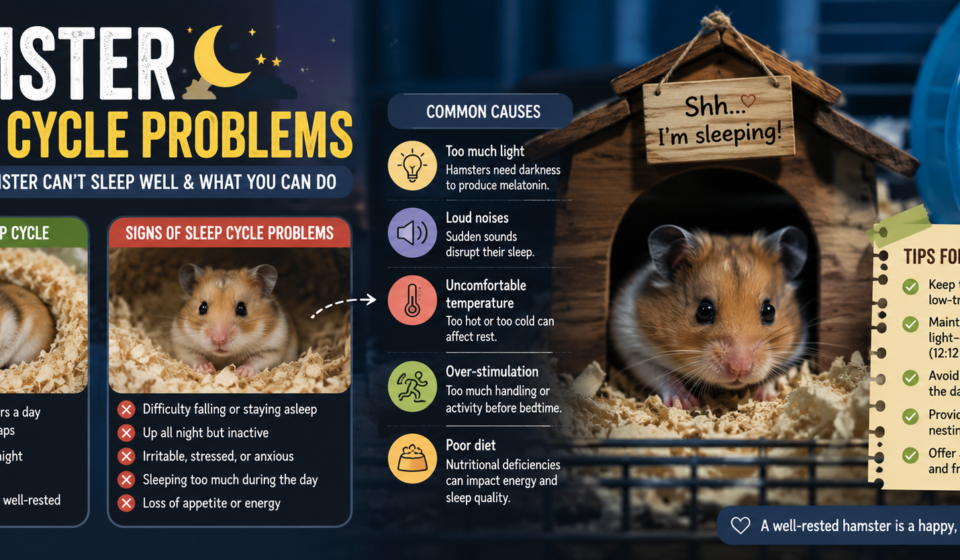
Hamster Sleep Cycle Problems: Why Your Hamster Seems Restless or Awake at the Wrong Times
If you’ve ever watched your hamster pacing at 9am when it should be fast asleep, or noticed it seems wired and restless well into the middle of the night rather than settling into the deep, still sleep hamsters are known for, you’ve probably wondered whether something’s actually wrong — or whether this is just “how hamsters are.”
The honest answer is: it depends. Hamsters are naturally nocturnal, so being active at night and quiet during the day is completely normal. But when that pattern becomes disrupted, erratic, or paired with visible restlessness, it’s usually a sign that something in their environment, routine, or health needs attention. Understanding the difference is the key to figuring out whether you need to make a change or just adjust your expectations.
Understanding a Hamster’s Natural Rhythm First
Before troubleshooting a “problem,” it helps to know what normal actually looks like. Wild hamsters evolved to be active during the cooler, safer hours of dusk, night, and dawn, avoiding the heat and predators of daytime. In captivity, that instinct doesn’t disappear — it’s hardwired. A healthy, well-adjusted hamster should be mostly still and sleeping during daylight hours and noticeably more active once the lights go down, typically settling into a fairly consistent pattern within its cage each night.
When that pattern breaks down — irregular waking during the day, visible agitation, pacing, or sleep that looks interrupted and shallow rather than deep and still — that’s when it’s worth looking closer.
Cage Placement Matters More Than Most Owners Realize
One of the most common, and most overlooked, causes of disrupted sleep cycles is simply where the cage is located. Hamsters kept near televisions, in high-traffic hallways, or in rooms with inconsistent lighting throughout the day often struggle to settle into a stable rhythm, because their internal clock relies heavily on consistent light and dark cues to know when it’s “safe” to sleep and when it’s time to be alert.
A cage in a room that gets bright light at unpredictable hours, or one that’s exposed to loud noise or foot traffic during the day, can leave a hamster in a semi-alert state even during hours it should be resting deeply. The fix is usually straightforward: move the cage to a quieter, dimmer location during daylight hours, ideally somewhere with a consistent light pattern day to day.
Too Much Daytime Handling
It’s tempting to interact with a hamster whenever you happen to be free, which for most people is during the day. But waking a hamster repeatedly during its natural sleep hours — even gently, even with good intentions — causes a real, measurable stress response. Over time, this chronic disruption can show up not just as grogginess or irritability during handling, but as erratic, restless activity at night, when the hamster’s system is trying to compensate for sleep it didn’t get.
If you want quality time with your hamster, the better approach is to shift your own schedule slightly to catch them during their natural active window in the evening, rather than pulling them out of sleep during the day.
An Undersized or Understimulating Cage
Hamsters that don’t get enough space, or enough to do, during their naturally active hours often don’t settle into a clean, organized sleep-wake pattern. Instead, they show restless, disorganized activity that doesn’t clearly separate into “active period” and “sleep period” the way it should. This can look confusingly similar to a health problem, when the underlying issue is really about environment.
A cage that’s too small relative to standard recommendations, or one that lacks a wheel, tunnels, or enrichment items, limits how much a hamster can physically tire itself out during its active hours — and a hamster that hasn’t been able to expend energy properly often doesn’t sleep as deeply or predictably afterward.
Temperature Swings Disrupt Rest More Than You’d Expect
Hamsters are notably sensitive to both heat and cold, more so than many small pets. A cage that gets too warm during the day — from direct sunlight, proximity to a heater, or a poorly ventilated room — can leave a hamster in an uncomfortable, restless state rather than settled sleep. On the opposite end, cages that get too cold, especially overnight, can push a hamster toward torpor-like states that look abnormal and can be mistaken for illness or even alarming lethargy.
Keeping the room at a stable, moderate temperature, and keeping the cage away from windows, radiators, and direct sun, removes one of the more common environmental disruptors to a hamster’s normal rhythm.
Pain or Illness as an Underlying Cause
If environment and handling seem fine but restlessness continues, health is the next thing to consider. Dental problems — which are extremely common in hamsters due to their continuously growing teeth — can cause chronic low-grade discomfort that disrupts normal rest patterns. Mites, skin irritation, and internal discomfort from digestive issues can all have a similar effect, causing a hamster to sleep in short, interrupted bursts rather than the longer, deeper stretches that are normal for the species.
Hamsters are prey animals, which means they’re instinctively good at masking illness — showing visible symptoms is, evolutionarily, dangerous for them. Sleep disruption is very often one of the first visible clues that something is wrong, showing up well before more obvious signs like reduced eating or visible lethargy.
Practical Steps to Restore a Healthy Sleep Cycle
Start with the environment, since it’s the easiest and most common fix:
- Move the cage to a quiet, dim location during the day, away from direct light, noise, and foot traffic.
- Avoid handling during daylight hours except when necessary, shifting interaction time to the evening instead.
- Keep the room at a stable, moderate temperature year-round, away from windows and heat sources.
- Make sure the cage is appropriately sized and includes a wheel and enrichment items so your hamster can properly tire itself out during its active hours.
If you’ve made these adjustments and restlessness continues for more than a few days, or is paired with other signs like reduced eating, visible weight loss, or changes in coat condition, it’s time to see an exotic-animal vet rather than continuing to adjust the environment. Hamsters hide illness well, and by the time symptoms are obvious, a health issue may already be fairly advanced — which is exactly why sleep pattern changes are worth taking seriously rather than dismissing as “just a quirky hamster.”
The Bigger Picture
A hamster’s sleep cycle isn’t just a curiosity — it’s one of the clearest windows into their overall wellbeing. Because they’re small, quiet, and largely nocturnal, it’s easy for subtle problems to go unnoticed for a long time. Paying attention to when and how well your hamster is actually resting is one of the simplest, lowest-effort ways to catch problems early and keep a genuinely happy, healthy pet.