
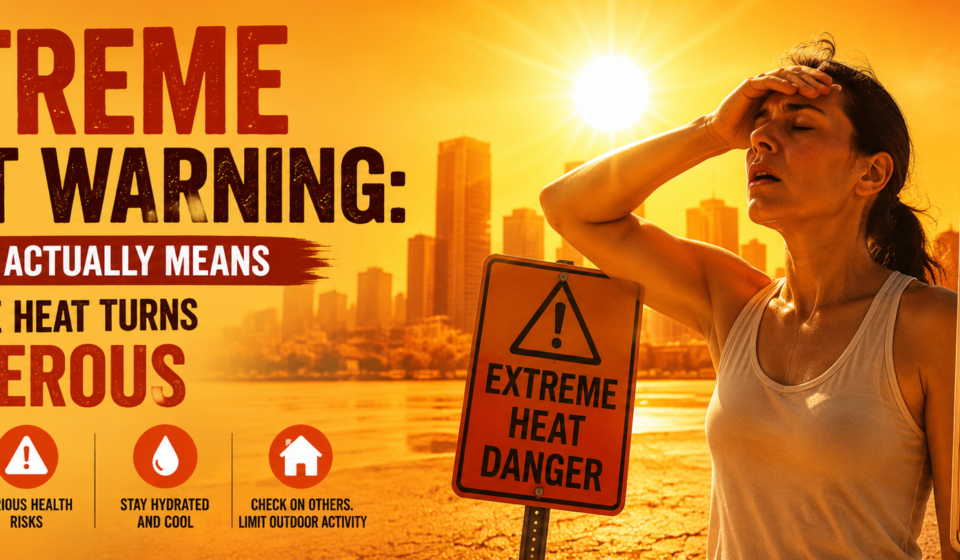
What It Actually Means When the Heat Turns Dangerous
Okay, so a few summers back I stepped outside around 9 am and it genuinely felt like opening an oven door. Not exaggerating. The air had this weight to it, as you could almost push against it. My phone buzzed right around then, too — extreme heat warning, stay indoors, avoid strenuous activity, check on elderly neighbors, the usual stuff. Honestly, my first reaction was “okay it’s hot, so what.” By afternoon, three people in my city ended up in the hospital with heat stroke and I remember sitting there thinking I had completely underestimated this thing.
That’s kind of the weird part about heat as a hazard. It doesn’t show up dramatic like a hurricane does, no spinning satellite image, no scary name attached to it. It just sort of sits on you, day after day, and then one day it tips over from uncomfortable into actually dangerous and a lot of people don’t notice the line being crossed.
So What Is an Extreme Heat Warning, Really
Weather services don’t just throw this label around for fun. An extreme heat warning gets issued basically when temps (and usually humidity along with it) are forecast to get high enough, and stay high enough for long enough, that it becomes a real health risk and not just a “ugh it’s hot” kind of day. The exact threshold changes depending on where you are — somewhere used to brutal summers needs a higher bar than somewhere that almost never sees this kind of heat.
The number that actually matters more than plain temperature is the heat index, aka the “feels like” number. It factors humidity in, because when there’s already a ton of moisture in the air, your sweat just sits there instead of evaporating off your skin. And evaporating sweat is basically your body’s main AC system. So weirdly enough, a humid 95 can mess you up worse than a dry 105, even though that sounds backwards at first.
When this warning goes out, it’s not just paperwork. Meteorologists are looking at numbers and basically saying, statistically, people are going to get sick or possibly die if nobody takes this seriously. Heavy thing to think about, but that’s really what’s behind that alert buzzing your phone.
Why Heat Doesn’t Get the Credit (or Fear) It Deserves
Ask people what the scariest weather event is and most will say tornado, hurricane, maybe a flood. Almost nobody says heat, even though in a lot of countries heat kills more people every year than all those other disasters put together. There’s no dramatic footage for it. No flattened roofs, no funnel cloud on the news. It just sits there quietly and takes people, usually the ones nobody’s checking on.
Who’s most at risk? Older folks, especially the ones living alone — their bodies just don’t regulate temperature or recognize the warning signs as well anymore. Babies and small kids too, since their internal cooling isn’t fully built yet. People with heart or lung problems are in trouble too because the body has to work overtime cooling itself, and that’s extra strain on organs already struggling. Outdoor workers, homeless folks, anyone without reliable AC — heat doesn’t pick favorites on purpose, but it sure picks favorites based on circumstance.
There was an elderly woman who lived two doors down from my grandmother. During a heat wave she kept her windows shut the whole time because she didn’t want her electricity bill going up from running a fan all day. Nobody checked on her for two days straight. She survived, barely, but it scared the whole street into actually going door to door the next time a warning came through. That’s the unsettling thing about heat — it happens quiet, indoors, where nobody’s watching, until suddenly it’s too late.
What’s Actually Going On In Your Body
Understanding the biology behind it kind of changes how seriously you take the warning, honestly. Once you get the mechanics, it stops sounding like overcautious advice and starts sounding like, oh, this is actually useful info.
Your core temperature rises, your body sweats and pushes blood toward the skin to cool down, normally that’s fine. But crank temperature and humidity high enough for long enough and that whole system starts breaking down. First stage is usually heat exhaustion — heavy sweat, weak, dizzy, nauseous, heart racing. Uncomfortable but you can usually reverse it by cooling off and drinking water.
Heat stroke is way worse. At that point the body’s cooling system basically shuts off entirely. Sweating might stop completely. Core temp can shoot past 104°F. Confusion kicks in. Skin can feel hot and dry instead of sweaty. This is a real emergency — minutes count here — because heat stroke left untreated can wreck the brain, heart, kidneys, muscles, sometimes permanently, sometimes fatally.
The scary part is confusion is one of the symptoms itself. So someone going through heat stroke might not even realize something’s seriously wrong with them. That’s exactly why checking on people during extreme heat isn’t just being nice — it can actually be the thing that saves someone, since they might not be in a state to ask for help themselves.
Stuff That Actually Helps During a Heat Warning
A lot of heat advice gets repeated so much it just becomes background noise, but the reasoning behind it is solid, worth actually unpacking instead of skimming past.
Hydration matters more than people think, and not in a “just chug water randomly” way. Spreading it throughout the day works way better than catching up once you’re already thirsty, because thirst shows up late — you’re already a bit dehydrated by the time you feel it. Electrolytes matter too if you’re sweating a lot, since plain water with zero sodium or potassium can actually mess with your blood’s balance in extreme situations.
Timing matters just as much as drinking water. Roughly 11am to 4pm tends to be the worst window. Got errands, outdoor stuff, exercise planned? Push it to early morning or evening when the sun’s not directly overhead — it actually makes a real difference in how much heat your body soaks up.
Clothes sound like a small detail but they’re really not. Loose, light-colored, breathable fabric bounces sunlight off instead of soaking it in, and lets air move against skin so sweat can do its job. Dark tight clothing traps heat right against you, working against your own cooling system basically.
AC, where you’ve got it, is honestly one of the best tools out there, and that’s why officials keep pushing cooling centers, malls, libraries, any air-conditioned public spot if home doesn’t have AC. Fans alone start losing effectiveness once it gets into the upper 90s and beyond, and in really extreme cases they can even work against you, just pushing already-hot air around instead of cooling anything.
And then the simplest one, most underrated honestly: check on people. A quick call or knock on a neighbor’s door during a warning costs you basically nothing and could be the difference between someone getting help in time, or not. Elderly relatives, neighbors living alone, anyone you know with health issues — a small check-in carries real weight here.
It’s Not Just Bodies — It’s Everything Around Us Too
Extreme heat doesn’t just hit individual people, it stresses entire systems at once. Power grids strain when millions of ACs run at the same time, sometimes causing blackouts right when people need cooling most. Hospitals see way more emergency visits. Farming takes a hit, livestock die, crops wilt. Roads and railways can literally warp or buckle under sustained extreme heat.
Cities make it worse too, something called the urban heat island effect. Concrete, asphalt, and packed buildings soak up and radiate way more heat than natural landscapes do, so a city center can run noticeably hotter than the area around it, sometimes ten degrees or more, especially at night as all that stored heat slowly leaks back out. That’s part of why nighttime temps matter just as much as daytime highs — without a cooler night to recover, the body never gets a real break, and several scorching days and nights back to back just compound the danger.
We’re Finally Starting to Talk About Heat Differently
There’s a growing push, among scientists and city planners both, to take heat as seriously as any other disaster. Some places have even started naming heat waves like hurricanes get named, specifically so the danger feels real to people instead of getting brushed off as “eh, it’s just summer.”
That shift matters because so much heat-related danger is preventable. Unlike an earthquake, we usually see heat warnings coming days ahead. There’s time to prepare, check on people, shift schedules around, stock up on water, plan for power cuts. The sad part about heat deaths is that a huge chunk of them didn’t have to happen — simple precautions and a bit of planning ahead would’ve been enough.
Last Thing
Next time that alert buzzes announcing,that don’t just swipe it away as overcaution. It’s not drama for drama’s sake. It’s a real signal conditions have crossed into territory where the human body, under the wrong circumstances, can actually fail. Drink water before you’re thirsty. Push outdoor stuff to cooler hours. Dres,s for the heat, not against it. And maybe most important — check on people around you who might be struggling quietly behind closed doors and drawn curtains.
Heat doesn’t roar like a storm does. It doesn’t rip roofs off houses. But quietly, year after year, it takes lives — a lot of which could’ve been saved with nothing more than a glass of water, some shade, and someone noticing in time.



[…] South Africa prides itself on collective defending rather than individual brilliance. […]
[…] out that’s a real thing. A gut that’s inflamed or imbalanced absorbs nutrients poorly. You can eat a perfectly reasonable diet and still end up deficient in […]
[…] expensive when you go looking for it on your own. Coverage depends on your plan and your state. If insurance doesn‘t line up, there are membership and pay-per-visit options instead. Not free, but cheaper than […]