
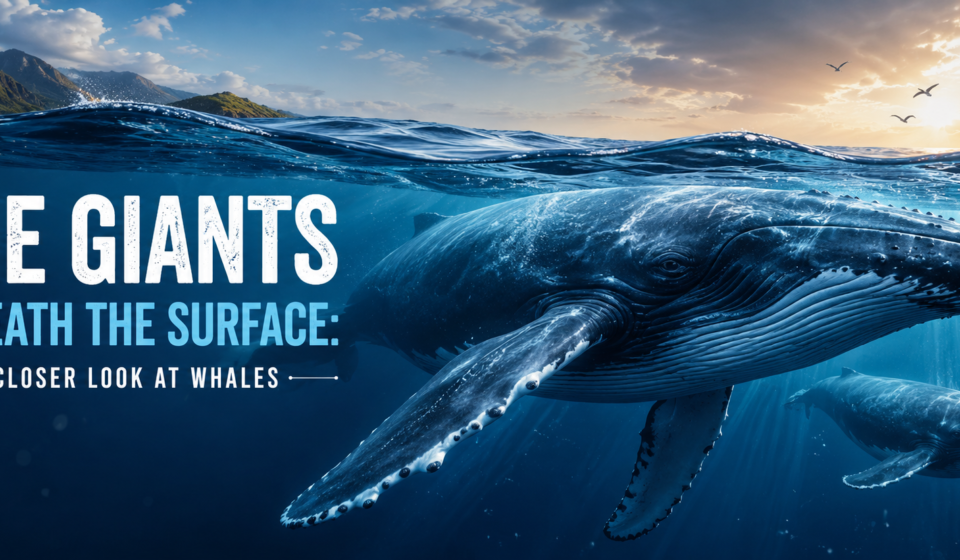
My cousin Tariq came back from a fishing trip years ago and couldn’t stop talking. Not about the fish he caught, not about the weather, not about the guys he went with. Just about the whale.
He saw it maybe two hundred meters from the boat. A humpback, he thinks, though he’s not certain — he’s not a marine biologist, he’s a mechanic from Faisalabad who went deep-sea fishing once. But he said it surfaced so slowly and so quietly that for a second nobody on the boat said anything. They just stood there. And then it was gone, back under, like it had never been there.
He told that story at three different dinners over the next month.
I think about that a lot when I try to understand why whales matter to people in a way that most animals don’t. It’s not just that they’re big. Elephants are big. Giraffes are tall and strange-looking. But there’s something about a whale that is different — something about the combination of scale and silence and the fact that they live in a world completely separate from ours. You catch a glimpse and then they disappear and you’re left standing there wondering if you imagined it.
That feeling has been around for as long as humans have been near the ocean. And the more scientists actually study whales, the stranger and more interesting the picture gets.
Nobody Expects the Whale to Have Had Legs
The first time a teacher told me whales evolved from land animals I assumed they were simplifying something. They weren’t.
About fifty million years ago there was a creature called Pakicetus. Small, four-legged, probably looked something like a stocky dog. It lived near coastlines in what’s now South Asia and it spent a lot of time in shallow water — probably hunting fish, probably because the water was safer than whatever was on land at the time. Over millions and millions of generations, its descendants went deeper. Stayed longer. Their bodies started reflecting that.
The legs shrank. The tail flattened out horizontally, which is actually different from fish tails — fish tails are vertical, whale tails are horizontal, because whales still move the way a land mammal runs, spine flexing up and down rather than side to side. The nostrils migrated upward along the skull, eventually landing on top as the blowhole. The fur mostly disappeared, replaced by blubber.
And here’s the thing that still strikes me as almost eerie: inside a modern whale, buried in the muscle and fat where you’d never see it without dissection, there are tiny remnant hip bones. They don’t attach to anything. They don’t serve any clear modern function. They’re just there — biological memory of limbs that haven’t existed for forty million years.
All of this eventually split into two groups. Baleen whales, like humpbacks and blues and bowheads, have no teeth. They eat by filtering — huge mouthfuls of water pushed through plates of keratin that trap krill and small fish inside. Toothed whales, the orcas and sperm whales and dolphins, kept their teeth and went the other direction entirely, developing a biological sonar system that can locate a fish in total darkness at remarkable distances.
Same common ancestor. Two completely different ways of surviving.
The Blue Whale Problem
There’s a thing that happens when people first encounter blue whale facts. They hear them, they nod, and they move on. I think the problem is that the numbers are just too large to feel real.
So let me try to put it differently.
A blue whale is about the length of two city buses parked end to end. Its tongue alone weighs as much as an elephant. When it exhales through its blowhole, the mist shoots up about nine meters — nearly three stories. Its heartbeat is so slow and so powerful that researchers have described it as more of a thud than a beat. And it’s not just the largest animal alive right now — it’s the largest animal that has ever existed in the entire history of life on this planet. Bigger than any dinosaur. Bigger than anything else we’ve found a fossil of.
Now here’s what this animal eats: krill. Little pink creatures about the length of your thumbnail. A blue whale needs roughly four tons of them a day during feeding season. It opens its mouth, takes in an enormous rush of water, closes its jaw, and pushes the water back out through its baleen plates, keeping everything small and edible inside.
The biggest animal that ever lived. Kept alive by things barely visible to the naked eye.
I don’t know why that contrast hits me as hard as it does, but it does every single time.
The Singing
Roger Payne was a biologist who, in the late 1960s, got hold of recordings that a Navy hydrophone operator had made in the North Atlantic. The operator had noticed that humpback whales made strange, complex sounds underwater and had recorded them almost as a curiosity. When Payne actually listened and analyzed them, he realized what he had.
The sounds weren’t random. They were structured. They had repeating phrases, organized into themes, the themes organized into something that had a recognizable shape from beginning to end. It was, by any reasonable definition, song.
He released an album in 1970. It sold over a hundred thousand copies. It was played on radio stations. People who had never thought about marine biology in their lives bought it and sat with it and felt something they couldn’t quite name. The album is genuinely credited by historians of the environmental movement as a turning point in public awareness about whales.
But the part that interested scientists wasn’t the emotional response. It was what came next, when researchers started tracking humpback songs over years and across populations. The songs change. New phrases appear, spread through a population, get picked up by other groups hundreds of miles away. Old phrases drop out. The whole thing shifts slowly and continuously, with patterns of change that look less like random variation and more like a shared musical culture, updating itself, spreading new ideas, retiring old ones.
Sperm whales do something different — they click. Their communication is built on rapid sequences of clicks called codas, and different populations have different dialects. Whales in one part of the ocean produce one set of patterns. Whales from another region produce another. Calves learn the dialect of their family group early in life. The learning is social, passed down through relationship and proximity, not genetics.
Hidden Lives of Whales
For a long time the scientific assumption was basically that big animals were simple. More size, less complexity. Whales and the decades of research into them have done serious damage to that assumption.
Orca pods are matriarchal. The oldest female in the group — sometimes sixty, seventy years old — carries knowledge about where to find food in difficult years that younger animals don’t have. Researchers have shown that when a matriarch dies, survival rates among other pod members, especially males, drop in the following years. What she knew, built up over a long lifetime in a specific stretch of ocean, doesn’t transfer automatically. It disappears with her.
That’s not instinct. That’s accumulated individual knowledge that has real survival value, stored in one animal, passed down through living relationship and proximity, just the way human expertise used to be passed down before we had writing.
Sperm whale females take turns watching each other’s calves. When a mother dives deep to hunt — and they can go incredibly deep, for over an hour at a time — other females stay near the surface with her calf. They rotate this babysitting. The calf is never alone.
Humpbacks have been recorded multiple times interfering with orca hunts. Not protecting their own calves — intervening in attacks on completely unrelated animals. Seals. Gray whale calves. A sunfish. The humpbacks push themselves into the middle of the hunt, disrupting it. Researchers are genuinely unsure what to make of this. It happens too consistently to be an accident or a territorial mistake. Something is motivating it and whatever that something is, it’s not simple.
Then there are bowhead whales. They live in the Arctic and they can live past two hundred years. Right now, in the Arctic Ocean, there are bowhead whales that were alive in the early 1800s. They were fully grown animals when your great-great-great-great-grandparents were children. They’ve been in the same ocean for two centuries, building up a picture of that environment that we have absolutely no way to access or measure. What that kind of lifespan does to an animal’s understanding of its world — we genuinely don’t know how to study that yet.
The History We’d Rather Not Dwell On
There’s no way to write honestly about whales without going through what we did to them.
Before electricity, whale oil lit the world. It burned in lamps in homes and streets and harbors from Europe to America. Baleen from their mouths stiffened the clothing fashions of entire eras. Ambergris from sperm whale intestines was so valuable in the perfume industry it was sometimes worth more than gold. The demand was massive, and for a long time people acted like the ocean would simply keep providing because it was too vast to empty.
Industrial whaling in the twentieth century tested that assumption and broke it. Factory ships that could process an entire whale while still at sea. Explosive harpoons. Sonar to track movements. Fleets that covered every ocean on earth. Population after population was pushed toward collapse.
The numbers are brutal. There may have been three hundred and fifty thousand blue whales in the Southern Ocean before commercial whaling. By the 1960s the number was in the hundreds. Not hundreds of thousands. Hundreds.
The moratorium came in 1986. Too late, but real. Some species have recovered — humpbacks in particular have made a genuine comeback in several regions, which is one of the more encouraging wildlife stories of the past few decades. Right whales in the North Atlantic have not. Around three hundred and forty of them remain. The population is still declining. They’re still getting tangled in fishing gear and struck by ships faster than calves are being born.
What’s Threatening Them Now
The harpoon isn’t the main threat anymore. What replaced it is less dramatic and in some ways harder to address.
Water temperatures are rising. The food chains that whales depend on are shifting. Krill populations change with temperature. Prey fish move into different ranges. Migration routes that evolved over millions of years are becoming unreliable guides to where the food actually is.
Most people don’t think about ocean noise but they probably should. The modern ocean is extraordinarily loud compared to what it was two hundred years ago — shipping traffic, military sonar, seismic surveys for oil exploration, underwater construction for offshore infrastructure. For animals whose entire lives are organized around sound — who use it to find food, to navigate, to communicate with family members, to find mates — this level of interference is serious. Whales have been found dead on beaches after military sonar exercises with signs of acoustic trauma. Others appear to be losing the ability to communicate with each other across the distances their biology was built for.
Fishing gear kills a significant number of large whales every year. Plastic and chemical contamination accumulates in fatty tissue, and long-lived apex animals at the top of ocean food chains absorb more of it than anything below them.
Why It’s Not Just About the Whales
There’s an argument for whale conservation that goes beyond the obvious one — beyond the fact that they’re magnificent and that losing them would be a tragedy. It’s an ecological argument, and it matters.
Whales feed at depth and come up to the surface to breathe and defecate. In doing so they bring nutrients from deep water up into the sunlit upper layers of the ocean where phytoplankton grow. Phytoplankton produce close to half the oxygen in Earth’s atmosphere and absorb carbon dioxide at a scale that genuinely matters to the climate.
When a whale dies naturally and sinks to the seafloor — a whale fall, in the research literature — the carcass becomes its own ecosystem. Hundreds of specialized species feed on it for decades. Some of these species exist almost nowhere else.
Whales aren’t a separate feature of the ocean. They’re part of how the ocean works.
What We Still Don’t Know
Every few years something comes out that reshapes the picture. A behavior nobody had recorded before. A cognitive ability that wasn’t expected. A population found somewhere they weren’t supposed to be.
My cousin Tariq still brings up that whale sometimes. It’s been years. He saw it for maybe thirty seconds, from a rocking fishing boat, and it didn’t do anything dramatic — it just surfaced and disappeared. And still. Still he brings it up.
That’s not nothing. That kind of impression, left by a single animal in a brief moment, is worth paying attention to. These creatures have been on this planet for fifty million years. They’ve outlasted ice ages and meteor events and mass extinctions that wiped out the majority of life on Earth.
Whether they outlast us is something we still have a say in, if we decide we want one.


[…] The virus was first identified in 1976, and even then it came twice at once — two separate outbreaks, one in Congo, one in Sudan, happening almost at the same time with slightly different strains. Scientists named it after the Ebola River in Congo, close to where one of the outbreaks was centered. From 1976 all the way through 2013, there were roughly 20 outbreaks recorded. Bad ones, some of them. Villages destroyed, health workers dead. But they stayed contained — remote areas, limited movement, the fire burning out before it could spread too far. […]
[…] A Border Collie needs serious mental and physical stimulation — we’re talking hours of activity daily. A Basset Hound? Much more laid-back. A Persian cat will mostly nap. A Bengal cat will systematically dismantle your home if under-stimulated. […]