
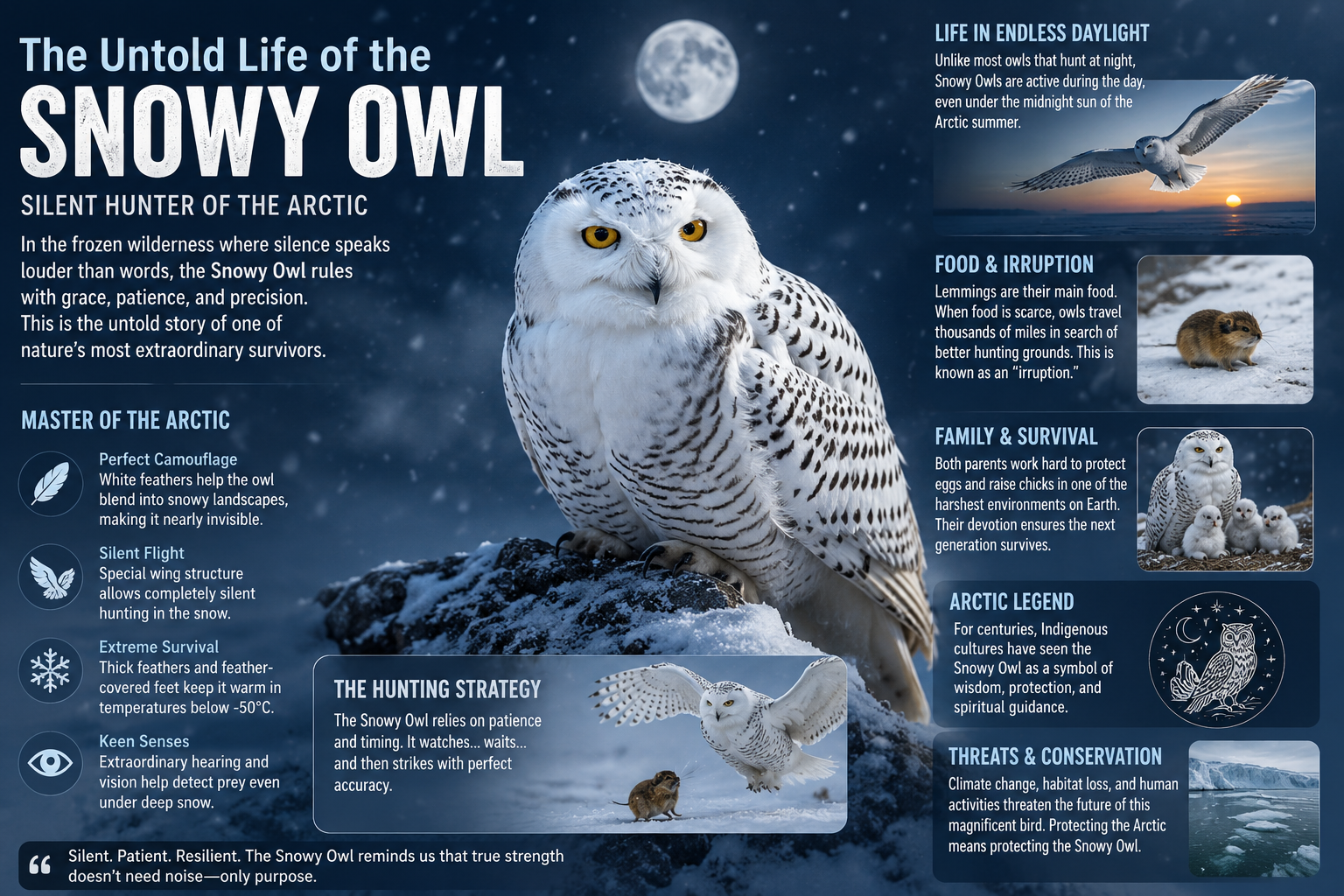
Where icy winds sweep endlessly across frozen plains and silence dominates the landscape, one magnificent bird continues to survive against nature’s harshest challenges. The Snowy Owl is not only one of the most beautiful birds in the world, but also one of the strongest symbols of patience, intelligence, and survival. With bright golden eyes and feathers as white as winter snow, this mysterious Arctic hunter has fascinated people for generations.
Unlike tropical birds known for loud sounds and colorful feathers, the Snowy Owl survives through silence and precision. Nature shaped every part of this bird for life in freezing conditions. Its thick layer of feathers protects its body from deadly Arctic temperatures, while its powerful wings allow it to glide almost soundlessly through the cold air. In a region where survival depends on conserving energy, the Snowy Owl wastes nothing. Every movement serves a purpose.
The Snowy Owl lives mainly in Arctic regions across North America, Greenland, Scandinavia, and northern Russia. These open snowy landscapes may appear empty to humans, but they provide the perfect environment for the owl. With very few trees or obstacles, the bird can easily observe prey moving across the tundra from long distances.
One of the most unusual facts about the Snowy Owl is that it does not behave like most owl species. While many owls are strictly nocturnal and hunt only in darkness, the Snowy Owl often hunts during daylight. This adaptation developed because Arctic summers experience nearly continuous sunlight. In some northern regions, the sun remains visible for twenty-four hours a day during summer months. Instead of depending on darkness, the Snowy Owl adapted perfectly to constant daylight hunting.
The bird’s primary food source is the lemming, a small rodent that lives beneath the snow. Snowy Owls depend heavily on lemming populations for survival. During years when lemmings are abundant, the owls successfully raise large families. However, when prey becomes scarce, the owls may travel great distances searching for food. Scientists call these movements “irruptions,” which occur when unusually high numbers of Snowy Owls migrate south beyond their normal Arctic habitat.
During irruption years, people living in areas far from the Arctic may unexpectedly spot Snowy Owls resting in open fields, near coastlines, or even at airports. Because airports resemble open tundra landscapes, the birds are often attracted to these areas during migration. Wildlife experts carefully monitor such situations to prevent accidents between birds and aircraft.
The Snowy Owl is an incredibly skilled hunter. Instead of chasing prey constantly, it relies on patience and observation. The owl may sit silently for long periods while scanning the snowy ground below. Once movement is detected, it launches forward with extraordinary speed and accuracy. Its hearing is powerful enough to detect animals moving beneath layers of snow, while its sharp talons can capture prey instantly.
One remarkable adaptation that helps the Snowy Owl survive freezing temperatures is its feather-covered feet. Unlike many birds that have exposed legs, the Snowy Owl’s legs are heavily insulated with soft feathers. This natural protection allows the bird to stand comfortably on ice and snow without losing body heat. Combined with its dense body feathers, this adaptation helps the owl survive temperatures that would be deadly for many other species.
Male and female Snowy Owls can also look surprisingly different. Adult males are often almost completely white, especially as they grow older. Females and younger owls usually have darker markings and spots across their feathers. These darker patterns help females blend into the environment while protecting nests and chicks during breeding season.
The nesting period begins during the short Arctic summer when snow starts melting across the tundra. Female Snowy Owls build nests directly on the ground, usually in slightly elevated areas that provide a clear view of the surrounding landscape. Unlike birds that build nests in trees, Snowy Owls depend on open visibility for protection.
Snowy Owl parents are extremely protective. While the female guards the eggs and chicks, the male continuously hunts for food. If predators approach the nest, both parents may attack aggressively. Arctic foxes, wolves, and even humans can become targets if they move too close to the nesting area. Despite the harsh environment, Snowy Owls show strong parental care and cooperation while raising their young.
Young chicks grow rapidly because they must become strong before winter returns. Long before they fully learn to fly, the chicks begin exploring the tundra near the nest. Their parents continue feeding and protecting them until their wings become powerful enough for survival in the Arctic wilderness.
For centuries, the Snowy Owl has played an important role in northern cultures and traditions. Indigenous communities respected the bird for its intelligence, hunting abilities, and calm presence. In many legends, the Snowy Owl symbolized wisdom, guidance, and spiritual protection. Its silent flight and mysterious appearance inspired stories passed from generation to generation.
Today, the Snowy Owl remains one of the most admired birds in the world. Wildlife photographers, birdwatchers, and travelers often dream of seeing one in its natural habitat. Watching a Snowy Owl glide silently across a snowy landscape is considered an unforgettable experience by nature lovers.
Modern research has helped scientists understand more about these incredible birds. Tiny tracking devices now allow researchers to study migration patterns and survival behavior. Some Snowy Owls travel thousands of miles across frozen oceans, isolated islands, and remote Arctic regions. Unlike many migrating birds that travel in large groups, Snowy Owls often migrate alone, relying completely on instinct and endurance.
However, the future of the Snowy Owl faces growing challenges. Climate change is rapidly affecting Arctic ecosystems. Rising temperatures influence snow conditions, prey populations, and breeding environments. Since the Snowy Owl depends heavily on stable Arctic habitats, environmental changes can directly impact its survival.
Human activity also creates additional threats. Expanding industrial areas, roads, vehicles, and power lines increase risks for migrating owls. Pollution and habitat disruption continue affecting wildlife throughout the Arctic. Conservation groups and wildlife researchers now work carefully to monitor Snowy Owl populations and protect important habitats.
Despite these difficulties, the Snowy Owl continues to represent resilience and survival. It survives in one of the harshest environments on Earth with quiet confidence and extraordinary adaptation. Every feather, every movement, and every instinct reflects thousands of years of evolution shaped by snow, ice, and survival.
The Snowy Owl teaches an important lesson about strength. True power does not always appear through noise or aggression. Sometimes strength exists in silence, patience, and the ability to adapt to difficult conditions. As Arctic winds continue blowing across frozen landscapes, the Snowy Owl will remain one of nature’s most extraordinary symbols of endurance and beauty.
Its story is far more than the story of a bird living in cold weather. It is a story of survival, intelligence, and the timeless connection between wildlife and the wild Arctic world that still exists beyond human control.



[…] For years, health trends focused mostly on fitness, dieting, weight loss, and workout routines. Social media platforms were filled with gym transformations, strict meal plans, and expensive supplements promising fast results. But now, a completely different wellness movement is taking over online conversations, Google searches, and health discussions worldwide. […]
[…] To understand why such speculation exists, it is useful to look at the broader political identity of Tulsi Gabbard. […]