
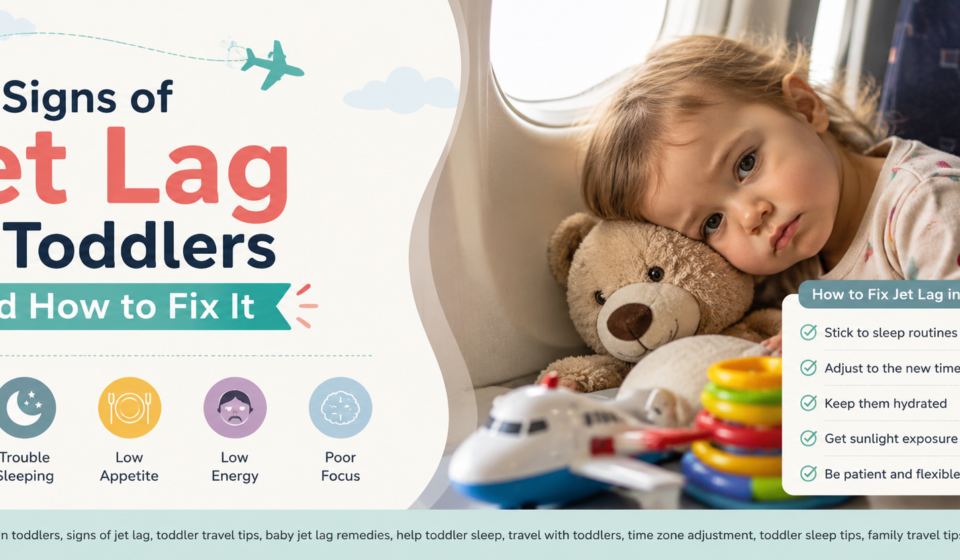
Adults dealing with jet lag can at least understand what’s happening to them. Toddlers can’t. They just know they feel wrong — tired but wired, hungry at odd hours, and completely uninterested in the schedule everyone around them is trying to follow. If you’ve landed somewhere new with a toddler in tow and things feel chaotic for the first few days, that’s very normal, and there’s a fairly predictable pattern behind it.
This guide covers what jet lag actually looks like in toddlers specifically, why it hits them differently than adults, and the adjustments that tend to shorten the rough patch.
Why Toddlers Get Hit Harder Than Adults
Toddlers’ circadian rhythms are still developing, and they rely heavily on external cues — daylight, mealtimes, nap routines — to regulate their internal clock. Adults can partially override jet lag through willpower, caffeine, or simply pushing through a rough day. Toddlers don’t have that override. Their body is telling them it’s 3am back home, and there’s no reasoning with that signal.
Generally, the rule of thumb travel physicians use is roughly one day of adjustment per time zone crossed, though toddlers on the younger end of the age range often take slightly longer because their sleep architecture is less flexible.
The Signs to Watch For
Jet lag in toddlers doesn’t always look like straightforward tiredness. It often shows up as:
- Waking up wide awake in the middle of the local night, sometimes for one to two hours
- Unusually early wake-ups, well before their normal morning time
- Resisting naps they’d normally take without a fight
- Increased irritability or meltdowns that seem disproportionate to the trigger
- Appetite changes — asking for meals at times that don’t match the local schedule
- General clinginess or needing more physical comfort than usual
It’s easy to mistake some of these signs for a toddler simply having a rough day, especially since travel itself is already disruptive in other ways. If your child also seems physically unsettled rather than sleep-disrupted, it’s worth reviewing common digestive triggers that can compound travel stress, since new foods and irregular meal timing often overlap with jet lag symptoms.
Adjust the Schedule Before You Travel, If You Can
For trips crossing more than three or four time zones, shifting bedtime by fifteen to twenty minutes a day in the direction of the new time zone, starting three or four days before departure, can soften the transition significantly. This isn’t always practical with a toddler’s fixed routine, but even a partial shift of an hour or two before departure reduces how far the adjustment has to happen after landing.
Use Daylight as the Reset Tool
Light exposure is the single strongest signal for resetting a circadian rhythm, in toddlers and adults alike. On arrival, getting outside in natural daylight during local daytime hours — especially morning light if you’ve traveled east, and afternoon or evening light if you’ve traveled west — helps recalibrate faster than staying indoors in a hotel room.
Conversely, keeping the room dark during the hours you want your toddler sleeping, even if their body clock says otherwise, reinforces the new schedule. Blackout curtains or a portable blackout shade for hotel windows make a real difference here, since hotel curtains often let in more light than expected.
Don’t Fight the First Night Too Hard
The first night after a long flight is often the roughest, and that’s expected. Rather than forcing an immediate switch to the new bedtime, many pediatric sleep specialists suggest treating night one as a transition night — let your toddler sleep a bit when they’re tired, even if it’s not quite the “right” time yet, and focus your effort on getting daytime light exposure right instead. By night two or three, the schedule usually starts falling into place more naturally.
A Simple Adjustment Plan
- Shift bedtime gradually in the days before travel if the time change is significant
- Prioritize outdoor daylight exposure at the right time of day after landing
- Keep the sleeping space dark during the hours you want them asleep
- Treat the first night as a transition, not a strict schedule
- Serve meals on the new local schedule to help anchor the day
- Expect three to five days for a full adjustment on longer time zone shifts
Frequently Asked Questions
How many time zones does it take before jet lag becomes noticeable in toddlers? Most families start noticing real disruption crossing three or more time zones. Crossing one or two zones usually causes only mild, short-lived disruption that resolves within a day.
Is eastward or westward travel harder on toddlers? Traveling east, which shortens the day, is generally considered harder to adjust to than traveling west, which lengthens the day. This matches what’s typically seen in adults as well, since it’s harder for the body to advance its clock than to delay it.
Should I keep my toddler on their home time zone for a short trip? For trips of two to three days or less, especially across only one or two time zones, it’s often easier to keep your toddler roughly on their home schedule rather than fully adjusting, since the adjustment period alone might last as long as the trip itself.
Final Thoughts
Jet lag in toddlers is uncomfortable for everyone involved, but it’s temporary and predictable once you know what’s actually happening. The combination of daylight timing, gradual schedule shifts, and a little patience on the first night or two usually gets things back on track well before the end of a typical trip. The rougher the first 48 hours feel, the more it helps to remember that this part passes faster than it seems like it will at 3am.