
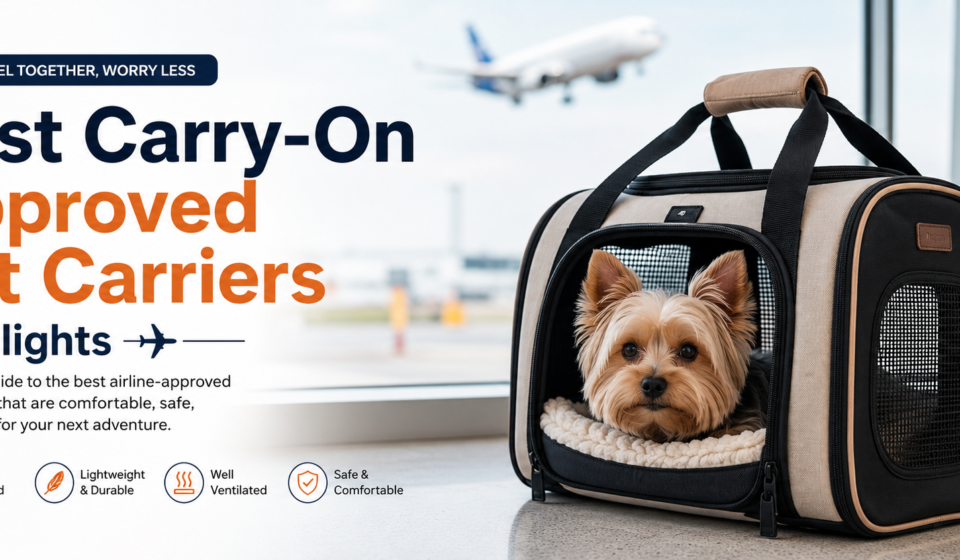
If you’ve ever tried to book a flight with a cat or small dog in tow, you already know the panic that sets in the moment you search “pet carrier” online. Hundreds of options show up, most claim to be “airline approved,” and almost none of them tell you which airline they mean. Airlines don’t share one universal standard, so a carrier that glides through security at one airline can get you turned away at the gate with another.
This guide breaks down what “carry-on approved” actually means, which carrier types hold up best in real travel conditions, and how to avoid the last-minute scramble that ruins so many first-time pet flights.
Why “Airline Approved” Is a Moving Target
There’s no single federal or international size standard for in-cabin pet carriers. Instead, every airline sets its own under-seat dimensions, and those numbers vary depending on the aircraft type flying that route. A carrier that’s fine on a widebody international flight might be too tall for a smaller regional jet.
As a general rule, most major U.S. carriers want soft-sided carriers no larger than around 18 x 11 x 11 inches, though a few allow closer to 17 x 12 x 8 inches. Rather than trusting a product listing, it’s worth checking the specific airline’s pet policy page before you buy anything, since policies get updated seasonally and enforcement varies by gate agent.
Soft-Sided vs. Hard-Sided Carriers
For flying specifically, soft-sided carriers are almost always the better pick. They compress slightly to fit under different seat configurations, they’re lighter to carry through a terminal, and most have a wider stance that keeps your pet from feeling like they’re being lugged around in a box.
Hard-sided carriers offer more physical protection and are easier to clean, but they don’t flex, which means a carrier that’s a perfect fit on one plane might not slide under the seat on another. If your pet is anxious or prone to motion sickness, pairing a soft carrier with calming strategies matters more than the carrier material itself — something covered in more depth in our guide
Ventilation Matters More Than People Realize
Airplane cabins are dry, and the space under a seat has less airflow than the rest of the cabin. A carrier with mesh panels on at least three sides — not just the front — makes a noticeable difference in how comfortable your pet is for a flight longer than two hours. Look for carriers with a full mesh top panel as well, since heat rises and pets often shift position mid-flight to find cooler airflow.
Avoid carriers that only have a small mesh window in the front. They look sturdy in photos, but they trap heat and limit your pet’s ability to see out, which can actually increase anxiety rather than reduce it.
Weight and Portability
Once your pet is inside, you’re not just carrying the carrier — you’re carrying the carrier, your pet, and usually a personal item or laptop bag through security and a terminal. A carrier that weighs three to four pounds empty is a very different experience than one that weighs six or seven pounds before your pet even gets in it.
Structured bottoms that keep the carrier’s shape without heavy internal framing tend to be the best compromise. They hold form well enough to keep your pet from feeling squished, without adding unnecessary weight to your shoulder for a full travel day.
Getting Your Pet Used to the Carrier Before the Trip
Airport day is the worst possible time for your pet to see their carrier for the first time. Vets and trainers consistently recommend introducing the carrier at least two to three weeks before travel, leaving it out in a common area with the door open, and placing treats or a familiar blanket inside so it becomes a neutral, even positive, space.
This matters even more if your pet already shows signs of stress around transitions. If your dog tends to get worked up in moving vehicles in general, it’s worth reading through practical strategies for easing that anxiety before you add air travel into the mix.
What to Pack Inside the Carrier
Beyond the carrier itself, a few small additions make a real difference:
- A absorbent pad on the bottom in case of accidents during a long delay
- A collapsible silicone bowl for water during layovers
- A familiar-smelling piece of fabric from home
- Any medication your vet has approved for travel, kept in original packaging
Skip heavy bedding or bulky toys. Extra padding reduces usable space and can shift the carrier’s shape enough to fail a gate agent’s under-seat check.
Confirming Fit Before You Fly
The safest approach is to measure the actual under-seat dimensions of your specific aircraft, not just the airline’s general policy, since regional jets and international widebodies differ. Airlines usually publish this by route or aircraft type. If you can’t find exact numbers, calling the airline’s pet travel line directly is worth the ten minutes it takes, especially for connecting flights where you might be on two different plane types in one trip.
For general guidance on what most airlines require for in-cabin pets, the outlines federal requirements around health certificates and documentation that apply regardless of which airline you fly.
A Quick Pre-Flight Checklist
- Confirm your specific airline’s under-seat dimensions for your aircraft type
- Choose a soft-sided carrier with mesh on at least three sides
- Introduce the carrier at home two to three weeks before departure
- Pack light: absorbent pad, collapsible bowl, familiar scent item
- Check documentation requirements at least a week in advance
- Arrive early enough to handle unexpected gate agent questions calmly
Frequently Asked Questions
Can I use the same carrier for every airline I fly? Sometimes, but not reliably. If you fly multiple airlines regularly, it’s worth choosing a carrier sized toward the stricter end of common requirements, roughly 17 x 11 x 8 inches, so it has a better chance of fitting under seats across different airlines and aircraft types rather than needing a different carrier for each trip.
Do airlines count carriers toward my carry-on limit? Most airlines treat an in-cabin pet carrier as your personal item, meaning it typically replaces your under-seat bag rather than counting as an additional piece. You’ll usually still be allowed a separate overhead carry-on, but it’s worth confirming this on the specific airline’s pet policy page before you pack, since a few airlines handle it differently.
Is it better to sedate my pet for a flight? Most veterinarians actively advise against sedating pets for air travel. Cabin pressure and altitude can interact unpredictably with sedatives, and a sedated pet has less ability to reposition itself for comfort or signal distress. Carrier training and calming aids are generally considered safer than sedation for routine flights.
Final Thoughts
Choosing a carry-on pet carrier isn’t really about finding the “best“ one in general — it’s about finding the right one for your specific airline, your specific pet’s size, and your specific route. A little research before you buy saves you from the worst version of airport day: standing at the gate with a carrier that doesn’t fit and a flight that’s about to leave without your pet.
If your travel plans also involve a longer road trip before or after the flight, it’s worth looking at how to prepare pets for extended time in a moving vehicle, since the stress factors overlap more than people expect.


[…] used to be the person who packed six outfits for a two-night trip. Every single time. I’d zip up the suitcase, sit on it, and still somehow forget my phone charger. So this checklist isn’t theory — […]